EDITORS' CORNER
OPINION: We can be thankful for our great country while still acknowledging its imperfections
I have a new appreciation for America after traveling abroad earlier this year.
One thing that keeps coming back to my mind after my trip to Israel is its citizens devotion to their country despite its flaws. It’s a trait that a lot of Americans have lost, in part, due to academia.
I particularly remember one Israeli who spoke with bitterness about leadership failures regarding the Oct. 7, 2023 Hamas terrorist attack. At the same time, there was no doubt in my mind that this man loved his country.
On another day, we visited Mount Herzl national cemetery where dozens of young soldiers – faces that still looked like children to me – also were touring the grounds. We were told that every new soldier is taken to the Jerusalem memorial site to learn about their country’s history.
I wondered how many of them were thinking that their future might be one of those graves. But I didn’t see panic or rebellion in their eyes. I saw respect and love for their country. The young Americans I was with noticed it, too, and later spoke with sorrow about how our own country is lacking this spirit.
My group was far from the only one to make such an observation. In his book “Israel: A Concise History of a Nation Reborn,” Professor Daniel Gordis details the struggles, triumphs, and failures of the country’s founders and leaders.
He wrote: “Israelis have much to be worried about and know that many dimensions of their country need improving. But most still believe, unabashedly, that their country is a story of extraordinary accomplishment.”
What does this have to do with Thanksgiving in America on our 250th anniversary?
Right now, there’s a huge debate about the role of politics, particularly civics, in education. Should students be taught to love their country? or to recognize and rectify its past wrongs? How much is too much emphasis on civic duty and patriotism, on one side, or critique and social justice reform, on the other?
All too often, it seems, the tendency is to lean to one extreme.
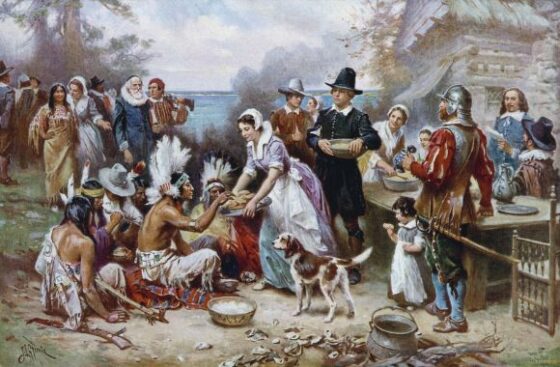
This week, I read an op-ed that reminded me of the overly critical attitudes that come out of academia, in this case Brown University. Native American studies Professor Mack Scott argued that Thanksgiving is not a holiday “of unity and brotherhood,” as President Abraham Lincoln intended when he created it in the aftermath of the Civil War.
Instead, it’s a holiday “of dominance and disappearance,” Scott wrote Monday at the university’s Center for the Study of Slavery and Justice:
The mythology of two distinct peoples coming together to enjoy the rewards of the American harvest (both literal and figurative) certainly seemed to fit the bill and would dominate not only how we reimagined this history, but also how we imagined ourselves. …
The problem with this distortion of the past is that it is not benign. By credulously telling and retelling this myth annually, we become complicit in the normalization and perpetuation of an absurd historical construction that rationalizes and justifies settler colonialism. It is to this that I say “No Thanks.”
Some of American leaders’ actions toward Native Americans were bad, to put it mildly. And we should not shy away from the atrocities in our nation’s history.
But Scott’s piece exudes bitterness alone. Nowhere does he acknowledge the virtue of Lincoln’s desire to promote unity among all people by presenting a picture of Pilgrims and Native Americans gathering together for a feast.
Coming back to my point, Israelis have the wisdom to recognize the value of gratitude — that something can be flawed but still worth loving and fighting for. It’s a nuanced view that does not dismiss or ignore injustice but also recognizes goodness where academics like Scott dismiss it.
Conservative scholar Frederick Hess wrote about this at Real Clear Politics on Monday:
The fact that we can look back on some of American colonists’ actions with revulsion shows the moral progress we have made as a nation.
It’s important at this time of year (and as we celebrate 250 years since the Declaration of Independence) not to lose the forest for the trees.
Our students are heirs to a nation forged by the sweat and sacrifices of generations of Americans who came before them. Educators would be best served by embracing a simple, distinctly democratic guiding pedagogical principle: the importance of gratitude.
I agree. No country is perfect, none are without corruption or injustices. But in realizing that, we can still be thankful for our nation and the founding principles, though imperfectly followed, that we continue to strive toward.
Finding fault is easy, and being grateful doesn’t come naturally. But when we start looking for reasons to be thankful, we will find them. This Thanksgiving, I’m more grateful than ever to be an American.
MORE: Former CIA analyst: Universities use ‘thought reform’ techniques to indoctrinate students