FEATURED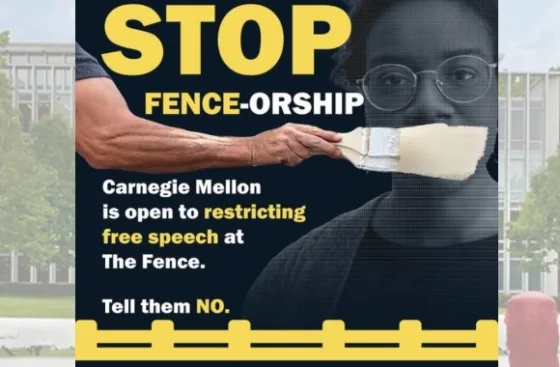
UPDATED
University leaders have taken action against pro-Palestinian, anti-Trump messages painted on campus landmark
A group of pro-Palestinian organizations recently condemned Carnegie Mellon University administrators for allegedly punishing students for painting messages such as “death to Zionism” and “Free Palestine by any means necessary” on a campus free speech landmark, according to a joint letter.
Those messages, painted on the Fence in the center of campus in June, added to a broader debate about what the private, Pennsylvania university should and shouldn’t allow on its long-standing open expression landmark.
“For decades, the Fence has served as an outlet for CMU student expression,” Charlotte Arneson with the Foundation for Individual Rights and Expression told The College Fix in a recent email. “However, recent events, including the investigation of students for their expressive Fence activity, raise serious concerns about CMU’s commitment to protecting free expression on campus.”
The Carnegie Mellon Student Government describes the Fence as “a student-centered space for free expression and community.”
Students are free to paint a portion of fencing with messages, including everything from political statements to advertisements for campus events to sports victory celebrations.
The joint letter, published July 28, demands that all investigations of students who painted the pro-Palestinian messages on the Fence be dropped. It also asks that the administrators “restore the fence’s legacy as a space of free expression on campus.”
The letter alleges that the university “banned ten campus community members for painting pro-Palestine messages on the campus free-speech fence” and threatened one student with expulsion. Additionally, several students are facing discrimination investigations, it states.
The groups that signed the letter include National Students for Justice in Palestine and the Institute for the Critical Study of Zionism, as well as the American Association of University Professors and several pro-Palestinian Jewish organizations.
Responding, the university said in a statement that the groups “grossly mischaracterized Carnegie Mellon University’s recent actions regarding the Fence, omitting important context regarding CMU’s community standards, legal obligations, and responsibility to ensure the safety and well-being of all members of our community while honoring one of our longest and most cherished student traditions.”
“Our actions regarding the Fence this summer have been informed by a number of factors,” including hostility toward its Jewish community, vandalism, and “non-student individuals participating in painting the Fence,” the university stated.
It also emphasized balancing free speech with safety and respect in the statement, which it shared with The Fix via email.
“… language that incites or implies violence — or can reasonably be perceived as threatening by members of our community — is inconsistent with our values and will not be tolerated. These standards apply regardless of the viewpoint being expressed,” it stated.
What’s more, the university’s actions are not “based on, or influenced by, any political viewpoint or advocacy for any cause,” it stated.
Commenting on the situation, Arneson with FIRE told The Fix: “All viewpoints should have equal access to The Fence. Even if university officials find speech to be particularly sharp or hurtful, Fence expression is protected by First Amendment principles. CMU should not paint over or shut down views it does not like and must make this clear in its policies.”
FIRE, a free speech and campus legal organization, ranks the university 98th out of 257 for its handling of campus free speech policies, giving it an “F” grade. According to a 2025 FIRE survey, 49% of Carnegie Mellon students say they self-censor at least once or twice a month.
Students from across the political spectrum have been urging the university’s administration to stop removing these messages.
In one example, in July 2025, administrators painted over a “no rapists on campus” message on the Fence during President Donald Trump’s visit to the university, The College Fix reported in April.
A conservative group, the Carnegie Mellon Young Americans for Liberty chapter created a petition during the spring semester that urges administrators not to censor fence paintings, “except in the rare cases already covered by tradition, such as profanity or unambiguous threats.”
The petition came in response to university President Farnam Jahanian commissioning the Fence Working Group, a committee of faculty members and students, to give policy recommendations concerning the campus landmark.
The group’s report, published in May, recommends that administrators not unilaterally censor the Fence except in “rare, extreme cases” to protect the university from legal liability.
The group also recommended that administrators work with student government leaders to “refine and publicize” specific guidelines for the Fence so that students clearly understand what is and is not allowed. Students also should be informed of what the university’s response will be if the guidelines are violated, according to the report.
The report emphasized that when campus leaders do paint over Fence messages, the administration must “make clearer to the broader community how these processes operate.” The working group acknowledged that “at times some will be troubled by actions” of the painters or the university administration.
Additionally, the working group recommended that university leaders “proactively” celebrate the Fence while emphasizing that the landmark is “a medium through which individual students, small groups of students and student organizations can express their personal views on diverse topics, formally subject only to the restrictions that are common to all on-campus speech.”
President Jahanian plans to respond to the recommendations this fall, according to a June campus message.
The Fix reached out via email to the Fence Working Group and the Carnegie Mellon Student Government asking about the Fence recommendations and actions by campus leaders, but neither responded.
Editor’s note: This article was updated to include a statement from the university.
MORE: Carnegie Mellon students tell administrators to stop erasing free speech Fence