
 FEATURED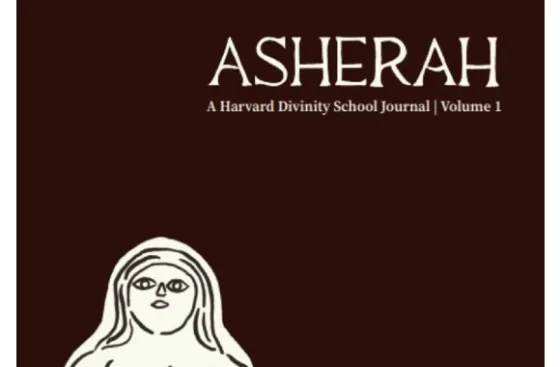
Journal ‘is tangential to Harvard’s tolerance of grotesque antisemitism,’ rabbi tells The College Fix
A new scholarly journal at Harvard Divinity School focused on “modern Judaism” and named after a pagan goddess is adding to concerns about antisemitism on campus.
The first edition of Asherah, a “journal of Jewish liturgy,” was published in May, funded in part by the dean’s office.
Rabbi Yaakov Menken, vice president of the Coalition for Jewish Values, told The College Fix in a recent email interview that the decision to name a journal after a pagan deity is not original but it is concerning
“That it is named after a form of idolatry reminds me of the Jewish feminist magazine ‘Lilith,’ named after an impure spirit, which is turning 50 this year,” Menken said.
He continued: “There’s nothing groundbreaking here. When the founder claims that they ‘received many responses stretching from congratulations to curiosity to disturbance and even anger,’ I would take that with a hefty grain of salt.”
The goddess, according to the journal introduction by student editors Daisy Jacobs and Lila Rimalovski, is “entirely present and invisibilized in most expressions of modern Judaism.”
“Some claim she was originally a Canaanite deity, but that remains a matter of scholarly debate. She was certainly adopted and used by Israelites in their places of worship and homes in both the kingdoms of Judah and the more unruly northern kingdom of Israel,” the preface states, citing Old Testament scriptures.
The name refers back to “a spiritual moment in the ancient Israelite tradition, not to subvert the norms that constitute Judaism today as much as to enhance them by reviving the idea of devotional practices that are not severed from the beauty of the natural world all of us inhabit,” it states.
However, a recent article by the Washington Free Beacon raised concerns that the use of the name Asherah constitutes a blatant disregard of biblical Judaism. The article cites Deuteronomy 16:21, which states, “You shall not plant for yourself an asherah, [or] any tree, near the altar of the Lord, your God, which you shall make for yourself.”
Menken told The Fix that the journal “is about hostility to Judaism, not just Jews. The journal claims to be respectful, but names itself after an idol and implies Judaism needs revision.”
“I would expect that several of its writers tolerate and even subscribe to beliefs about the modern-day country of Israel and its enemies that all traditional scholars would deem antisemitic,” he said.
The Free Beacon similarly raised issues with the journal and antisemitism, describing Harvard as “a cesspool of Jew-hate.”
“… it’s more than a bit much for the Harvard Divinity School dean’s office–after all that had happened in recent years–to subsidize the production of an openly non-scholarly magazine devoted to redefining Judaism into something that will strike many Americans, justifiably, as a perversion,” according to the article.
Rabbi Menken also referenced Harvard’s record on this score, telling The Fix that the journal “is tangential to Harvard’s tolerance of grotesque antisemitism.”
To Menken, the journal’s intentions were questionable from the outset.
“The notion that Harvard Divinity would genuinely contribute to ‘Innovations in Jewish Prayer and Ritual,’ much less with a journal devoid of any authentic Jewish scholarship, is alternately humorous and sad, more than hateful,” the rabbi said.
Neither of the co-editors nor the school’s media relations responded to two emailed requests for interviews over the past two weeks, asking about the academic value and mission integrity of the journal as well as the concerns about antisemitism.
Although the journal’s first issue invites inquiries, pointing interested parties to its website, Asherah does not include any means of contacting it. Under the donations tab, there is a place for donors to include a message. But otherwise, neither the website nor the first issue of the journal include an email address, phone number, or contact form.
The journal, which is dedicated to “Innovations in Jewish Prayer and Ritual,” states that it is offered “in the hope that it will serve a broad community of Jews and non-Jews.”
The first article of the journal is an interview with Rabbi Jericho Vincent who self-identifies as “trans” and “nonbinary.”
In the interview, Vincent told student editor Rimalovski, “The word ‘God’ is one way to hold on [to the concept of one divine being], ‘Goddess’ another, ‘Goddexx’ another.’”
Vincent praised the journal, exclaiming: “And now — oh my Goddess — there’s going to be an Asherah journal at Harvard Divinity School! Our ancient mothers and fathers, ancestors two and a half thousand years ago, they’ve been waiting so long. How much nachas they must have that we’re coming home [to a faith with Asherah].”
Vincent described “mainstream Judaism” as an “articulated myth” surrounding a “new king [who] is going to rise, some dude on his calico donkey who will save us all.”
Vincent said of the Messiah of traditional Jewish religion, “It’s very beguiling, and, of course, he’s never going to come.”
Instead, Vincent painted a picture of Jews worshipping Asherah, lamenting, “We know so heartbreakingly little about how the ancestors worshiped the Goddess, but we know there’s strong evidence of dancing around the tree…Spending time dancing in circles — versus sitting in a pew that doesn’t move, staring at people performing for us, checking a box and leaving — it moves the energy in a completely different way.”
Vincent also called on Asherah in the closing prayer of the interview: “From our places of deep center, I call out to Asherah — the One within us, between us, and beyond us.”
When asked about the potential impact of the Asherah journal, Rabbi Menken was confident in the victory of the traditional Jewish religion over the quasi-Jewish, pagan rituals.
“It will not have a meaningful, long-term impact upon the Jewish world, especially among those practicing Jewish Prayer and Ritual,” he said.
MORE: Harvard ignored own antisemitism taskforce’s advice: House investigation

