FEATURED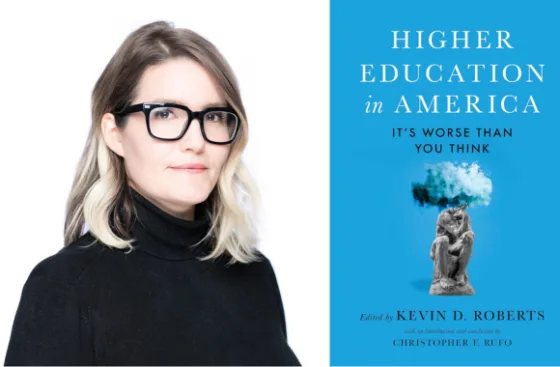
ANALYSIS
“Women generally prefer not to attend schools where the sex ratio is too skewed in their favor, or an institution where they’re on the very short end of a dating gender ratio.”
So argues Inez Stepman in an essay titled “How colleges undermine men and the American family.”
The essay, along with others about the state of higher education and what must be done to reform it, appears in a new book called “Higher Education in America: It’s Worse Than You Think.” The Heritage Foundation organized the book and its publisher, Encounter Books, provided a copy to The College Fix.
Stepman’s essay is the only one that directly addresses how women’s educational choices shape the culture and future family formation. The imbalance in higher education leads to fewer dating options for women, she told The Fix during a recent phone interview.
“The fact that universities themselves are so disproportionately female…means that there is essentially not a date for everybody in university” even though college is “one of the best times to date somebody,” the senior legal analyst with Independent Women said.
She said “what you end up with is women who are going to college and men who are not.”
“And that is not a fertile ground, pun intended, for family formation,” Stepman said. She pointed out that for years sociologists have noted the problems created by black women attending college at higher rates than black men.
Women who do not attend college are hurt by the oversaturation of degrees, Stepman says.
“For women who don’t have degrees, there’s just the simple decline of working class life and prospects in America,” she said during the interview.
The imbalance also influences politics, as women hold about two-thirds of the student loan debt.
Still, Stepman sees hope in new federal student loan caps and how they might reduce debt. There is anecdotal evidence now of colleges capping tuition in response to the limits.
She predicts the cap will have a stronger effect in the coming years since it is not “pegged” to inflation. Therefore, more colleges will have to control costs and reduce student loan debt.
Too many female administrators in college also hurts men
The sex imbalance among the student body creates one set of problems. The dominance of female administrators creates another problem, Stepman argues in her essay.
Around two-thirds of college administrators are female, which contributes to the rise of bias reporting, microaggressions, and cancel culture. Women are more feelings based, Stepman writes.
She is backed up by data from the Foundation for Individual Rights and Expression which showed female students are more likely to support limiting “controversial speakers.”
Stepman concludes in her essay: “Simply put, an overproduction of female college-educated elites has changed the culture of truth-seeking on campus, worsened the debt crisis, delayed family formation, and driven political polarization by sex.”
Higher ed is ‘worse than you think’ but could be better than you think
In addition to Stepman’s essay, other contributors to the Heritage Foundation book include well-known names like Chris Rufo, Kevin Roberts, and Larry Arnn.
The book also benefits from the insights of lesser known higher education leaders, including George Harne, the president of Christendom College, and Kyle Washut, a Catholic deacon and the president of Wyoming Catholic College.
The writers make the case clearly that higher ed is “worse than you think,” but leave hope that it could end up better than you think.