FEATURED
Key Takeaways
- The Native American repatriation director at Indiana University Bloomington said on a 2024 podcast that she sometimes conceals information from airlines regarding the transport of human remains, based on tribes' wishes.
- Thomas leads workshops that teach other university staffers how to return Native American remains in their collections to their descendants.
- Scholar Elizabeth Weiss questioned the ethics of Thomas's comments, emphasizing the importance of transparency. Weiss also said human remains might be transported as carry-ons under certain conditions.
A Native American Graves Protection and Repatriation Act director at Indiana University Bloomington who trains other higher education staffers on the law admitted to withholding information from airlines when she transports human remains to their tribes in a podcast recently uncovered by The College Fix.
Jayne-Leigh Thomas, director of the public university’s Office of the Native American Graves Protection and Repatriation Act, made the comment on the Heritage Voices podcast with Jessica Yaquinto in August 2024.
The episode focused on Thomas’s involvement in the first Intensive NAGPRA Summer Training and Education Program, held the prior year.
INSTEP is a training program for higher education staff and others that focuses on “best practices related to Ancestral human remains under NAGPRA,” according to IU’s website. Thomas also helped to lead the third annual INSTEP training at the University of South Carolina this past summer.
The 1990 NAGPRA law requires “federal agencies and institutions that receive federal funds … to repatriate or transfer Native American human remains and other cultural items to the appropriate parties,” as described on the U.S. Bureau of Indian Affairs website. These include human remains in university museums and research collections.
The law was updated in 2023 to require “deference to the Indigenous Knowledge of lineal descendants, Tribes, and NHOs [Native Hawaiian Organizations]” in the repatriation process and “free, prior and informed consent from lineal descendants, Tribes or NHOs before allowing any exhibition of, access to, or research on human remains or cultural items.”

On the podcast, Thomas stated that she defers to the tribes’ wishes when returning their ancestors’ remains, and further implied that this sometimes means ignoring rules for their transportation.
Thomas said she does communicate often with the Transportation Security Administration when tribes ask her to “escort their ancestors by myself to their community.”
However, she said there are times when “we never tell the airlines, because airlines have rules about human remains on a plane being under the plane in a coffin or a funerary urn.”
“And in some instances that won’t work, particularly when the tribal communities I’ve worked with have said that they do not want their ancestors to be underneath the plane, and so we don’t tell the airline,” she said, laughing.
“The key in all that is the tribes are making the decision about all this,” Thomas said, adding that this includes ”all of the decisions about how the ancestors will go through security, how they will be transported, and any of the other specific details.”
Thomas did not reply to multiple emails or phone message from The College Fix over the past week, asking for clarification of her comments, including why she said she withholds information from airlines.
The university media relations office also did not answer multiple emails or a phone message from The Fix.
When contacted about the matter, a TSA spokesperson told The Fix via email that they “screen all carry-on and checked baggage,” and deferred to TSA Cares, a service to aid passengers who need “additional assistance to better prepare for the security screening process,” and flying with cremated remains.
The cremated remains page states, “Some airlines do not allow cremated remains in checked bags, so please check with your airline to learn more about possible restrictions.”
The Tribal and Indigenous section of the TSA Cares page says that “TSA coordinates with Department of State and our colleagues at Customs and Border Protection to facilitate domestic and international repatriation in accordance with Native American Graves Protection and Repatriation Act.”
The Fix asked the agency how it handles situations in which a tribe opposes having the remains stored under the plane with the cargo, if the remains may be carried by the passenger in the plane and, if so, if there is a specific way this must be done.
The TSA media relations office responded: “Typically, we work with NAGPRA coordinators to start the process and gather relevant information — who is travelling, when are they travelling, what (remains, other items) are they traveling with, how is it packaged, and what would they prefer in terms of screening.”
“We honor the request(s) of the Tribe and if they want to hand carry, we coordinate with the airport they will be traveling from, to arrange for screening assistance. Many museums, universities and Tribes will also send us a document that lists and describes the items being repatriated,” the agency stated via email.
‘Ethical’ questions
Elizabeth Weiss, emeritus professor of anthropology at San Jose State University, questioned the ethics of Thomas’s suggestion in an email to The College Fix. She is the co-author of “Repatriation and Erasing the Past,” which discusses NAGPRA in part.
“I would expect that someone like Dr. Thomas, who is teaching young archaeologists how to comply with NAGPRA and handle repatriations, would engage in the same ethical practice. It’s quite surprising that she wouldn’t be honest and forthcoming,” she told The Fix.
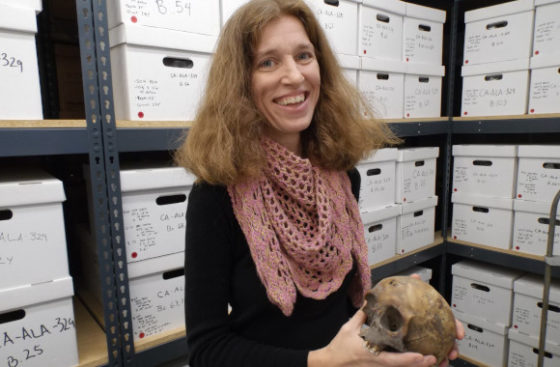
Weiss said Thomas appears to be “assuming that by telling airlines that boxes contain human remains that these boxes will need to go below where the cargo is located. I don’t think this is accurate.”
She said “cremains” can be taken as carry-ons, while “cadavers” generally are “required to be in a casket or coffin, sometimes even a leak proof one if the body hasn’t been embalmed; and, the body would be below the passengers with cargo or checked luggage.”
“However, for dry, clean bones, there’s likely no issue about having these materials as carry-on luggage. I have transported human bones this way without any issue,” Weiss told The Fix.
Weiss cited the TSA guidelines from an AskTSA post on X, which stated: “A skeleton may be transported in carry-on and checked bags if it’s properly packaged, labeled and declared to your airline. We also strongly recommend that you contact your airline as they may have additional policies on traveling with this item.”
“So, although some airlines may have policies against having human skeletal remains as carry-ons, I suspect it’s because they are not expecting only bones … My approach would be an open and honest approach with the airlines,” Weiss said.