BUZZ
BUZZ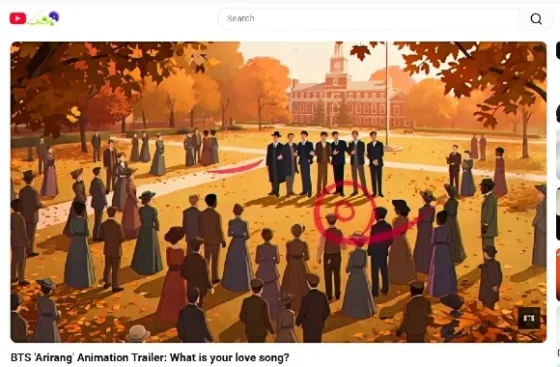
Entertainment industry employs ‘too few Black professionals,’ USC professor says
A brief cartoon depiction of Howard University in popular K-pop band BTS’s music trailer “Arirang” has prompted criticism because so few of the people in the clip are African American.
Howard is a historically black university, but it welcomes students of all races. Still, the video’s depiction of the campus prompted a University of Southern California professor to comment that problems arise when entertainment companies employ “too few Black professionals.”
The South Korean band’s trailer, published earlier this month, advertises their album “Arirang,” named after a traditional Korean folk song.
The video briefly features an historic event in 1896 when seven newly enrolled Korean students sang the folk song at Howard, a predominantly black university, drawing a crowd of observers. The Washington Post covered their stories and an ethnologist later recorded them singing it – “the first recording of the song anywhere in the world,” Howard’s The Dig reports.
However, the depiction does not accurately represent the university, USC Professor Shaun Harper wrote at Inside Higher Ed in a column published Monday.
“Perhaps it was intended to also honor Howard’s embrace of those international students during a time at which most other postsecondary institutions in the U.S. were inaccessible to Asian persons and matriculants from other non-European nations,” Harper wrote. “The video fell short on the latter because it includes no Black people in the crowd to which those Korean students were singing.”
The video actually does show about a dozen black people in the crowd, but the clip is so brief that it is difficult to see without pausing. The Fix emailed Harper about the error Monday, and received an automated response stating that he is on sabbatical until August.
To Harper, a business professor and founder of the USC Race and Equity Center, the boy band’s video is emblematic of a larger problem:
Very few students at U.S. colleges and universities will join K-pop bands. However, many more will become music industry professionals; directors of movies, television shows, podcasts and music videos; and digital illustrators who produce animated videos like the BTS album teaser. Also, some will become marketers and publicists who work with singers and others in creative professions.
Having consulted across many of these spaces in Hollywood and elsewhere, I am qualified to confidently declare the following: Companies and studios employ too few Black professionals, especially in decision-making capacities. Cultural errors like misrepresenting Howard as a predominantly white institution are likelier to occur when Black people are not meaningfully involved in content creation or invited to offer input on Black-related projects that their non-Black colleagues produce. At very least, everything involving HBCUs ought to be run past students, employees and alumni of those institutions to verify cultural accuracy prior to being released. This responsibility should not rest entirely on Black people. It is important for college students across all racial groups, including whites and Asians, to learn about Black culture and history.
An article in The Dig, Howard University’s news site, also pointed out a few inaccuracies in the video, including a building that had not been constructed in 1896.
“… most of the people depicted in the audience on The Yard are not Black, which belies the institution’s history as one of the country’s foremost colleges with a predominantly Black student body,” according to the article. “Though much of the faculty at the time was not Black, the video does elucidate the need for cultural sensitivity and historical accuracy even when intentions are positive.”
The Dig also mentioned issues with “cultural appropriation” in the wider K-pop phenomenon, tracing its musical influence to 1990s boy bands like the Backstreet Boys and N-Sync who, in turn, were “heavily influenced by Motown-era groups such as the Jackson Five and the Temptations.”
“K-Pop stars also often replicate hip hop fashion and dance, another cultural contribution by Black Americans which has taken on global popularity,” according to the article.
The problem with cultural appropriation is that “artistry, expression, and traditions which originated in Black communities are usurped by people from other communities without an understanding of the related history, sensitivities, and contexts,” according to the article.
“When meaningful cultural expression is contorted into superficial entertainment, it can become a disrespectful form of mimicry and perpetuate negative stereotypes, especially when used for commercial purposes without attribution or royalties,” the article states.
MORE: Poor-performing California school district shells out $600,000 for ‘rap’ curriculum