FEATURED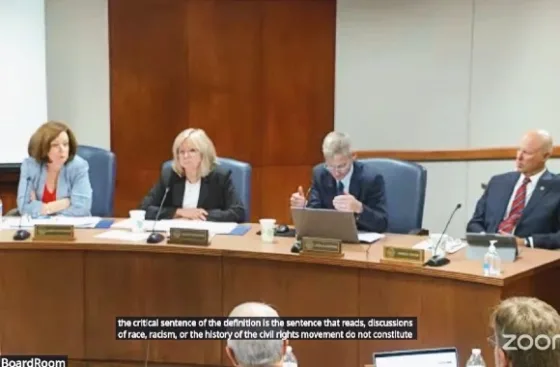
Policy says professors can’t promote ‘preferential treatment of groups based on race, color, gender, ethnicity or national origin’ in required courses
A policy to limit and define diversity, equity, and inclusion and critical race theory in Kansas universities passed the Board of Regents last week, prompting praise from free speech and higher education reform groups and criticism from a libertarian scholar.
During the meeting, which The Fix watched online, regents’ general counsel John Yeary introduced the new definitions, telling the board: “That definition was not easy to get to. There were lots of competing ideas and interests but those have all been weighed and vetted.”
Kathy Moore, one of the regents, commented that the definitions are “very important,” but she expressed certainty that they “will come under scrutiny.”
Regents spokesperson Matt Keith confirmed that the DEI and CRT definitions passed on June 17 and directed The College Fix to the policy language listed in the meeting agenda when contacted for comment.
The new definitions are “a requirement of the Republican-controlled Kansas Legislature, which during its last session attached a provision to the state budget that says the state’s universities must have a DEI-CRT policy in place in order to receive their full amount of state funding for the next school year,” the Lawrence Journal-World reports.
The definitions pertain to “any course whose course title, course description or learning outcomes include DEI-CRT-related content,” according to the approved policy changes, listed in the agenda.
This is defined as “content that intentionally establishes and promotes the preferential treatment of groups based on race, color, gender, ethnicity or national origin.”
Additionally, DEI-CRT content “presents racism as systemic within laws, policies, or institutions and promotes acceptance of that viewpoint rather than presenting it as a subject of scholarly, historical, or legal study.”
When teaching ideas like systemic racism, professors must refrain from endorsing or promoting them, according to the policy.
However, the policy clarifies that class discussions of race, racism, and the civil rights movement’s history are not considered to be DEI-CRT content.
The policy also takes care to note that it “does not prohibit postsecondary educational institutions from complying with federal or state law, including antidiscrimination laws, or from taking action against a student, faculty member or employee for violations of federal or state law.”
What’s more, a few majors still can require classes with DEI and CRT content. As the policy states, “Academic program requirements whose title clearly establishes its course of study as primarily focused on racial, ethnic or gender studies may” request an exemption from the regents.
David Randall, director of research at the National Association of Scholars, praised the regents’ action in a recent email to The College Fix.
“This is an excellent policy, which aims (and should have some effect) to prevent faculty from inculcating and requiring discriminatory concepts in their classes, and to prevent DEI from being foisted on students via degree requirements,” Randall said.
“DEI activists seek to abrogate students’ freedom of speech by a specious claim to their own freedom of speech,” he told The Fix, adding that the distinction between teaching systemic racism and endorsing it “properly protects the freedom of speech of everyone in the classroom.”
The president of the Institute for Free Speech also expressed approval of the definitions.
“I think the Board did a reasonable job of writing the definition as required by law,” David Keating told The Fix in an email Tuesday.
“There is considerable flexibility in both the definition and the law respecting academic freedom and free speech, and there’s nothing in either that affects speech outside the classroom. I’m sure that some professors will be more cautious than needed in their teaching, and that’s unfortunate,” Keating remarked.
However, a scholar with the libertarian Cato Institute described the legislation prompting the change a “dangerous precedent for government overreach.”
“People who are not academics or even adjacent to academia should not be the sole decision makers for academic issues,” Cato research fellow Erec Smith wrote in an April 26 article on the institute’s website.
The Board of Regents “allows exemptions for race and gender courses. But these exemptions must be accepted by that board, which may or may not include people well-informed about how academia works,” Smith wrote.
The College Fix also contacted the United Academics of KU, the faculty union at the University of Kansas, several times within the past two weeks asking about the policy and any potential concerns it may have, but received no response.
However, a leader of the Kansas American Association of University Professors did tell Inside Higher Ed that he was somewhat pleased with the definitions, calling them “pretty narrow” and a “half win.”
“… and the regents even went out of their way to state that this does not ban teaching about race, it does not ban teaching about civil rights. So the faculty are very pleased with that,” Michael Smith, a political science professor at Emporia State University, said.
However, the faculty union president also expressed concerns that the definitions “seem to be based more on the popular understanding of DEI and CRT among the MAGA movement and others, and we were hoping for … an academic definition.”
MORE: Undercover videos catch Kansas university employees saying DEI still used despite law