FEATURED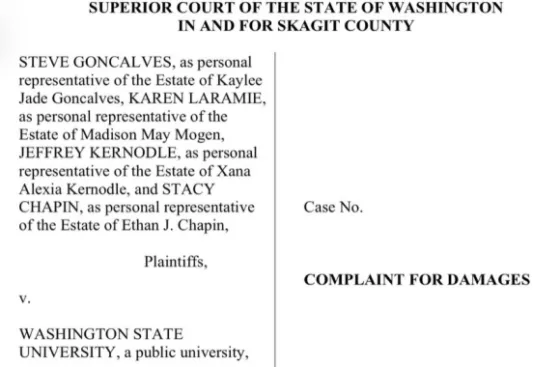
‘This guy was harassing women. He was stalking women. He was a general creep. … Could they have foreseen that he might harass somebody?’
A high profile public interest attorney said the personal injury lawsuit against Washington State University by the families of the four University of Idaho students stabbed to death by one of its employees is a complicated and emotionally charged case that will likely end in a settlement.
The families of the four University of Idaho students who were stabbed to death in November 2022 recently filed a lawsuit against WSU, alleging administrators were negligent, and contributed to the tragedy, by ignoring numerous warnings about the killer’s behavior.
The perpetrator, Bryan Kohberger, was a Ph.D. student in criminology and a teaching assistant at WSU, located not far from Moscow, Idaho, where the crime was committed.
Kohberger pleaded guilty in July 2025 to four counts of first-degree murder and one count of burglary. He was sentenced to four life terms without parole, plus 10 years for burglary, but avoided the death penalty.
The 126-page complaint filed Jan. 7 claims that WSU received at least 13 formal complaints from female students, staff, and faculty describing the perpetrator’s behavior as “inappropriate, predatory, and menacing.” This included staring, blocking exits, following individuals to their vehicles, and instilling fear in several women, court documents state.
The lawsuit alleges WSU had “substantial control” over the perpetrator because he was a student, employee, on-campus resident, and resource user. Despite the complaints, campus officials did not investigate or discipline him.
“This effort is not about vengeance or speculation,” the families’ attorney stated in a statement to the public. “This is about ensuring that institutions entrusted with the safety of young people take threats seriously and act decisively when warning signs are present.”
WSU has limited its responses during the lawsuit. Pam Scott, the vice president of system communications and strategy, said in a statement to The College Fix, “Our hearts remain with the families and friends impacted by this horrific tragedy. Because this is a legal matter, we are declining further comment at this time.”
George Washington University law Professor John Banzhaf, a high profile public interest attorney, provided a detailed explanation of the case in an exclusive phone interview with The College Fix, describing it as primarily a negligence action requiring proof of five elements: duty, breach (negligence), causation in fact, proximate cause, and damages.
On duty, often decided early by a judge on policy grounds, Banzhaf said the courts have in the past been slow to impose this rule to protect strangers or in unforeseeable scenarios, citing examples like no liability for bystanders watching harm. They can watch a crime and have no duty to report it.
However, duties have expanded over time, and universities now generally owe reasonable care to protect students from foreseeable risks, he said.
Banzhaf said the off-campus location of the crime and non-WSU victims complicate duty, but the perpetrator’s role at the university as a student and a teaching assistant strengthens the whole argument, “given the fact that he was a student, plus that he was a teacher, I think makes a stronger argument for duty.”
He referenced the 2023 court decision in Brown v. State of Arizona, where a university faced potential Title IX liability for an off-campus assault by a football player due to “substantial control” through scholarships and team rules. The court ended up extending the idea of duty because the university had some liability over the student.
On the negligence cause, Banzhaf highlighted the idea of foreseeability.
“There were a lot of complaints,” he said. “This guy was harassing women. He was stalking women. He was a general creep. … Could they have foreseen that he might harass somebody? Yeah. Could they foresee that he might even commit a sexual assault? Yeah. But a mass murder? That’s somewhat of a reach.”
“I’m not even sure why they hired him to begin with,” he added, noting the unused risk assessment team as potential evidence of negligence.
Causation is a jury issue, he said. Juries often sympathize with victims’ families against institutions, the professor told The Fix.
While the case is still new, Banzhaf said he thinks the families had a strong case against WSU and that the university would probably end up settling in order to avoid a public court case.
“There’s a strong tendency, I think, to side with the poor students and now, their families, against the university… And I don’t have to tell you that universities are really getting criticized these days,” he said.
MORE: As students return to Brown University, shooter’s motive remains unclear