
 EDITORS' CORNER
Will the values of the Federation be scorned … just like America’s?
There’s been plenty of opinions and reviews of the Star Trek franchise’s latest offering, “Starfleet Academy,” and to virtually no one’s surprise progressives are the only ones who actually dig the show.
These folks must be doing so purely out of a political allegiance (again, no surprise), because not only is this show Trek-bad … it’s bad period.
Its supporters, too, are out in force on social media, going after anyone who disagrees (my personal fave: “the REICH people don’t like it”), the most common refrain being “Star Trek was always ‘woke!’”
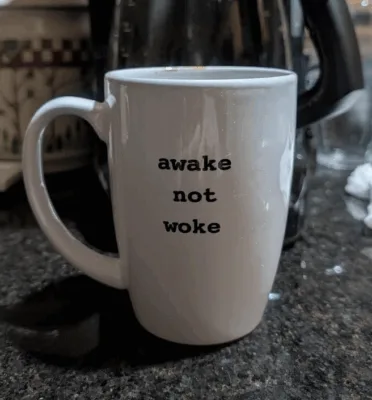
However, at The College Fix we have a saying (which we even put on our coffee mugs): “awake, not woke.”
From a critical perspective, Grok defines “woke” as “an overzealous, performative, or authoritarian form of progressive ideology that prioritizes identity politics, political correctness, or ‘cancel culture’ at the expense of free speech, merit, humor, or practical concerns.”
First, a quick background on “Starfleet Academy”: Set about 900 years in the future and about 150 years after an event called “The Burn” that destroyed warp (interstellar) travel capability across the galaxy (and helped dismantle the Federation of Planets, of which Earth is a founding member), it’s a direct sequel to “Discovery,” the last three seasons of which jumped from about a decade before Capt. Kirk’s time into this far future.
All three so-called “NuTrek” series – “Discovery,” “Strange New Worlds,” and now “Starfleet Academy” have been panned not just for being woke, but for ignoring continuity, bad writing and premises (“The Burn” being one big example), and wooden acting.
I mean, how could The Burn cripple space travel 750 years from Kirk’s era? How is it the Federation was still using the same warp travel it uses in Kirk/Picard’s time that far in the future? That’d be like us today still using horses and carts to get around on land, and wind-powered vessels on the water. Not to mention, in The Original Series and its spinoffs there were ample examples of superior alternatives to warp already established. It makes zero sense Starfleet didn’t take advantage.
At any rate, never-hairbrushed Holly Hunter (Nahla Ake) is tapped to lead the reestablishment of Starfleet Academy, and her class/crew look as if it’s a 32nd century version of “Saved by the Bell” or early “Beverly Hills 90210” or some other silly teen-based show. And they act accordingly.
Like The Burn can be considered a middle finger not only to people’s intelligence but past Trek lore and continuity, so too can Hunter’s Ake treating the captain’s chair of her vessel (the Athena) as an easy chair in which she seems just plain bored.
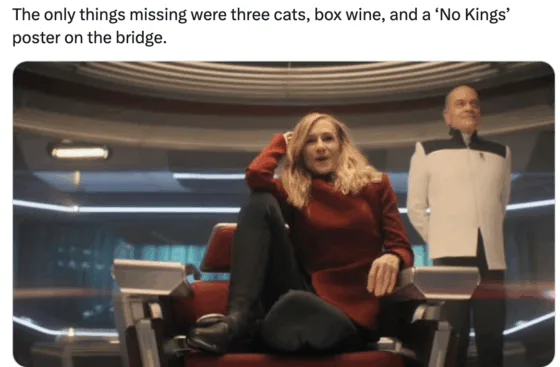
The premiere even overtly establishes one of the few (straight) white men as a privileged and coddled fop, and thus is immediately a villain. Several cast members are fat. There’s a cadet in a wheelchair. Another uses sign language.
So you see? A “prioritization of identity politics … over merit … and practical concerns.”
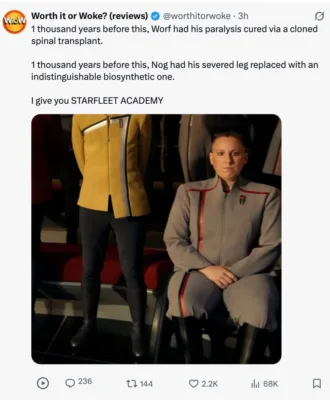
In the film “Star Trek IV: The Voyage Home” Dr. McCoy gives a lady in a hospital a pill which regrows her kidney … and then he pulls out some gadget which instantly heals fellow Enterprise crew member. Chekov’s skull fracture – nine hundred years before “Academy.”
But somehow in the 32nd century, paraplegia and deafness can’t be fixed. Because representation. And they admit it.
Washington and Lee University Journalism and Media Ethics Professor Eric Deggans chimed in on “Academy,” saying that Trek’s Federation of Planets “has often been an allegory for America’s belief in itself,” and during The Original Series this “meant [it] was an unquestioned force for good and equitable order.”
He adds “many episodes were centered on persuading wayward alien species to just get with the program and join the Federation” – much like how American politicians “were fighting to keep countries around the world from aligning with Communist systems.”
(Ironically, a phrase often uttered on “Academy” is “fellow traveler,” whose origins come from the 1917 Bolshevik Revolution’s term “poputchik.” Go figure.)
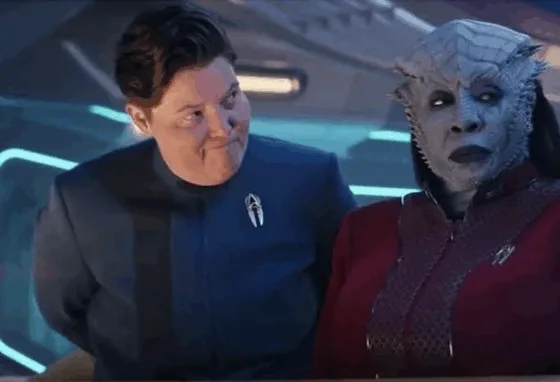
Deggans wonders what values “Academy” will imbue on its charges: Does the Federation “really stand for an advanced way of uniting life forms across the galaxy? Or is it a collection of myths humanoid species have told each other to justify colonizing increasing numbers of sentient species?”
He says the main villain in “Academy” “really takes on the Federation’s capacity for arrogant condescension.”

I find it a bit hard to believe Deggans considers himself a “longtime Trek fan” given these statements, which further add to the criticisms of “Academy” being “woke.”
First, yes, just as Winston Churchill noted of democracy (“the worst form of Government except for all those other forms that have been tried from time to time”), what we see of the Federation throughout various series is the best form of organization out there.
As noted by Capt. Picard in the TNG episode “The Drumhead,” Judge Aaron Satie, a man he greatly admired, called the Federation “the most remarkable institution ever conceived.”
The Federation’s most immediate neighbors still are/were all aggressive militaristic regimes: the Klingons, the Romulans, the Tholians, and the Cardassians for starters (think Russia, China, and various Islamic terror cells). And don’t forget the more-distant-yet-immediate threats of the Dominion and Borg, both of which almost destroyed the Federation.
Second, the Federation doesn’t “colonize” other species. It offers them membership if they agree to follow its principles. If they don’t, they don’t get in (TNG’s “The Hunted”); if they do but don’t want to join, then that’s that (TNG’s “First Contact”). The Federation will still maintain friendly relations with such planets/species. There’s ample examples of such throughout canon.
Further, there are several instances where Starfleet officers took superiors to task for violating the Federation’s principles. See the TNG film “Insurrection,” and episodes “Ensign Ro” and “The Pegasus” among others.
In “Deep Space Nine” (DS9) when the Federation is literally on the brink of defeat against the Dominion, several episodes debate the strategy of introducing a biological weapon against the enemy that will completely eradicate them (commit genocide or be slaves?). And in possibly the best-ever DS9 episode, Capt. Sisko struggles mightily with his planned deception to get the arch-enemy Romulans to join the war against the Dominion (“In the Pale Moonlight”).
The Federation has earned the right to be “arrogant,” if you will. It is a beacon of light in a galaxy full of brutal dangers (to paraphrase the nigh-omnipotent Trek character Q). It is far from perfect, but the series’ modern creators and writers want viewers to ignore what came before … and question the Federation’s way of doing things as the optimum.
An there you have it. It’s exactly what contemporary progressives are doing with the United States and the West in general.
MORE: If ‘Star Trek’s’ Starfleet operated like a university
MORE: Prof says colorblind philosophy behind ‘Star Trek’ is a ‘blind spot’

