FEATURED

Independent expert questions value of these programs
Minnesota State University, Mankato plans to spend $70,000 in mandatory student activity fees on its “gender and sexuality” programs during fiscal year 2027, according to documents provided to The College Fix.
The 2026-27 budget describes these funds as “critical” to ensuring “an affirming and educational space for students from a wide range of identities including (but not limited or exclusive to) lesbian, gay, bisexual, transgender, intersex, asexual, two spirit, and queer backgrounds/identities.”
Mandatory fees will also fund programs that “[a]llow students to explore the connections between feminist theory and practice” and support anti-violence programming, according to documents obtained via a public records request.
Spokesman Dan Benson told The Fix money will go to “gender Equity in STEM events, leadership programming, student support and outreach to students with dependent children, civic engagement and non-partisan voter registration campaigns, and student organizations.”
The allocation for fiscal year 2027 is $10,000 less than the program’s $80,000 base subsidy for fiscal year 2026. In its Budget Proposal for 2027, the Gender and Sexuality Programs attributed this change to “fiscal accountability and equity.”
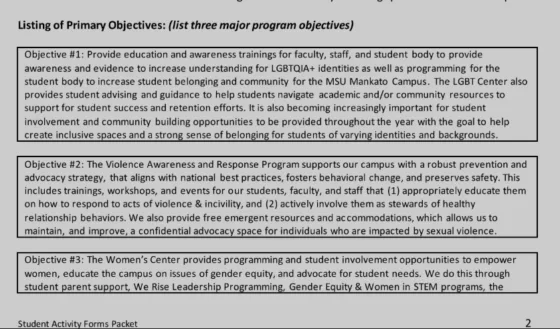
The university’s Gender and Sexuality Programs includes the LGBT Center, Women’s Center, and Violence Awareness and Response Program.
The Budget Proposal cites university data from fall 2025 that shows more students reaching out to these centers for information and support.
According to Benson, $22,000 will go to the Women’s Center, and the same amount will go to the Violence Awareness and Response Program. The LGBT Center did not respond to The Fix’s inquiry.
The LGBT Center strives to “increase understanding for LGBTQIA+ identities” and foster community amongst its students. Its goal is to “create inclusive spaces and a strong sense of belonging for students of varying identities and backgrounds.”
According to the budget proposal, the LGBT Center also receives funding from private donors via the Foundation Office for scholarship and operation costs, and for graduation stoles.
The Violence Awareness and Response Program trains students on health relationships and how to respond to violence, according to the proposal. It also offers assistance to victims of sexual violence.
The Women’s Center “educates the campus on gender equity, advocates for gender justice, and empowers students to lead change,” according to its website. It sponsors programs for women and “other antiracist, antisexist, empowerment education” for all members of the MNSU community.
Neither the student government nor Student Allocations Committee responded to The Fix’s inquiry about their roles and criteria in approving the funds and how the $70,000 was allocated.
Chance Layton from the National Association of Scholars said the large allocation towards Gender and Sexuality Programs seems to be a “misuse of student fees,” which he said is often the case.
Regarding whether it is appropriate for mandatory student fees to go to programs like this, Layton wondered whether it also goes towards Catholic or other religious programs/centers. “If student fees fund ideological diversity on campus, that would be a fantastic outcome,” Layton wrote.
The university’s budget, as provided to The Fix, does not designate fees towards religious programs in particular. It does, however, list “Recognized Student Organizations,” which includes several organizations under the “Faith/Spirituality” umbrella.
The allocation for these “Recognized Student Organizations” is $4,000 for FY27, up about $300 from the allocation for FY26, in contrast to the $70,000 allocation towards Gender and Sexuality Programs.
Layton noted there are differences between university services and funding advocacy or ideological programming.
“Chess club and the like are a service. They’re programs you can find in public schools but also in many communities around the country,” Layton wrote. “Students typically find first exposure to Women’s centers and LGBT centers in college. Their programs are typically oriented toward ‘re-education’ rather than the enrichment of students’ lives.”