BUZZ
UPDATED
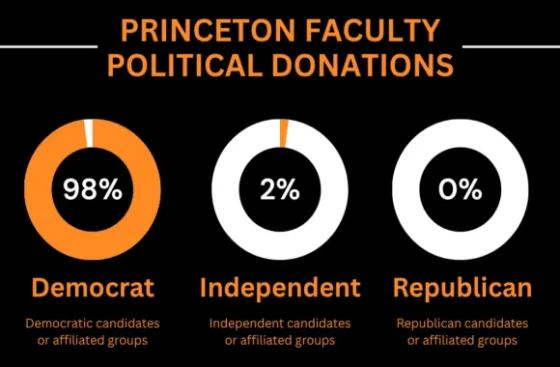
Editor’s note: Roughly a month after publication, Princetonians for Free Speech retracted and revised its data. The Daily Princetonian reported: “Following changes to the website, which included data from over 200 more faculty — and 38 more donors among the faculty — than the original study, the contribution percentages are listed as 96.4 percent Democratic, 1.44 percent independent, and 2.16 percent Republican. The updated amounts total $374,820 towards Democrats, $69,770 towards independents, and $3,782 towards Republicans.”
“The bottom line is that Iron Light has found discrepancies in the list of faculty it used,” PFS Chairman and co-founder Edward Yingling told the student newspaper. “The list they used was incomplete. It did not include all the relevant faculty. It also included some who did not qualify as teaching faculty.”
Nearly all of the reported political contributions by Princeton faculty — 98 percent — went to Democratic candidates or affiliated groups during the most recent election cycle compared to zero donations to Republican candidates and affiliated groups, according to a study released Tuesday.
Princetonians for Free Speech reviewed Federal Election Commission data covering the 2023-24 election cycle and matched it to a roster of Princeton faculty department by department.
Among the 818 faculty members reviewed, 101 made a federal contribution, and of those, 99 supported Democrats and two supported independents; none went to Republicans.
In terms of dollars, $300,747 went to Democratic recipients and $1,270 to independent recipients.
“[A]cross all 34 departments, no department recorded a single Republican contributor,” the study found. “Politics, the department whose subject is American electoral politics, returned five contributors and five Democrats.”
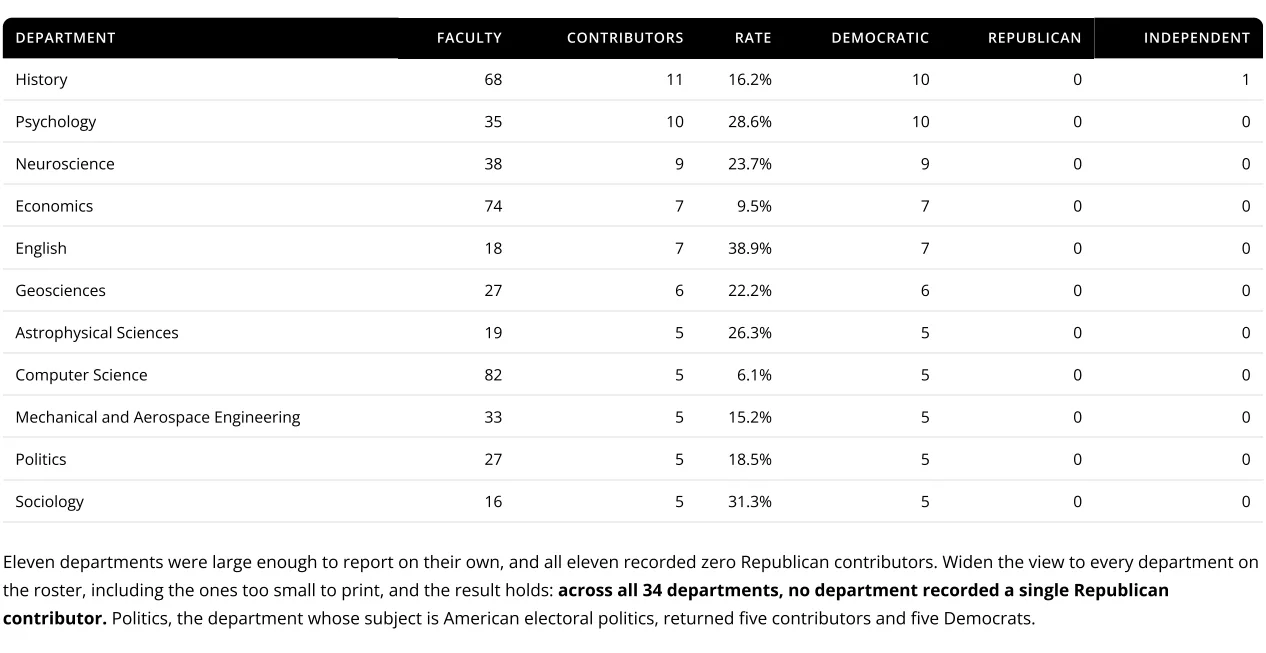
What’s more, within the School of Public and International Affairs, the study found its faculty donated at a higher rate comparatively: “The school that trains the country’s public servants is, on this measure, both twice as politically engaged as the university around it and less politically varied.”
“Students cannot learn how to think critically if they are only exposed to one narrow view; knowledge will not advance if research cannot be subject to evaluation and criticism through different lenses,” the group stated in a news release.
“If everybody on a campus has pretty much the same viewpoint because other viewpoints have been excluded, there cannot be real open debate and freedom of inquiry.”
Editor’s note: After publication, criticms
MORE: Rutgers, Princeton educators identified in New Jersey-based Antifa-styled group