FEATURED
Key Takeaways
- The Cato Institute is launching Cato Courses in October to educate students aged 16-25 about libertarian principles such as free markets and limited government, while promoting skills for navigating difficult campus conversations.
- A unique interactive element, Campus Crossroads, uses role-playing scenarios to foster civil discourse, allowing students to engage with different viewpoints and collaborate on solutions.
- Cato Courses will incorporate AI tools like 'Talk Liberty' where users can converse with chatbots representing historical figures to explore concepts of liberty and civil debate.
- The program aims to improve understanding of constitutional rights, citizenship, and leadership through quizzes, addressing the perceived lack of knowledge among students about these topics.
A new program from the libertarian Cato Institute will help students learn about navigating difficult conversations on campus. Cato Courses, which officially launches on Wednesday, will also help students learn about libertarian ideas including limited government and free markets.
“Cato Courses is an incredible resource for young minds to learn the ideas of liberty,” Stephen Rowe, director of Cato Courses, told The College Fix via a phone interview. “We’re trying to target people aged 16 to 25 as they’re seeking to understand and apply the principles of a free society.”
One of the ways the think tank will accomplish this goal is through choose-your-own-adventure games, such as Campus Clash. The game helps students learn about free and open debate.
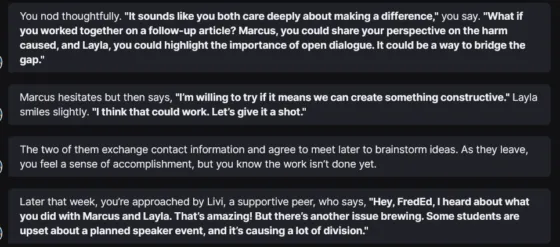
In one scenario of Campus Clash, fictional students Marcus and Layla shout in the campus dining hall. One is a student activist, the other a student journalist. Marcus complains that a recent campus article is too divisive and must be taken down. Layla counters that censorship isn’t the answer and other opinions must be heard. The user must then decide how to proceed.
The Fix played the game and decided to mediate the conversation, encouraging both students to share their perspectives. The students then take turns sharing their opinions and discover they both share common ground. The Fix then suggested that the students collaborate on an article, and they agree.
Campus Clash is one of the many resources on Cato Courses that encourages students to foster civil discourse, according to Rowe. “Hopefully, this course and online learning experience really just allows them to basically gain the confidence and skills to voice what they believe, whatever that is,” Rowe said.
The think tank has been providing educational resources for decades, but Rowe said he is helping overhaul the content to put “fresh paint on these timeless and ageless ideas and making [them] more interactive and accessible for people.”
This includes using artificial intelligence through a program called “Talk Liberty.”
“We’re trying to create dynamic and engaging ways for young people to learn libertarian ideas,” Rowe said. “We also use innovative tactics and apply artificial intelligence where you can have fun learning conversations with AI chatbots that represent history’s greatest leaders.”
Rowe said that young people use chatbots to engage in conversations and explore life’s problems. “And so we saw AI chat as a great mechanic to make learning dynamic.”
Talk Liberty has a selection of AI chatbots using the latest language model, ChatGPT Five. Here, users can interact with AI-powered versions of renowned liberty thinkers, such as Adam Smith or Aristotle, to discuss ideas on freedom, self-governance, and libertarianism.
The College Fix engaged in a conversation with the Socrates AI Chatbot to discuss the topic of respectful civil discourse and debate on college campuses and social media.
The Socrates chatbot explained that the Socratic dialogue “thrives on asking, not attacking—it seeks clarity through probing questions rather than quick judgements,” it said.
The chatbot said, “Imagine if, instead of trading insults or memes, people online asked: ‘Why do you believe this is true?’ Do you think most online debates aim for truth, or just for victory?” It then asked, “What would change if participants genuinely questioned their own assumptions as much as ours? What would it take for someone to pause and truly listen, rather than just react?”
Cato Courses included a disclaimer that said, “These chatbots promote open dialogue and free thought, but operate on automation. Responses do not constitute official advice. Always think for yourself and verify information independently.”
Rowe addressed concerns that critics may have about AI chatbots. “They’re safe [and] they’re fun,” he said. “This is definitely just the beginning of what’s going to happen in AI education. We’re using AI education for the ideas of liberty. We’re using AI education for libertarianism. It’s going to be a great thing.”
Cato Courses also will offer quizzes on other subjects, including constitutional rights, citizenship, and leadership.
Rowe said the inspiration for these tests came from a “lack of knowledge” among Americans.
He said these quizzes are designed to test students’ knowledge of liberty and the American government, and to educate them further.
MORE: Zero Brown U. freshmen interested in critical Indigenous studies degree