
 EDITORS' CORNER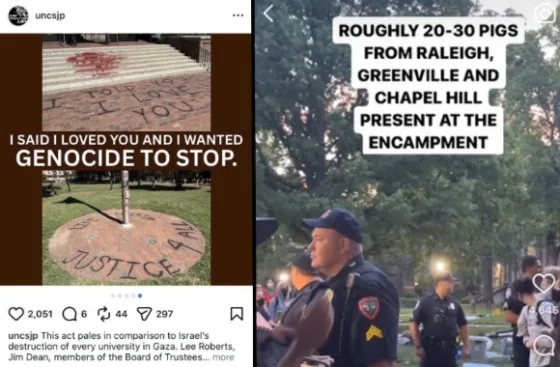
A North Carolina law that puts college students’ financial aid in jeopardy if they assault a police officer is facing criticism as the academic year begins.
One professor suggested it could be racist and another said it could “chill” students’ right to protest, The Daily Tar Heel reports.
The law passed in July as part of the state budget. Starting Dec. 1, it will cut off in-state tuition benefits and state financial aid, including grants and scholarships, to students convicted of the crime, according to the student newspaper. It applies to assaulting state employees as well as police officers.
Students would not be penalized unless convicted of the crime, and the penalties would begin the semester after the conviction, the report states.
“The design of it is to chill free speech protests on college campuses and I think it’s pretty obvious that it’s a response to the Gaza protests because those are the most recent politically controversial protests that we’ve had on a number of campuses,” political science Professor Frank Baumgartner told the Tar Heel.
The University of North Carolina professor said he is concerned that something as simple as accidentally touching a police officer could be misconstrued as assault.
The new law “doesn’t say ‘assault inflicting serious bodily injury,’ it just says assault,” Baumgartner said.
According to the student newspaper, several UNC students were charged with assaulting an officer during pro-Palestinian protests in 2024; however, “most did not result in a conviction that would trigger the new provision.”
Another political science professor also raised concerns about the law, including “vague” terminology and its supposed “racial” impact, according to the Tar Heel:
Kaneesha Johnson, an assistant professor of political science at UNC, said the policy lacks certain specificity, which she said means it could be applied to instances occurring off of college campuses.
“It doesn’t say that it has to happen on campus. It doesn’t say if it has to happen within North Carolina,” she said. “It’s so vague, and oftentimes when laws are written in such a vague way, that means that it opens up a window for them to be enacted in a very biased manner.”
Johnson added that the charge of assault on a police officer can carry significant racial disparities.
“There is no way to know the true rate of those behaviors. All we know is that police are enforcing these laws disproportionately,” Johnson wrote in an email to The DTH.
However, some have accused universities of being too lenient toward violent pro-Palestinian protesters. In recent years, anti-Israel students across the country have taken over campus buildings, injured police officers, and destroyed millions of dollars worth of public property.
Soon after the 2024 protests at UNC Chapel Hill, questions were raised about why the Students for Justice for Palestine chapter was not punished for repeatedly disrupting campus events in apparent violation of school policies, The College Fix reported at the time.
Among other things, the anti-Israel student group “took over a building on campus and shut down its administrative operations for a day, disrupted a guest speech by prominent pro-Israel journalist Bari Weiss, and frequently interrupted a recent Board of Trustees meeting,” The Fix reported.
MORE: UNC frat brothers restore American flag again after anti-Israel protest

