
 EDITORS' CORNER
OPINION
The death of Plato at Texas A&M University has been greatly exaggerated.
For the past month, we’ve been hearing stories about how school leaders banned Professor Martin Peterson from teaching from Plato in an ethics course. But the truth is a little more complicated.
Professor John Kainer recently highlighted how Peterson specifically appears to have added a section from Plato into his syllabus to trigger a confrontation with school leadership, enforcing the state’s limits on what can be taught in the classroom.
“When one compares the old version of the syllabi to the new version, we find that the units are the same and the readings are almost identical,” the University of the Incarnate Word scholar wrote recently in RealClearEducation. “Peterson simply renamed his unit on ‘Race and Gender Issues’ as ‘Race and Gender Ideology 1 and 2.’”
“In other words, Peterson didn’t change what he was assigning students to read; he simply labeled it something else,” Kainer wrote.
When it comes to Plato, “[t]hese excerpts were not included in the version of the class taught in Fall 2024,” the Catholic university professor notes.
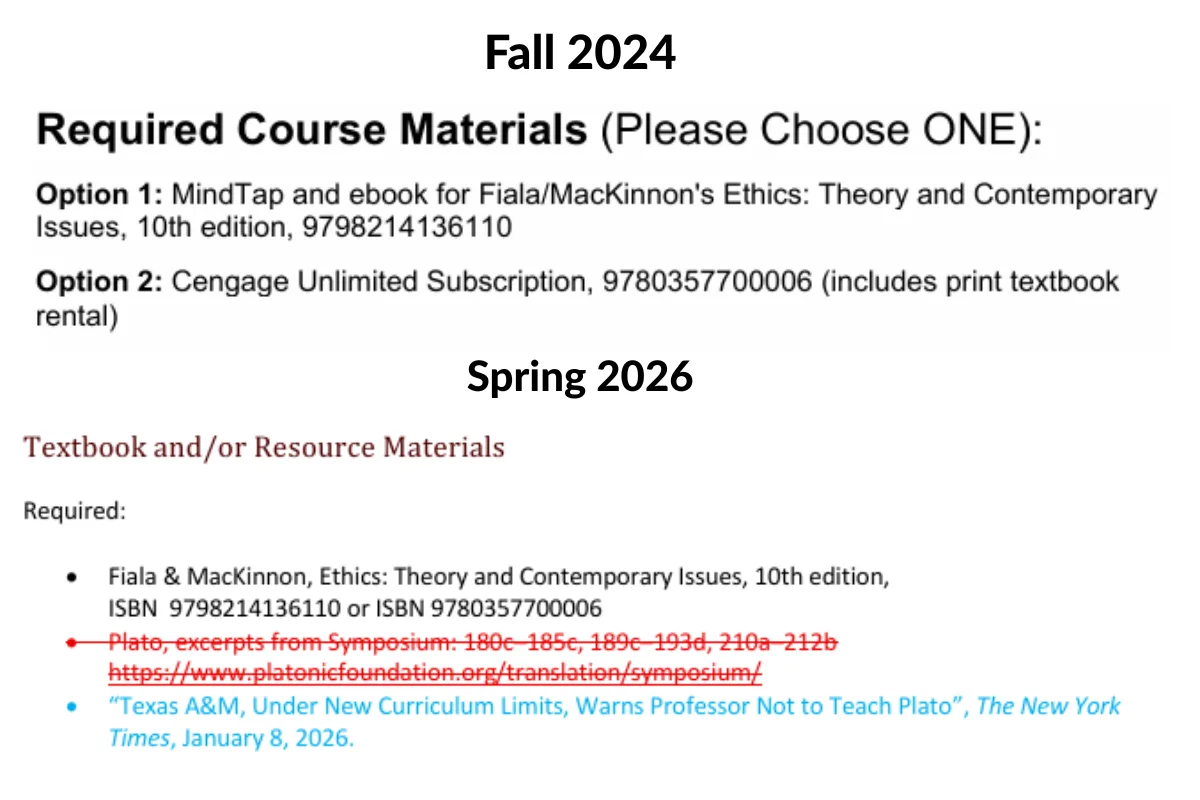
Peterson contends he “[wasn’t] trying deliberately to be provocative,” according to the New York Times when he added the new section on Plato.
Kainer is not buying it. Calling it a “set-up,” the Incarnate Word scholar said Peterson’s alleged defense of academic freedom falls flat and makes a mockery of the concept.
“Five minutes of tinkering with an old syllabus to use intentionally inflammatory language is not an exercise of academic freedom,” he wrote. “It’s just dishonesty.”
Defenders of Peterson might argue that even if he changed the syllabus just to create an issue or make a point that it does not change the general problem of universities and lawmakers overregulating what professors do. After all, peaceful challenges to First Amendment restrictions can be a salient way to make a point and attract publicity for a perceived injustice.
However, the problem here is that Peterson, as an employee of the university, and ultimately the state, has a duty to respect authority when it is acting within its proper bounds.
Lawmakers, along with university officials, are within their rights to ensure the classes are informative and educational. If they, based on the totality of circumstances, believed Peterson’s class was going to push an ideology that did not align with the priorities of the university, then officials were right to intervene.
A math department chair, after reviewing a variety of textbooks, would act within his proper authority to prohibit the use of one version that he did not find of high quality.
Similarly, he could ask a professor not to teach from Stephen Hawking or Isaac Newton if he felt those works were not appropriate to the specific class being taught. That does not mean the works themselves are not worthy of study, but that they are not appropriate for the class.
Indeed, TAMU officials have no broad objection to Plato – students in Philosophy 251 study it this semester, along with other authors including Rousseau, Hobbes, and Hannah Arendt. Likewise, students in Political Science 203 must read Plato and Aristotle.
Students who want to read Plato have plenty of avenues to do so at Texas A&M, because, thankfully, it is not banned.

