
 BUZZ
BUZZ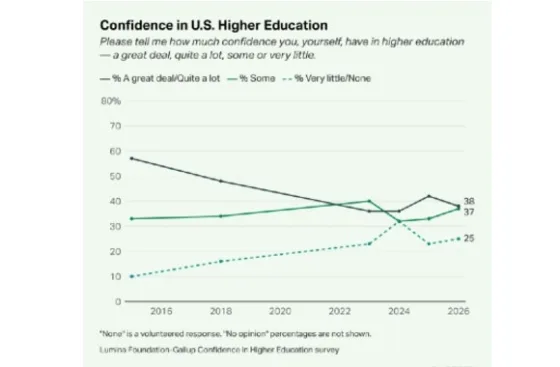
Gallup poll shows steady drop in Americans’ trust in college across the past decade
Concerns about academic rigor and political indoctrination have led to a continued decline in Americans’ confidence in higher education, according to a new Gallup poll.
Published Tuesday, the poll shows a steady decline in public trust over the past decade, with those expressing a “great deal” or “quite a lot” of confidence in higher education slipping from 57% in 2015 to 38% today.
Additionally, “37% of Americans say they have ‘some’ confidence in higher education, while 25% have ‘very little’ or ‘none,’” the poll found. “The percentage with very little or no confidence in higher education climbed from 10% in 2015 to 32% in 2024, before retreating to 23% last year.”
Broken down by education level, those with the strongest confidence are the same people who have been in higher education the longest.
According to the poll, “… 49% of postgraduates have confidence in higher education, compared with 36% of graduates with a bachelor’s degree only and 35% of nongraduates.”
When asked why their trust declined, most people mentioned one of three reasons: “political agendas on college campuses (31%), the high cost of a college education (30%), and colleges not preparing students well for the workforce (25%),” according to Gallup.
These concerns likely relate to professors from state schools to the Ivy League who have voiced alarm about declining competency in basic reading and mathematics skills. As a result, some institutions have begun to require the SAT for admissions again, and others are being urged to do the same.
The issue of grade inflation also has received widespread media attention. In May, Harvard University faculty voted to approve a cap on A grades, The College Fix reported.
What’s more, the concerns about “political agendas” could be linked to the increased scrutiny of diversity, equity, and inclusion programming by Republican leaders, including the Trump administration.
Notably, the Gallup poll found a sharp divide in confidence between Democrats and Republicans:
Declining confidence this year is seen primarily among Democrats. The 50% of Democrats who are confident in higher education is a new low for the group and is down from 61% last year. Still, Democrats remain more confident than independents (39%) and Republicans (23%). The latter groups’ opinions are similar to a year ago.
The long-term decline in confidence in higher education has been steepest among Republicans, down 33 percentage points from 56% in 2015, compared with declines of 18 points among Democrats and nine points among independents.
This year, Gallup added a question about the impact of artificial intelligence on the value of a college degree.
“Americans generally see AI as a threat to the value of a college degree, with 46% predicting that AI will make college degrees ‘somewhat less’ (29%) or ‘much less’ important (17%) …” the poll found.
Only 20% “think college degrees will become ‘somewhat more’ (9%) or ‘much more’ important (11%),” according to the poll. “The remaining 33% do not think the importance of a college degree will change because of AI.”
MORE: Only 1 in 10 Ivy League trustees is Republican, Yale has none: report

