
 FEATURED
Higher ed reform group calls for mandatory civics class for all college students
A higher education reform group is calling for a nationwide requirement that every college student complete a semester-long course on the American story.
The goal is to offer students training not just in facts and dates, but in the civic awareness and responsibility that is essential to being human, its endorsers say.
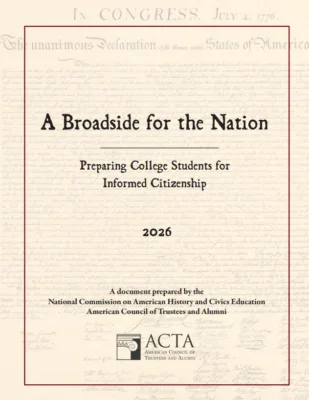
The American Council of Trustees and Alumni recently published its report, “A Broadside for the Nation: Preparing College Students for Informed Citizenship,” which argues the requirement would help the nation’s future “schoolteachers, business leaders, professionals, and government leaders.”
“It used to be understood that this was indispensable,” Paul Carrese, director of the Center for American Civics at Arizona State University, said in a telephone interview with The College Fix.
According to Carrese, ACTA’s proposal that America’s future leaders be required to study their country’s history and government for at least one semester is simply “a restoration of what used to be common in American colleges and universities—a higher civics.”
While Carrese acknowledged that “ACTA is calling for a very challenging self-assessment by any college or university that tries to implement this mandate,” he praised the Stanford Civics Initiative as a successful example of what the council proposes.
Under the initiative, Stanford freshmen must uniformly study several foundational principles in American civics.
Stanford’s model “is a single syllabus taught to every student by every faculty called ‘Citizenship in the 21st Century.’ There are over 100 sections taught by dozens of faculty,” Carrese said.
Carrese is one of 57 scholars, philanthropists, and civic leaders who endorsed the report, published in April. He told The Fix that nationwide implementation of the council’s proposed course would take “quite a bit of commitment, but it could be done.”
In addition to Stanford, other universities have enforced required civics courses.
Lee Strang, executive director of the Salmon P. Chase Center for Civics, Culture, and Society at Ohio State University, identified additional examples: “The State of Iowa recently made two required civics courses, and Florida has a similar approach. Their board of regents have approved three courses.”
The state of Ohio also requires a civics course, Strang said in a telephone interview with The College Fix. Strang, who also endorsed the report, said a civics class is necessary because “a lot of young Americans have never been exposed to core parts of American history.”
In response to the possibility of student frustration with a required course, he said “how a course is taught can really enhance a student’s learning experience,” citing Ohio’s Chase Center, where the “standard model for a course is between 15 to 20 students around a table with a lot of debate and a lot of discussion.”
Students tend to find such a class memorable and enjoyable, he said. Some will grumble at the requirement, but “that’s just a necessary cost of forming young people to be great American citizens,” he said.
As Strang put it, “being a good citizen makes us better humans as individuals when we participate in the civic process;” being required to take civics “is a good thing, just like taking algebra is a good thing—it provides access to truth in some way.”
ACTA suggests the mandatory civics course “could pool expertise from political science, economics, history, art, classics, literature, and music.”
“The National Commission maintains that the required course should be carefully crafted, incorporating essential primary texts: at a minimum, the Declaration of Independence; the United States Constitution; the Federalist and Anti-Federalist Papers; the Emancipation Proclamation and the Gettysburg Address; and documents of the civil rights era,” the 28-page report states.
“The course should offer a broad survey of the major moments and themes in American history.”
Clifford Humphrey, vice president of strategic initiatives at the University of West Florida, said rolling out the requirement is not insurmountable. He told The College Fix in a telephone interview that colleges already offer history, government and civics courses, so it’s a matter of implementation.
For example, Florida college students must choose from a few courses related to American history and government. He said: “Florida has walked a middle path, giving both restrictions and options.”
This approach allows students to make their own choices, while not overwhelming them with too many options. As Humphrey noted, “freedom is putting guardrails up as much as you can, but where there’s the possibility for choice, you want to give choice.”
Humphrey, who also endorsed the report, suggested that any mandated civics course should use the same principles of transparency that Florida universities practice, pointing out state law requires professors to publish their syllabi.
This attitude of transparency holds professors accountable, since they “are telling the public that this is what students are reading in my class,” he said.
Asked how faculty would be selected to teach ACTA’s proposed course, American legal scholar and civil liberties activist Nadine Strossen said that “a professor has a responsibility to educate and not to indoctrinate, to teach students how to think and not what to think.”
In Strossen’s opinion, she said selection criteria should be the same as for any other course: “Take the people who have the most apt background and the most interest.”
As for the hopeful outcome of this course, Strossen told The College Fix in a telephone interview that “it doesn’t matter that one doesn’t recall the details.”
“Facts and figures and dates are the most superficial form of learning. What we’re trying to teach are habits of mind, critical inquiry, problem solving, analysis, discussion and debate, interest and inspiration to prod the student into becoming a lifelong learner and stimulate their curiosity,” said Strossen, who endorsed the report.
Steve Frankel, a professor in the Hamilton School for Classical and Civic Education at the University of Florida, agreed that the proposed course is about igniting an appreciation for America’s unique founding principles.
“The genius of America is that it invites debate, discussion, and deliberation as essential for citizenship. Exposing students to these debates creates a lifelong attachment to America, and if done properly, to the best way of life,” he told The College Fix via email.
Frankel, who also endorsed the report, pointed out that ACTA’s course proposal does not pretend students will remember every detail of the American story, but it hopes for a deeper education in broader civic awareness, saying “every student can and should learn the principles of the founding.”
Of course, faculty play a major role in how students encounter these civic principles, but David Bruce Smith, founder and president of The Grateful American Foundation, said he is hopeful.
“The founders believed that reason could liberate one from prejudice and that, using reason, everyone could judge for themselves whether this regime is just. I think most teachers are still open to the power of reason and open to a thoughtful discussion about the best regime,” he told The College Fix via email.
As Smith noted, this course is intended to be memorable and impactful: “The Broadside emphasizes the entire American story: its literature, its art, its music, its scientific breakthroughs, the energy of its commercial sector.”
To read ACTA’s “Broadside” report and view the list of its endorsers, click here.
MORE: Conservative scholars debunk claim Declaration of Independence was document of revolt

