FEATURED
‘Anyone registering voters can be as partisan as they want, and there is certainly no accuracy standard for things they might say,’ official says
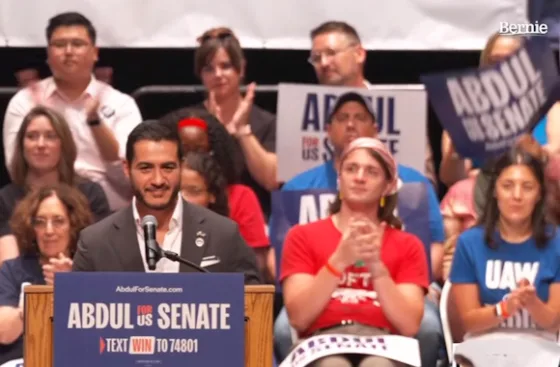
At the University of Michigan, two professors running a nonpartisan get-out-the-vote effort have both donated to Democratic candidates, with one of them having donated to Abdul El-Sayed during his gubernatorial campaign.
The U.S. Senate race in Michigan is one of the tightest races currently. The outcome may decide which party controls the Senate, and Democratic candidate El-Sayed has a slight lead heading into the November election, polls show.
In preparation for the Nov. 3 election, the University of Michigan has two voting hubs on campus and more than 20 ballot education stations designed by Stamps School of Art & Design faculty Stephanie Rowden and Hannah Smotrich as part of the Creative Campus Voting Project.
The project, run by Professors Rowden and Smotrich, is responsible for the ballot education stations designed to teach students how to vote, according to its website.
Smotrich has made 32 donations to various Democratic candidates, including Kamala Harris and Elissa Slotkin, dating from 2012 to 2024, according to Federal Election Commission data supplied by OpenSecrets.
Smotrich has not responded to The College Fix’s request for comment.
Smotrich is “a visual communication designer whose work explores how design can make the possibilities for change visible, accessible, and actionable… and loves watching her students discover their design superpowers,” her bio states.
Rowden has made four donations to Democrats, including one to El-Sayed in 2017 when he ran for governor of Michigan in the 2018 Democratic primary. Rowden has not responded to The College Fix’s request for comment.
Rowden “is an audio documentary producer whose work encompasses installation, podcast and participatory public art [and] she’s inspired every time she sees students use their creative energies to help their peers register and vote,” according to her bio.
“We design spaces, experiences and materials, ranging from campus voting hubs … to informational signage and handouts, pop-up installations, celebratory participatory activities and playful digital tools to help students make a plan to vote,” the two professors told Forbes.
The stations aim to reduce “young voters’ anxiety and confusion whenever possible.”
Lawrence Kestenbaum, the County Clerk and Register of Deeds for Washtenaw County, told The College Fix that “Michigan election administration is highly decentralized.”
Kestenbaum said every state manages elections differently. For Michigan, he said he does not know “of any recognized standards for voter engagement organizations to be accurate or impartial.”
“It used to be that voter registration drives in Michigan had to be coordinated with the local (city or township) clerk, with registrars deputized and trained to work in a completely nonpartisan manner, but as you surely know, those rules were completely overridden by federal legislation,” Kestenbaum told The Fix.
“Now, anyone registering voters can be as partisan as they want, and there is certainly no accuracy standard for things they might say,” Kestenbaum said.
Kestenbaum told The Fix that “the judgement about the partisanship or accuracy of initiatives is left up to individual voters to determine.”
“A few years ago, the Michigan Supreme Court ruled that signatures on an initiative petition are valid, notwithstanding that the petitioners misrepresented what they were signing,” Kestenbaum said. “Moreover, in the current political climate, ‘accuracy’ might be seen as a fraught concept.”
Kestenbaum said he had not heard of the “Creative Campus Voting Project.” He did not think that his office had had any dealings with the organization.
The University of Michigan media relations team did not respond to The College Fix’s request for comment.
“This year’s Ballot Education Stations reflect insights from over eight years of our human-centered design research [and] this project not only helps to demystify the voting process, but also normalizes that it’s okay to have questions,” Smotrich told Michigan News.
“All of the content is carefully vetted for accuracy and nonpartisanship,” Rowden told Michigan News. “We know from interviews, testing and years of CCVP observations that approachability, trustworthiness and care with design are key to building curiosity and confidence.”
In 2024, a Chinese student, who has since fled the country, illegally voted in the presidential election at the University of Michigan museum’s voting hub. The same voting hub is open again this year and currently a site for early voting.
MORE: University of Michigan voting hub where foreign student illegally voted remains active