FEATURED
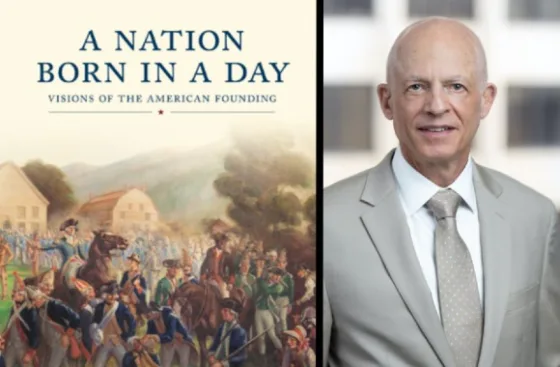
Historians and professors refute arguments from popular ‘1619 Project’
In keeping with the nation’s 250th anniversary, a new book “A Nation Born in a Day: Visions of the American Founding” brings together a collection of scholarly essays examining America’s founding and critiquing the claims made by “The 1619 Project.”
“In 1776, America’s Founders set forth principles of equality, liberty, and consent of the governed,” the book’s editor, Michael Poliakoff, told The College Fix in a recent interview. “Although it would be a long journey to shed the stain of slavery, the Founders set us and the world on that path.”
Poliakoff is a professor of classics and president of the American Council of Trustees and Alumni, a conservative organization that works to support liberal arts education and uphold academic standards.
The book, published by Stone Tower Press, features essays by 10 historians and scholars who refute the claims of the popular 2019 New York Times series “The 1619 Project.”
The project’s main, much-disputed thesis put slavery and the contribution of black Americans at the center of American history, claiming that it was central to the nation’s historical development. The title emphasizes the year when the first enslaved Africans arrived in the English colony of Virginia, as a symbolic starting point for understanding the country. This slavery-focused historical outlook argues that slavery is paramount in impact and importance over the principles set by the Founding Fathers.
Years later, despite numerous scholarly critiques, the project continues to be taught. For example, the Pulitzer Center continues to make free lesson plans and reading guides based on the project available to educators. And the National Council for the Social Studies has defended teachers’ use of those resources to address slavery and its legacy.
Poliakoff said the new book dispute the still-popular project’s framing, arguing that its thesis diminishes the revolutionary significance of 1776 and fails to meaningfully credit the Founding Fathers’ principles that led to the abolition of slavery.
“It is essential that we Americans share a fundamental, accurate understanding of why and how our nation was founded,” Poliakoff told The Fix. He said the narrative of “The 1619 Project” “undermine[s] that unifying truth by making Americans question our founding principle and history.”
In one of the book’s chapters, former University of Kentucky history Professor Jane Calvert examines Founding Father John Dickinson, who began freeing 37 enslaved people in 1777 and later pushed for abolitionist legislation in Delaware. Calvert writes that Dickinson’s efforts show that the country’s early leaders did not all hold a unified view on slavery.
Another chapter by historian Peter Coclanis challenges arguments linking the development of American capitalism primarily to slavery, while Diana Schaub’s chapter examines Frederick Douglass’s criticism of slavery alongside his appreciation for the nation’s founding principles. Schaub is a professor of political science at Loyola University Maryland.
Poliakoff told The Fix that he hopes the book will help readers to distinguish between acknowledging the country’s historical failures and rejecting the ideals on which it was founded.
He also said understanding slavery requires looking beyond American history to its broader global context. Poliakoff said many readers may be surprised by how widespread slavery was worldwide and by the compromises the Founders made while trying to preserve the Union.
“The famous sentiment from James Joyce’s Ulysses, with which Robert Paquette ends his chapter, deserves our reflection: ‘History is a nightmare from which I am trying to awake.’ That can only happen when we face it squarely,” he told The Fix.
When contacted about the book and its critiques of her work, lead author of “The 1619 Project” Nikole Hannah-Jones told The Fix that she never heard of it.
“However, it speaks to the continued importance, impact and relevance of The 1619 Project that seven years later, historians continue to debate, write about and think about this single work of American journalism,” Hannah-Jones said.
Poliakoff’s new book is just the latest in a long series of criticisms of the project since its initial launch.
In 2019, shortly after the project’s release, prominent historians urged The New York Times to revise major factual errors in the series. Moreover, in 2020, a group of black conservative scholars and activists launched the initiative “1776” to counter what they described as the project’s flawed arguments about America’s founding.
MORE: 1619 Project releases new ‘reparations math’ curriculum for high school students