
 FEATURED
UPDATED
The Purdue Center for Voice has quietly discontinued its Gender-Affirming Voice and Communication Training program though the reason behind the shutdown remains unclear.
The program, housed under the Department of Speech, Language, and Hearing Sciences at Purdue University, still advertises clinical training on its website.
The clinic is designed to help “gender diverse and trans individuals seeking to adapt their voice and communication in a way that is safe and authentic, resulting in communication patterns that are congruent with their gender identity,” according to an explainer sheet.
However, in response to an inquiry regarding the clinic’s operation, age thresholds, funding sources, and clinical priorities, clinical assistant Professor Lydia Kruse said the program is no longer in operation.
“The Gender-Affirming Voice and Communication Training Program is no longer active, and we are not accepting clients or conducting services in this area,” Kruse told The College Fix on July 13. “Your email is a good reminder for me to request that the website be updated to include only the services that are currently offered.”
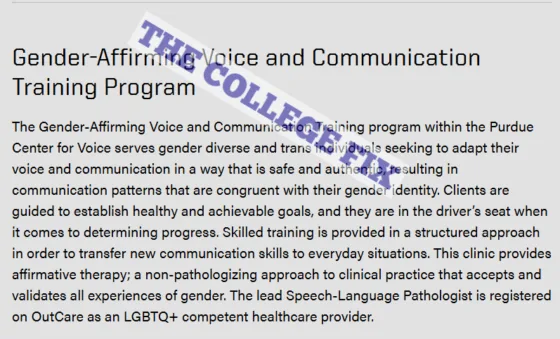
The program is still listed on Purdue’s website as of Aug. 12.
Kruse did not respond to follow-up inquiries in the past weeks asking for more information on why the program is no longer in operation.
Her academic experience includes presentations on “Gender-Affirming Voice Therapy” and “Vocal Feminization in Gender-Affirming Voice and Communication Training,” according to her curriculum vitae.
Several experts criticized the clinic in comments to The College Fix.
“Purdue should never have been running a clinic devoted to helping people pretend to be the opposite sex,” Nathanael Blake said. He is a fellow on family and life at the Ethics and Public Policy Center.
“Keeping public universities from promoting gender ideology and sex-rejecting procedures requires Indiana leaders to be vigilant about oversight,” Blake told The Fix. “Rules and regulations are unlikely to be enough if state leaders are not dedicated to ensuring that they are followed,” he said.
Indiana law currently prohibits chemical and surgical procedures to make gender-confused minors look like the opposite sex.
The policy counsel for the Indiana Family Institute also criticized Purdue’s program.
Corrine Youngs told The Fix this program, and all others, should be closely scrutinized.
“Hoosier taxpayers deserve transparency into how tuition and state dollars are allocated, particularly for programs built around a notion that a person can change their sex,” Youngs said via email.
“A person’s sex is a biological fact, not something voice training, hormones, or surgery can alter,” Youngs said.
Youngs also noted that “public universities have finite clinical training resources,” questioning the clinical prioritization of gender-affirming services over “the state’s most pressing healthcare needs.”
She said that, “Communication disorders following stroke, traumatic brain injury, childhood speech delays, infant feeding and swallowing issues, and swallowing disorders in the elderly are core, universally recognized needs that Hoosiers depend on speech-language pathologists for,” stating that this “should come before a specialized program built around helping someone present in a way that differs from their biological sex.”
Youngs pointed out that no amount of voice training can “resolve the underlying psychological distress of gender dysphoria.”
“A public institution dedicating clinical training and public funds to a service built on the notion that a person’s gender can be changed or affirmed through voice training is a position many Hoosiers, myself included, don’t accept.”
Editor’s note: The spelling of Youngs’ and Blake’s first name have been fixed.
MORE: Trump NIH funds ‘gender minority birthing people’ study

