FEATURED

Document undermines propaganda from Chinese Communist Party
A University of Michigan police report undermines claims by the Chinese consulate and the school’s graduate employees’ union that the Department of Homeland Security pushed a Chinese researcher to commit suicide.
The College Fix obtained two reports from the university via a public records request. The documents concern Danhao Wang’s suicide in March of this year. He worked at the Ann Arbor campus as an assistant research scientist in the electrical engineering and computer science department, according to a still public bio.
Following Wang’s suicide, the Chinese consulate in the United States implied he died because of harsh questioning from federal law enforcement officials. The campus Graduate Employees Union, GEO, amplified these concerns. Other media outlets repeated the assertions.
“For some time now, the U.S. has overstretched the concept of national security for political manipulation and groundlessly interrogated and harassed Chinese students and scholars,” the Chicago Consulate, which includes Michigan, wrote on X.
The post continued: “These moves infringe on Chinese citizens’ legitimate and lawful rights and interests, poison the atmosphere of people-to-people and cultural exchanges between China and the U.S., and create a serious chilling effect.”
At the end of the post, the China Consulate Chicago warns Chinese citizens of the United States about law enforcement.
The graduate union similarly advised members not to cooperate with law enforcement, following the incident. Prominent publications, including the Detroit News, ran with this narrative.
While Homeland Security did contact Wang on the morning of March 19, his attorney advised him “that this is nothing serious,” according to a responding police officer’s recollection of an interview with a witness. It appears Customs and Border Patrol officials were interviewing him, based on a business card found in Wang’s belongings.
The witness was talking to Wang about a research paper when the Chinese researcher jumped out of the building.
Two witnesses declined to talk to law enforcement, according to the police report.
A supplemental report from a police officer also clarifies that Wang was not “on the phone arguing with someone before he jumped to his death,” as the medical examiner’s report stated.
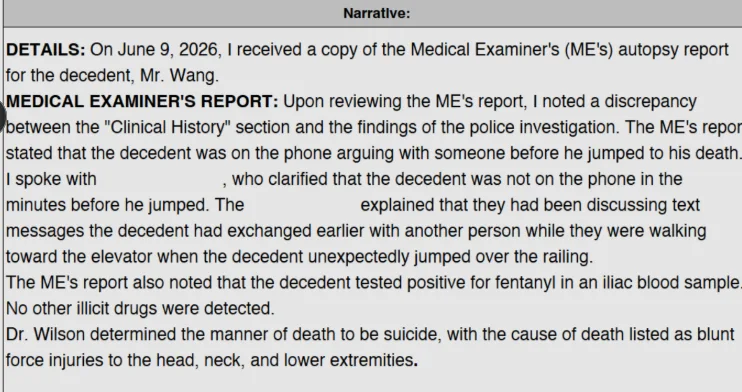
The initial police report said Wang “did not have any alcohol or illegal drugs in his system at the time of the suicide,” though the supplemental report said there was fentanyl in his body.
Homeland Security did not respond to two emails sent in the past three weeks. The Fix asked why agents were interviewing Wang, what his visa status was, to respond to the Chinese consulate’s claims.
The Fix also emailed the University of Michigan GEO and its communications committee chair, Natalie Chen, on Oct. 31 and followed up on Nov. 3. She did not respond to either message about how the union came to understand Wang’s suicide and any further information it had.
The University of Michigan’s communications office did not respond to emails and phone calls asking about the situation in the past several weeks.
However, a scholar at the American Enterprise Institute says to take comments from the Chinese government “with a grain of salt.”
Audrye Wong told The Fix that whenever something legally happens with Chinese citizens or of descent, the “Chinese government has an incentive to frame any unfortunate incidents as a result of U.S. law enforcement.” The former fellow in a Harvard University national security program gave her analysis via a phone interview. She said every country has a right to advocate for their citizens, but China is known to push false narratives.
Wong, a former University of Southern California professor, said the consulate may have been trying to “deflect or push back on charges of espionage or IP theft or sort of broader concerns over Beijing’s foreign influence.”
In this case with the Michigan researcher, Wong warns about CCP influence in this case, targeting Chinese people to believe that China is “protecting you against discrimination, against unfair targeting.”
Wong cited the Hawaii wildfire as a case where Chinese social media users spread misinformation that the United States caused the fire through a military experiment, as an example of China using disinformation to create “uncertainty and increased distrust of American institutions writ large, certainly among, say, Chinese Americans and Chinese national states, but also broadly among the public.”
Wong said there is a “legitimate concern about disproportionately targeting” Chinese researchers, but “this concern has been exploited and certainly distorted and manipulated” by the Chinese Communist Party.
Officials use this “as a shield against efforts to root out foreign influence.”
MORE: Harvard professor convicted for hiding ties to China gets new job in China