
 FEATURED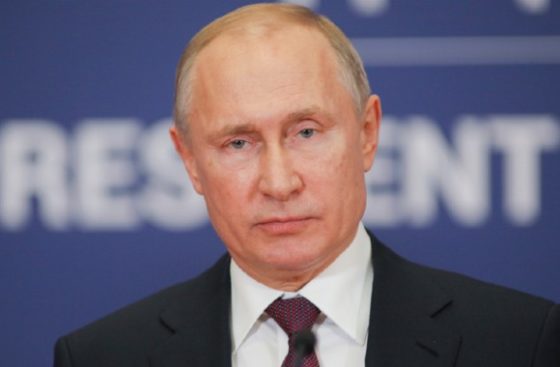
Russian President Vladimir Putin’s regime is intimidating Russian organizations and scientists on American soil, according to a prominent professor speaking out about the situation.
The incoming president of the Russian-American Science Association, University of Southern California chemistry Professor Anna Krylov, told The College Fix she fears for her safety and the safety of academics caught in the Kremlin’s scope — but refuses to stand down.
“I definitely am not going to quit RASA, because that’s not the proper response to bullies, and so I will continue with operations as usual,” she said. “I will be organizing our next conference, and I will be participating and doing my job as president-elect and then as president of RASA.”
But American college students and academics are in danger of extradition and punishment by the Russian government over speech it deems “undesirable,” she said.
In March, the Russian General Prosecutor’s office designated the Russian-American Science Association as undesirable, leading to its former president, UNC chemistry Professor Alexander Kabanov, facing charges as a “foreign agent” in April.
Its current president, Sergei Erofeev, received the same foreign agent charges as Kabanov on May 15. In its response, RASA condemned the decision as politically motivated.
The Russian-American Science Association “is a professional academic organization that supports the global Russian-speaking scientific diaspora,” Krylov wrote on her Substack.
“It has no political agenda. Its mission is to sustain and develop a shared intellectual and cultural space through conferences, awards such as the Gamow Prize, and mentoring and networking programs.”
She wrote the intimidation campaign “is not merely an administrative act—it is an attempt to sever scientific ties, isolate scholars, and export repression beyond Russia’s borders.”
“If left unaddressed,” she added, “it will normalize the idea that governments can criminalize scientific collaboration and intimidate scholars anywhere in the world.”
Krylov told The Fix that travel is one of the biggest challenges under the designation.
“I will be not traveling now to China and Turkey and other countries that I’m aware are directly cooperating with Russia,” she said. “Since I am often in Germany, I may end up in German jail if the government decides to cooperate with the Russians. So, I very much hope it doesn’t happen, but it’s quite concerning for me.”
Russia has a track record of using international law to punish scholars outside its borders, Krylov said.
“One way pressure can be exercised on people who get slapped with designations is that their relatives, friends, or collaborators in Russia can be harassed and intimidated,” she said, adding Russian authorities question and search their houses as a tactic.
For those who do not have Russian connections, Russia abuses international agreements using their INTERPOL red notices, she said.
“You can be traveling in Europe, be in Spain or Denmark or Germany, and you can be arrested by local authorities because your name is on this list,” she said. “Even worse is the fact that some countries can also freeze your assets, which is also part of international agreements.”
INTERPOL, the International Criminal Police Organization, is a global network of 196 countries that exists to fight transnational crime. By issuing red notices, it instructs countries to arrest its targets.
Russia’s General Prosecutor’s office has labelled several American universities and academic organizations undesirable under a 2015 Russian law cracking down on such nonprofits. The alleged connections to foreign actors or interests often surround the war in Ukraine.
Russia’s increased hostility, Krylov said, has implications for more than just its citizens.
“Of course it has an impact for those who are in Russia,” she told The Fix. “You may say that Russian scientists and Russian scholars in Russia would be most affected, and they are, because they can be punished, and they are not allowed to collaborate with people abroad.”
“But what I wanted to emphasize is that these actions are meant to have and have had a direct impact on our academic and other activities abroad, and on American soil.”
Students studying in America face just as much danger as their European counterparts, Krylov said.
“There’s a very significant impact on students because there are quite a few international students studying in the U.S. and they’re now in a very dicey situation,” she said.
“If they’re studying in one of these designated universities, Berkeley or Stanford or so forth, they can be considered as participating in activities of undesirable organizations. And then, for many students who actually plan to go back, that’s a big problem.”
Their parents can be intimidated and targeted as well, she said.
Students who associate with people who are deemed undesirable are in danger too, she said. For example, Kabanov’s students are in direct association with an alleged “foreign agent.”
“Basically this shadow can expand pretty far,” she said.
Krylov said the restrictions and targeting will disrupt educational spaces globally.
“It’s really detrimental to science and education when people start experiencing these restrictions,” she said. “It offends the missions of the universities, and hurts the students who will be intimidated to participate and whose travel will be restricted.”
MORE: Socialism bankrupted her family in Venezuela. Now, she’s warning American students.

