FEATURED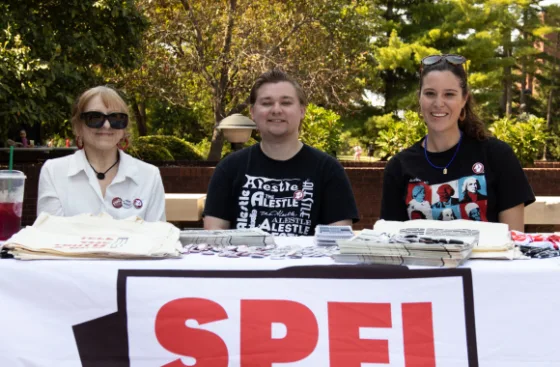
UPDATED
Journalist and press freedom groups already battling school over interview restrictions
Campus police quickly closed an investigation into the editor-in-chief of the Southern Illinois University-Edwardsville newspaper for “harassment.”
Editor Dylan Hembrough and his advisor were ordered to speak to campus police after the student journalist criticized the school’s media team for what he saw as restrictive interview policies.
Hembrough (pictured, middle) told The College Fix on Thursday that the interview took only 15 minutes or so at the police station and the matter is now “closed” after the meeting earlier this week on Tuesday.
Two officers were present for the “short interview,” Hembrough said.
“It was really cordial, I didn’t feel any malice from them,” the student journalist told The Fix. “After a couple question he said he was going to close the case because it’s not harassment,” Hembrough said.
The investigation is the latest battle between the student newspaper The Alestle, and Director of Communications Nicole Franklin.
The newspaper objects to a university policy that appears to require a spokesperson to be present at all interviews with staff or professors.
Over the summer, Franklin “stopped a reporter…from interviewing a staff member without her presence,” the Foundation for Individual Rights and Expression told The College Fix via email.
FIRE, which is intervening along with the Student Press Law Center to fight the policy, criticized the latest maneuver by the university.
The school “should be ashamed of its strong-arm tactics to silence its own students,” Marie McMullan told The Fix via a media statement on Wednesday. “Siccing cops on journalists is something you’d expect to see from a tinpot dictatorship, not a university in the heartland of America.”
Hembrough reportedly wrote to the media team on Sept. 3, criticizing it for its “insistence on interfering with our newsgathering process is dangerous and detrimental to both press freedom and freedom of speech.”
Officer Levi Cox, in an email published by the national free speech group, said he did not think the comments amounted to harassment. “I do not believe this statement in and of itself to be harassing in nature,” he wrote to the school’s faculty advisor. Cox is one of the two officers who met with Hembrough.
McMullan, the program manager for press freedom at FIRE, said her group’s client was just asserting his rights.
“Universities may not like it when student journalists speak truth to power and ask tough questions, but they have a clear First Amendment right to do so,” she told The Fix.
Hembrough, the editor in chief, said he won’t be deterred.
“We’re going to keep reporting, and keep reporting critically, just like we have been,” he said on the phone interview.
“We’re not going to let something like that intimidate us out of doing our jobs.”
University disputes it requires staff presence at interviews while defending practice
The Edwardsville campus disputes that it requires staff to be present at interviews.
In an open letter published over the summer, executive communications director Paula Bridges, who has since left the school, disputed the newspaper’s claims.
Commenting on the conflict with Franklin, the spokeswoman, Bridges wrote:
The claim that the Communications Director threatened to block a student reporter’s interview is simply false. The follow-up assertion that she has increasingly insisted on sitting in on interviews is also false. What occurred, which is documented in writing, is that she informed the reporter she would attend an interview that she was arranging, exactly as she has done throughout her tenure at SIUE. This is a standard communications practice, not an obstruction of any kind.
The school’s Chancellor James Minor provided comments to The Fix in an emailed statement.
Minor says his school has addressed FIRE’s concerns.
“This has never been about free speech or freedom of the press. SIUE has a long history of sponsoring The Alestle and training student journalists, and that commitment has not wavered.” he said.
“The real issue is the lack of journalistic principles of objectivity, truthfulness, and accuracy,” Minor stated. “Calling for accuracy is not interference. The Alestle has repeatedly published information that is inaccurate and, despite requests for corrections, has been slow or unwilling to make them.”
He said it is “standard communications practice” to have a “representative present during interviews involving official university business.”
The union representative for professors at SIUE challenged the claim that most campuses require a staff member for interviews.
“While cases like this have been rare, they are increasing in frequency – FIRE and the ACLU would be more likely to have data on the frequency than I would,” Rachel Tollett told The Fix via email.
She is the regional director for the Illinois Education Association, which represents SIUE faculty.
“Faculty are free to speak to any news publication either in their capacity as faculty or in their role as private citizens,” she said, noting her union supports “the protection of extra-mural speech from censure.”
The teachers union supports “student journalists at SIUE and their pursuit of the news with the integrity and ethics necessary for their future profession.”
Editor’s note: The date of Hembrough’s initial email has been corrected.