
 FEATURED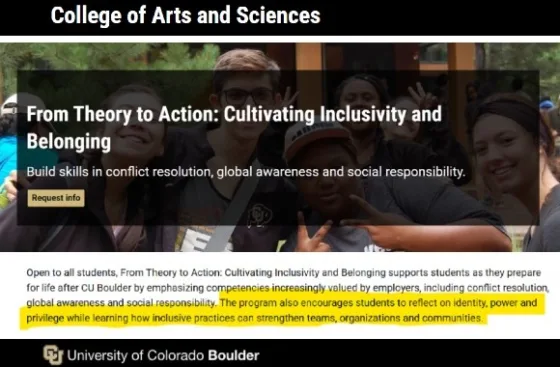
Micro-credential teaches that ‘inclusive practices can strengthen teams, organizations and communities’
The University of Colorado Boulder is offering a new micro-credential about workforce preparation skills that, based on its description, appears to take a diversity, equity, and inclusion approach.
The course, “From Theory to Action: Cultivating Inclusivity and Belonging,” is offered for free this fall by the Office for Access and Community Engagement in the College of Arts and Sciences to undergraduate students.
Its goal is to “help undergraduate students translate academic learning into practical, workforce-ready skills,” according to the course description.
Accessed online through Canvas, the course aims to provide students with skills employers look for, including “conflict resolution, global awareness, and social responsibility.” Students are also supposed to learn how “inclusive practices can strengthen teams, organizations and communities.”
Students will write about and discuss their “personal experiences with poverty and privilege and how those experiences intersect with broader societal structures.” Additionally, the class states that it “encourages students to reflect on identity, power, and privilege.”
Several students and faculty developed the micro-credential together during the spring semester through the public university’s Students As Partners program. Micro-credentials are short courses that focus on a specific skill set.
The program “brings together equity-minded undergraduate students and faculty members in collaborative partnerships that strengthen teaching and learning,” according to its website.
In a description of the micro-credential project on the university’s Center for Teaching & Learning webpage, student developer Aris Wertin expressed a need for students to learn skills that prepare them for the workforce, such as time management and conflict navigation. Wertin also said students should learn “conflict navigation that honors multiple perspectives.”
The College Fix reached out to the Office for Access and Community Engagement and Aris Wertin via email, asking for more details about the course and its development. The Fix was redirected to Program Manager Marysia Lopez and Assistant Dean Patricia Gonzales, but neither responded. Both Lopez and Gonzales are mentioned as “project leads” on the micro-credential development team.
The Fix also reached out to the university media relations team twice via email, asking for more details about the Students as Partners program and the micro-credential, including its meaning of the term “inclusivity” and preparation for students for the workplace, but no one responded.
The Fix also requested the course syllabus through an open records request, but the university’s public records office responded that a syllabus does not exist.
A fellow at The Heritage Foundation and critic of DEI in education told The Fix that the concepts embedded in the micro-credential are there for reasons beyond education.
“What may initially appear to be harmless or even compassionate theoretical concepts are, instead, closely connected to practical institutional programs that seek to reshape organizational culture and public policy along ideological lines,” Heritage fellow Allen Mendenhall said.
“The emphasis on identity typically serves as a vehicle for radical perspectives on race, gender, and sexuality, while the concepts of power and privilege encourage interpreting social relationships primarily through group-based hierarchies of advantage and disadvantage rather than personal merit or responsibility,” Mendenhall told The Fix.
These teachings are not limited to students either. This fall, the public university also is offering a micro-credential for educators called the Just & Equitable Teaching Program, which “supports educators in developing inclusive, equitable teaching practices through a social justice framework.”
MORE: First-year classes this fall range from Wonder Woman to ‘queer’ art to the occult

