FEATURED
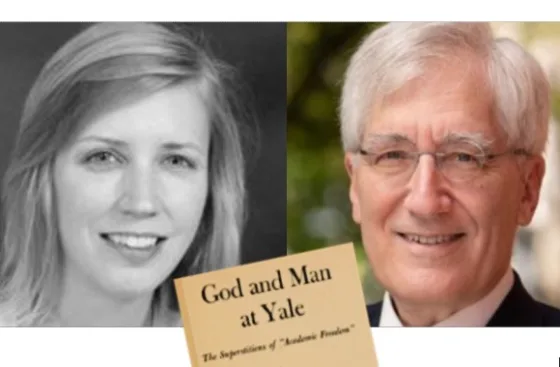
Event hosted by Florida State University explored what role alumni and religion should play in academia
Two prominent conservative scholars discussed the role of alumni and religion in university mission shaping on Monday during a Florida State University Institute For Governance and Civics event about William F. Buckley’s book, “God and Man at Yale: The Superstitions of ‘Academic Freedom.’”
Buckley, a well known conservative author and founder of National Review, published his famous book 75 years ago in response to his own experiences at Yale.
The book “focuses on core questions that we are still debating: Who owns the university? What is its mission? Its role in a democracy? Who should decide what is worthy of academic attention in a pluralist society?” according to the Florida State institute’s webpage.
The discussion between Princeton University Professor Robert George and Cheryl Miller, executive director of the Hertog Foundation, was moderated by the institute’s Neal McCluskey. The College Fix attended the online webinar.
One subject of debate was how large a role alumni should play in the university. Buckley believed that alumni should play a significant role in shaping the mission of the university in order for institutions to stay focused on the pursuit of truth.
Miller said she believes there should be “shared responsibility, or what academics called shared governance” between alumni, trustees, and faculty.
She said Buckley’s book critiques “a particular kind of shared governance, which is the faculty gets to be in control of the curriculum and the hiring, and the trustees and the alumni. They have governance, but that’s constrained to writing checks, fundraising, maybe keeping up with the facilities, the stuff the faculty understandably doesn’t want to be bothered with.”
In her opinion, Buckley is “pushing back and saying, trustees and alumni also have an important role … in setting the institution’s mission. And that is going to necessarily impinge on questions of curriculum and hiring. A university cannot educate without making judgments about what is worth knowing,” she said.
George, a professor of jurisprudence and director of Princeton’s James Madison Program, said he agrees that faculty should not be making “all the calls.”
However, he firmly stated that professors should be in control of the curriculum because they know their subject matters best.
“We’re the experts here, so we get to completely control the curriculum,” George said. “… And when it comes to the fine points, getting all the way down to what’s going to be on the reading list, what’s going to be on the syllabus for this seminar or that course, well, yes, obviously there the faculty has to have overwhelmingly the dominant role.”
George and Miller also discussed what universities should teach and particularly whether religion should be taught in private institutions. In his book, Buckley lamented how Yale in the 1940s had strayed from teaching the Christian values upon which it was founded.
Miller said that Buckley believed in teaching Christian values, but he did want universities to expose students to opposing views as well. His problem was with universities eroding those values.
“Buckley wants his students in his ideal university to be exposed to strong critiques of Christianity, of religious belief, of capitalism, of American democracy, right? He even name-checks Marx and Nietzsche and says, you’ve got to read the most powerful critics of your values and your principles in order for there to be real education,” she said.
George said he believes that religious perspectives should not be part of the overall educational mission of universities like Yale that have disaffiliated with religious institutions. These schools do not advertise themselves as offering an education from a specific religious perspective, he said.
However, institutions that do, such as the Catholic University of Dallas or the Mormon Brigham Young University, should be teaching from religious perspectives because that is their mission, George said.
At the same time, George, who is a vocal conservative and a Catholic, also emphasized the importance of universities teaching truth. Doing so means presenting students with different arguments and perspectives, he said.
The purpose of the university “is to form the young men and women entrusted by their families, to help them to form themselves to be determined truth seekers and courageous truth speakers,” he said.
“Now, how do we pursue that mission, that fundamentally truth-seeking mission? It seems to me, not by deciding what is true and false and then telling them,” George said.
Miller agreed that “a university shouldn’t be dictating what students think or believe. And Buckley is really clear about that.”
However, “I do think that professors sometimes do need to say, ‘This is true,’ and a university that refuses to make any truth claims has kind of given up on the reason it exists. Professor George has argued this, that academic freedom is ultimately in service of the truth,” she said.
Prior to the discussion, George and Miller wrote essays reflecting on Buckley’s 75-year-old arguments.
In George’s essay, “God, Man, and Academic Freedom,” published at Law & Liberty, he critiqued three of Buckley’s arguments about academic freedom. One was “that truth is not as knowable as we might think.”
“I believe that intelligent people, when confronted with the truth, will tend to be brought closer to it,” George wrote. “This is not to claim that truth will always or inevitably win out in a true marketplace of ideas; rather, it is, in effect, to bet that the chances of truth prevailing are better where there is such a marketplace than where there is indoctrination or coerced belief.”
“Genuine education, including civic education, is formation, not catechesis,” he wrote.
Miller wrote a response essay, “The Catechized College,” that pushed back on some of George’s critiques.
She wrote that Buckley was not advocating solely for a religious perspective to be taught in academia but rather one that teaches students to be good and moral citizens through values that come out of Christianity.
“Formation requires institutions willing to make judgments about what is worth knowing and to take responsibility for the curriculum through which students come to know it,” Miller wrote.
“That is the university Buckley ultimately sought: not the catechetical university, but a formative university— the modern, free, enlightened University with a purpose, and with the will, the courage, and the conviction to imbue her students with that same purpose,” she wrote.
MORE: Scholars fear beauty and art being replaced by power and politics in humanities