
 FIX EXCLUSIVES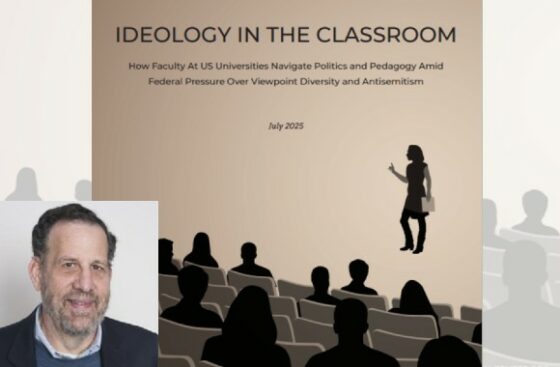
Recent Harvard grad says self-censorship is still happening among ‘too many Jewish students’ due to campus antisemitism
A recent study on faculty attitudes and classroom ideology reveals little hostility toward Israel and Jews, sparking questions and calls for universities to address the few professors with “extreme” views.
Approximately 90 percent of faculty didn’t show any pattern of views hostile to either Israel or the Jewish people, researchers at Brandeis University’s Steinhardt Social Research Institute and Cohen Center for Modern Jewish Studies found.
However, of the 10 percent who did, 3 percent were hostile toward Israel and 7 percent were hostile toward Jews, according to the July study.
“I am surprised, but not shocked, that some faculty have views that have long been considered antisemitic,” Leonard Saxe (pictured), one of the study’s authors, told The College Fix in a recent email.
The study also found 21 percent of faculty said they have been involved in political activism or posted an opinion on social media about the Israel-Palestine conflict.
And “despite the intense focus on how faculty teach about Israel, more than three quarters of the faculty in our sample reported that, over the past academic year, the Israel-Palestine conflict never came up in class discussions, and less than 10% reported actively teaching about it,” the researchers wrote.
Interestingly, the study also examined faculty views on diversity, equity, and inclusion in relation to antisemitism and politics.
“Faculty who were extremely liberal were the most likely to be hostile to Israel, while those with more conservative political views, including those who were the most critical of DEI, were the most likely to be hostile to Jews. However, those faculty with the strongest views on DEI, Israel, or decolonization were still unlikely to indicate hostility to either Jews or Israel,” according to the research.
Researchers surveyed over 2,300 faculty from 146 research-intensive universities to understand what they “think about contentious political issues and how these issues are addressed in the classroom,” including the nation of Israel and Jews.
Agreeing with statements such as “I wouldn’t want to collaborate with a scholar who supports the existence of Israel as a Jewish state” would indicate hostile views towards Israel, whereas agreeing with statements such as “Jews in America have too much power” would indicate hostile views towards Jews.
Researchers wrote that the problems with antisemitism on campus are “more likely to be driven by the actions of a very small number of faculty members with extreme views, as opposed to the actions of whole fields or disciplines.”
Saxe, director of the Cohen Center for Modern Jewish Studies, said he believes that in order to create more productive dialogue on campuses around the issue of antisemitism, “subject-matter experts need to be given the opportunity to engage with more students — in formal courses as well as non-credit.”
When asked how university administrators can improve open dialogue on controversial topics, Saxe told The Fix that the solution is that “rules of conduct be applied equally to liberal and conservative members.”
“Most faculty handbooks that I’ve reviewed require that faculty treat their students and colleagues respectfully and that civil discourse prevail,” he said.
MORE: Columbia will suspend, expel dozens of pro-Palestinian protesters
Shabbos Kestenbaum, who is Jewish, described the study “as distressing as it is affirming” in an email to The Fix on Friday.
Kestenbaum is a recent graduate of Harvard Divinity School who sued Harvard for policies that allegedly “enabled, normalized, and celebrated a culture of antisemitism,” The Fix previously reported.
“For years, many of us in the Jewish communities warned about what academia was slowly accepting — not just overt hostility toward Israel, but increasingly, toward Jews themselves… That should sound an alarm,” he said.
“The biggest threat to free speech on college campuses are college professors and administrators,” Kestenbaum told The Fix.
“They have silenced their own students, including me, over political ideologies that do not follow their own. Too many Jewish students, conservative students, Asian Americans, and others routinely self-censor in order to appease dominant, illiberal culture,” he said.
When asked about how antisemitism can be combatted, Kestenbaum told The Fix that universities must do something they “aren’t used to.”
Specifically, he said universities should be ensuring that Title VI is “upheld by punishing students, faculty, and administrators who violate it” and refusing to “take tainted foreign money from adversaries such as Qatar, China, and Russia, or at the very least, report the amount publicly.”
Additionally, he suggests that universities stop hiring professors who are “more interested in ideological purity than ideological diversity.”
“Jewish students do not want special treatment under the law, they want equal treatment under the law,” Kestenbaum said.
Meanwhile, a senior fellow for Middle Eastern studies at the Council on Foreign Relations said the study raises more questions than answers.
On the council’s Pressure Points blog recently, Elliott Abrams wondered about the small group of “woke,” “activist” faculty that the study found “impose their views on students.” Abrams is a former deputy national security advisor in the President George W. Bush administration.
He quoted the study, “Government and university rules already prohibit much of this conduct, and university administrators—working in conjunction with faculty committees— already have substantial power to regulate faculty behavior.”
Abrams responded: “Quite so, but that conclusion does give rise to an important question. Given that the number of faculty who violated rules and laws was so small, why was it so hard to discipline them? Why did university boards of trustees, and presidents and provosts, and faculties themselves, fail in their duties—fail to uphold their own stated standards and to protect students?”
MORE: Columbia U. grad details ‘worst antisemitic attack I faced personally on campus’
IMAGE CAPTION AND CREDIT: Brandeis University researcher Leonard Saxe appears alongside an image displaying his new study; Brandeis University Cohen Center for Modern Jewish Studies

