
 FEATURED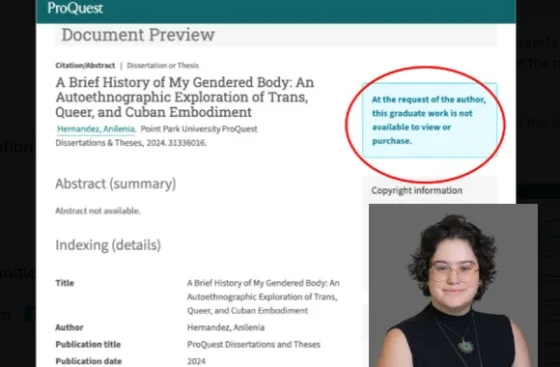
Scholar now works as mental health clinician at Johns Hopkins University
“A Brief History of My Gendered Body,” a dissertation by Point Park University graduate student Anilenia Hernández, is no longer available to read online after it faced criticism, in part, for starting with an unusual “Hello, darling. Welcome.”
ProQuest, an academic website that publishes dissertations and other scholarly writings, removed Hernández’s dissertation last month after initially publishing it in 2024, according to screenshots posted by Colin Wright on X. Hernández now works as a mental health clinician at Johns Hopkins University and promotes “gender-affirming” care.
“At the request of the author, this graduate work is not available to view or purchase,” the dissertation webpage stated, according to the screenshot.
Since December, any mention of the dissertation also appears to have been removed from the website. The College Fix could not find the paper by searching ProQuest by the author’s name or the full dissertation title, “A Brief History of My Gendered Body: An Autoethnographic Exploration of Trans, Queer, and Cuban Embodiment.”
The Fix emailed ProQuest multiple times over the past month, asking why the dissertation was removed from public access, but received no response.
Colin Wright, PhD, founding editor of Reality’s Last Stand and a fellow at the Manhattan Institute, first drew attention to the dissertation in a Dec. 7 X post.
“Apparently, the author of one of the most absurd doctoral dissertations I’ve ever exposed has since requested that ProQuest prevent the public from viewing or purchasing it,” Wright, an evolutionary biologist, wrote.
Wright said scholars often pay thousands of dollars to have academic journals “make their research open access. Imagine going out of your way to contact an academic publisher requesting to make your open access research completely inaccessible to the public.”
“It’s like they want to be recognized as having a doctorate but realize that anyone who actually reads their dissertation will view them as an academic charlatan,” he wrote on X.
Before the dissertation was taken down, Wright downloaded a copy and shared it via Google Drive.
“The dissertation is fundamentally unserious because it is an ‘autoethnography,’” Wright told The Fix in a recent email. “Which in practice means the author is writing about their own subjective experiences.”
“There is nothing scientific or scholarly about this approach: subjective experiences are unfalsifiable, and peer review is incoherent when there is nothing that can be invalidated or criticized even in principle,” Wright said.
Characterized by Hernández as an “autoethnographic love letter,” the dissertation discusses a wide range of ideas, including feminism, academia, genital size, and God.
Hernández argues in the dissertation that “autoethnography is not merely a methodology. It’s an orientation to lived experiences. It focuses on evocation, intimate detail, reflection, and our lived realities, not merely abstract concepts.”
“Autoethnographic texts often center folks with marginalized identities,” Hernández writes. “Providing personal identity performance narratives and stories about the lived realities of their identities.”
The dissertation also says the project “is a recommitment to critical decolonial subversion and reimaging of cultural concepts both theoretically and materially.”
Hernández’s background in women’s and gender studies runs throughout in the dissertation. The paper makes an argument about what’s wrong with academic feminism:
“Academic feminism has been forced to water itself down, to make itself small .… Academic feminism is hard to read. I can’t get through more than a few pages of Judith Butler (and if we’re being honest, I know that’s true for you, too).”
The critiques of academia didn’t stop at feminism. Hernández writes near the end of the dissertation, “We aspire to whiteness and the respectability it grants those of us who are and look white, but cling to our ethnicity card when someone dares to point out the ways we perpetuate white supremacy.”
“For white people, regardless of whatever or how many marginalized identities and positionalities we hold alongside it,” Hernández writes. “Whiteness will always be the heaviest thing about us.”
The Fix tried to reach Hernández through the media relations offices at Point Park University and Johns Hopkins University. None responded to The Fix’s requests.
According to her Johns Hopkins University bio, Hernández uses “they/them” pronouns and writes letters of support for “gender affirming care” treatment.
Meanwhile, Wright told The Fix that he believes the paper represents “a much larger problem” with academia.
“Most people see a dissertation like this and assume it must be an outlier—a rare instance of academic laziness or ideological excess slipping through an otherwise rigorous vetting process. But that assumption is wrong,” he said.
Commenting on the state of higher education in general, he said, “It shows that many academic fields have become entirely unserious and function as diploma mills for left-wing activists.”
“These fields have no place in a university,” he told The Fix. “They damage the reputations of the institutions that house them and contribute directly to the public’s growing distrust and disdain for higher education.”
MORE: U. Nebraska student’s graduation project mocks Catholic Mass with drag performance

