FEATURED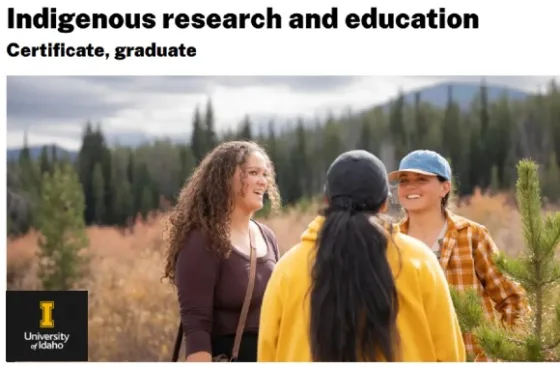
Professor says ‘Indigenous Research’ program teaches students to consider conventional science alongside other ‘forms of knowledge’
The University of Idaho offers a 13-credit graduate certificate that encourages students to incorporate “Indigenous knowledge systems” and “decolonizing” research methods into their academic work.
A professor at the public university says the goal is to expand scientific understanding through Indigenous cultural knowledge. However, an outside scholar expressed concerns to The College Fix about the program watering down the scientific method and pushing political views.
The “Indigenous Research and Education” certificate says it is designed for both Indigenous and non-Indigenous graduate students; it is offered through the university’s College of Letters, Arts and Social Sciences. The university website states that the program prepares students to engage with “Indigenous Knowledge Systems, land education, and community-based research methods.”
The certificate includes courses such as “Decolonizing, Indigenous, and Action-Based Research Methods,” which has a “social justice” focus.
Another class, “Indigenous Land/Water Relations and Governance” has students examine Indigenous knowledge and “critique anthropocentric knowledge systems.” It also explores knowledge “inclusive of ecosystems and other-than-human beings,” the course description states.
Among the program’s stated learning outcomes is for students to “design research that engages methodologies grounded of Indigenous epistemologies, ontologies and axiologies and scholarship in the field of Indigenous research.”
Potential careers for graduates include sociologists, interpreters, museum curators, and political scientists, according to the program website.
How are the certificate’s approaches distinguished from the conventional scientific method? Professor Vanessa Anthony-Stevens told The College Fix that Indigenous methodologies are “relational and situated in context.”
“When put together with the conventional scientific method, these methodologies make relationships and context transparent in approaching and interpreting data,” she said in a recent interview.
Anthony-Stevens told The Fix that the certificate does not ask students to abandon conventional science. Instead, she described its goal as allowing students to place traditional scientific research alongside other “forms of knowledge” and to consider how context and worldview influence research.
When asked about the term “decolonizing,” Anthony-Stevens said it refers to considering how a researcher’s worldview influences the purpose of knowledge and the ways knowledge is sought and shared.
“Decolonizing is a living concept, debated, articulated, and changing in scholarly circles,” she said. “Students are not told one definition, but explore scholarship and develop understanding to determine and define aspects of this philosophical field of research methods for themselves.”
A professor of social and cultural studies, she said the certificate has been offered since 2024.
The program has ties to the university’s broader Indigenous research initiatives, which expand beyond higher education. These include its Cultivating Indigenous Research Communities for Leadership in Education and STEM, or CIRCLES, program.
In 2022, the National Science Foundation awarded a $3 million grant to the “Cultivating Relationships” program to incorporate Indigenous knowledge into K-12 STEM education.
Anthony-Stevens told The Fix that the project involves the university “partnering in STEM education with four Tribal Nations to deliver a teacher professional development program.”
She said the NSF grant funds the K-12 program and is not connected to the graduate certificate.
However, the university programs raised concerns in the mind of one scientist who spoke with The Fix.
“My main concern is that the ‘decolonial’ movement is purposely political,” James Nuzzo, an exercise scientist and academic writer, said in a recent interview.
Nuzzo said that “decolonization” advocates seek to dismantle traditional research methods in favor of what he characterized as a collectivist and subjective approach to knowledge.
“Genuine researchers often acknowledge that their research methods have limitations,” he said. “Yet, so long as science remains open to debate, those methods can continually be refined to minimize bias.”
Nuzzo distinguished this process from what he described as the “decolonial” approach.
“Whereas traditional research methods are inclusive in the sense that anyone can engage in and refine them in the objective pursuit of truth, ‘decolonial’ research is purposely subjective and exclusionary,” he said.
He also brought up potential consequences of such coursework on students who are just learning conventional research methods.
“Many students already struggle to learn traditional research methods,” Nuzzo said. “In part, this is because traditional research methods are rigorous. ‘Decolonial’ research is an ideological distraction likely to hinder students’ ability to learn more rigorous, traditional research methods.”
However, Nuzzo also said that academics who share concerns about decolonial research may be reluctant to express those views publicly because of potential professional consequences.
“Many sensible academics will understand the issues with ‘decolonial research,’” he said. “Yet, most of these academics will refrain from questioning ‘decolonial research’ publicly for fear of potential consequences to their well-being and careers.”
He said academics could fear being labeled racist, accused of “scholarly harassment,” or facing other professional consequences.
MORE: U. Chicago biologist warns against growing effort to ‘braid Indigenous knowledge’ into science