FEATURED
Heritage scholar says fellowships should be based on merit, not adherence to ‘particular set of beliefs‘
The University of Illinois Urbana-Champaign offers fellowships that require prospective graduate students to adhere to the precepts of diversity, equity and inclusion — a requirement that raised potential legal flags with one scholar who spoke with The College Fix.
Although the University of Illinois recently renamed its DEI office, the language is still being used in several of its graduate-level fellowship descriptions.
“We aim to promote the values of diversity and inclusion by encouraging the admission and funding of students who represent a broad array of life experiences and perspectives, for this enhances the quality of the intellectual environment for all students,” UI Urbana-Champaign’s Aspire Fellowship Program website states.
The Aspire Fellowship, which has versions for both graduate and doctoral students, does not appear to require students to write diversity statements. The essay question asks students to reflect on times they made a difference in their community.
However, the stated goal of the fellowship is to “sustain the academic excellence and inclusiveness of the Illinois graduate community, one that embraces students with diverse experiences and goals and who come from many educational, cultural, geographic, and familial backgrounds.”
“By offering financial assistance to those students who might not otherwise have access, we aim to reduce disparities in graduate education,” the fellowship website states. Students awarded the fellowship receive up to $25,000 per year and tuition waivers.
However, another program for master’s and doctoral students called the Equity Fellowship does specifically require candidates to adhere to DEI.
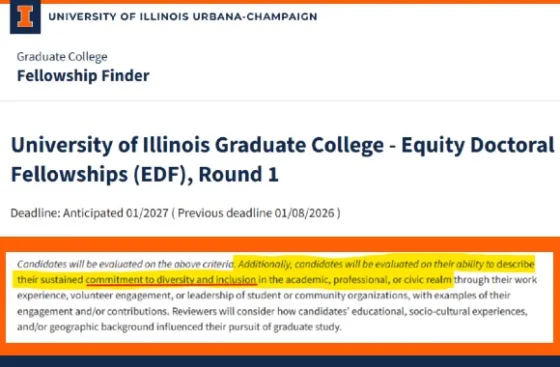
On the Equity Fellowships webpage, the eligibility criteria states that “candidates will be evaluated on their ability to describe their sustained commitment to diversity and inclusion in the academic, professional or civic realm through their work experience, volunteer engagement, or leadership of student or community organizations, with examples of their engagement and/or contributions.”
The fellowship provides financial aid of up to $25,000 per year and tuition waivers.
The College Fix contacted Lisa Abston, the assistant dean of diversity, equity and inclusion who oversees the fellowships, and the university media relations office twice via email within the past two weeks, requesting comment on the fellowships and the DEI statements. Neither responded.
However, a research fellow at the Heritage Foundation and former business professor at Troy University said taxpayer-funded public universities shouldn’t be requiring students to conform to DEI to get fellowships.
“DEI initiatives contribute to division by emphasizing group identity over individual achievement. This approach undermines merit-based evaluation and limits personal freedom by pressuring individuals to conform to particular viewpoints,” Allen Mendenhall said in a recent email.
He told The Fix that there are potential legal problems with mandatory DEI requirements in fellowships “if they result in unequal treatment or function as ideological tests.”
“Because public universities are government institutions, they have a responsibility to use public funds in a way that’s neutral and fair,” Mendenhall said. “Fellowship opportunities should be based on individual merit, not on whether an applicant agrees with or promotes a particular set of beliefs.”
Another problem with requiring a diversity statement is free speech and viewpoint discrimination, he said.
“Courts have consistently warned against government programs that favor certain viewpoints over others,” he told The Fix. “When tax dollars are used to promote specific social or political agendas, there is a risk that individuals with different perspectives will be unfairly excluded.”
However, the University of Illinois is not alone.
Another public institution, the University of California San Francisco also offers a scholarship that requires medical students to show their dedication to the school’s “diversity, equity, and inclusion” principles and “marginalized” communities, The Fix previously reported.
MORE: Boston U. teaching hospital glossary says ‘biology’ doesn’t define sex