FEATURED
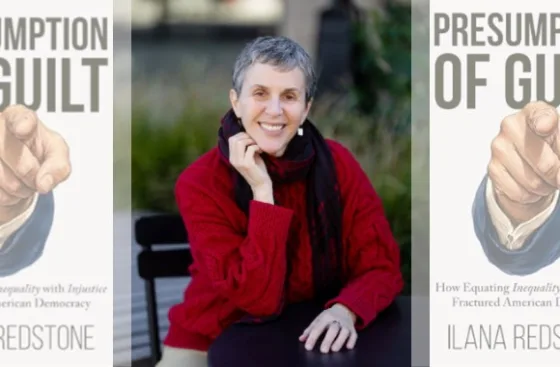
Professor Ilana Redstone discusses her upcoming book on ‘How Equating Inequality With Injustice Fractured American Democracy‘
Sociology Professor Ilana Redstone is challenging her field to reconsider the assumption that unequal outcomes between different demographic groups, even when given equal treatment, is inherently discriminatory.
The University of Illinois Urbana-Champaign professor recently spoke with The College Fix about the argument she makes in her new book, “Presumption of Guilt: How Equating Inequality With Injustice Fractured American Democracy,” set to be published in April 2027.
The book expands upon a paper that she had published in August in the Theory and Society journal. In it, she argues that discrimination such as systemic racism is almost always assumed to be the cause of inequalities in the field of sociology — and that’s a problem.
“The paper is not an argument that institutional discrimination is a myth. Rather, it’s an argument that sociology no longer treats the question of what causes inequality as open and that has significant consequences,” Redstone wrote.
Challenging her field, she wrote: “A discipline that treats a hypothesis as given and then produces research confirming it is not discovering that the hypothesis is correct. It is demonstrating that its methods are organized to confirm it. The hypothesis may also be correct. But ‘possibly correct’ is not the same as settled.”
She argued that the field should “[recover] the capacity to ask open questions about inequality.”
In her upcoming book, she told The Fix that her main thesis is that sociology today treats the belief that disparity equals discrimination as a given. This “casts a shadow” over the field and pushes out scholarly arguments that challenge the assumption or posit alternative explanations, she said.
An example she gave was the term “colorblind racism,” an idea in sociology that a thing can be neutral on its face, but if it produces unequal outcomes, then it is racist.
She told The Fix the idea that “racism lives in systems” even when it does not live in individuals has always been around, but was given “institutionalized weight” with the Supreme Court case Griggs v. Duke Power Co.
In 1971, the court heard a case about Duke Power Co., which had a history of making overtly racist decisions. The company put in place two tests that appeared to be non-discriminatory but actually “screened out black employees at a far higher rate than they screened out white employees,” leading to disparate outcomes, Redstone said.
The court unanimously sided with Willie Griggs, the black plaintiff in the case.
The professor said this decision gave institutional weight to the idea that disparate outcomes, even without the intent to discriminate, is still discrimination. It also gave weight to the moral claim that inequality itself is unjust, she said.
She believes the main reason why academia has reached this point is because no one has been able to accurately diagnose the problem: the baseline assumption of how the political left views the world. The problem is “in the thinking,” she said.
The culture in academia also has not been helpful. “The barriers are institutional and moral — the professional costs of questioning the paradigm, the moral reclassification of dissent as complicity, the self-reinforcing alignment of intellectual and institutional capital … These barriers are real and they are powerful,” Redstone said.
When asked if she has faced backlash for her views, she told The Fix that she has had a lot of freedom and is fortunate for having tenure.
“I have not faced an enormous amount of backlash, mostly because I think it’s clear, and students can see, that I’m not trying to tell anyone what to think,” Redstone said.
In one of the courses she teaches, “Bigots and Snowflakes,” she said she has found “students to be generally very open. Really without exception, which is good.”
When asked about executive orders from the Trump administration pushing back on “disparate-impact” — the “presumption of unlawful discrimination exists where there are any differences in outcomes in certain circumstances among different races, sexes, or similar groups” — Redstone was not optimistic.
“They are getting rid of all this DEI stuff. I understand why they’re doing it, but I don’t think it’s the solution, because all of the ideas, all of the moral commitments, are still there. The core of the problem has not been solved. I think in the long run, it’s better for democracy if we solve the problem in our institutions where it lives,” she said.
She said most of higher education needs to “make in intellectual change” for the problem to be fixed.
“A content neutral way to solve this problem … is to make assumptions clear and explicit,” Redstone said.
An example of this would be universities making the ideological leanings and biases in their courses clear. For example, in class syllabi or in course names, an institution could state that the course is starting with the assumption that disparity equals discrimination as a framework, she said.
As for what is next for her work, Redstone said her new book will be out in April. She said she also would like to “develop the empirical side of the work” to verify her claims.
MORE: Princeton offers class on ‘conservative’ ‘sociological thought’