
 FEATURED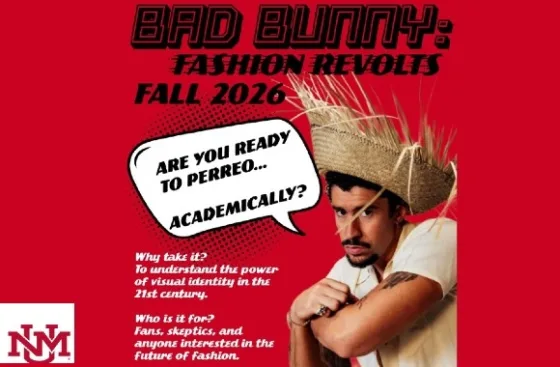
Students ‘feel seen when we treat their cultural icons with the same rigor we apply to studying phenomena in traditional disciplines,’ professor says
The University of New Mexico has introduced a new fall course about Puerto Rican singer Benito Antonio Martínez Ocasio, stage name “Bad Bunny,” that explores his fashion as “political expression” of “decoloniality” and “intersectionality.”
The “Bad Bunny: Fashion Revolutions” course, offered through the Department of American Studies, focuses on the rapper’s fashion as self-expression and commentary on the political scene, according to a university news release.
“The idea for this course grew out of my love for Bad Bunny’s style and music and the impact he is making in the current moment,” class instructor Professor Francisco Galarte told The College Fix. He is a professor of American studies and women’s and gender studies.
“Pop culture is the ‘common language’ of our time,” Galarte said in a recent email. “By using a figure like Bad Bunny, we can teach students complex concepts like neoliberalism, decoloniality, and intersectionality through a lens they already engage with daily. It transforms the classroom from a place of passive listening into a pop lab where students learn to decode the world around them.”
Galarte said his goal for the class is to take a topic that students love and turn it into a springboard to teach specific ideas and career skills.
Class projects centered around the rap star will teach students the skills of archival research, critical analysis, and creative AI usage — which are “crucial” for the current job market, the professor told The Fix.
“Students learn that a ‘good’ AI output results from rigorous historical research,” he said.
One AI project will have students create a “Digital Atelier” to “design speculative high fashion looks for the artist,” according to the news release:
While many see Bad Bunny simply as a music icon, Galarte’s curriculum treats the artist’s wardrobe as a primary text. “We are moving beyond the celebrity spectacle,” says Galarte. “We are looking at how a single outfit—whether it’s a 1940s-inspired zoot suit or a gender-fluid gown—can challenge the traditional policing of Latinx identity and the history of the Global South.”
The final project will have students pair AI with Latino history, “soundscapes,” symbolism, and artistic theory to “conceptualize an entire runway experience,” the release states.
When asked how the class has been received so far, the professor described students’ responses as “electric.”
“They feel seen when we treat their cultural icons with the same rigor we apply to studying phenomena in traditional disciplines. The ‘aha!’ moment happens when a student realizes that their final project, a printed gallery show, is actually a sophisticated defense of Latinx identity, backed by decades of fashion history and critical theory,” Galarte told The Fix.
However, a conservative higher education leader critiqued the political emphasis of the class, as well as the focus on pop culture that is happening in many universities today.
“In American Studies courses, critical theory often means being a negative critic of traditional American culture. That’s a key element of this course, and it’s not a good look,” National Association of Scholars board member Adam Kissel said in an email interview.
Kissel, a Trinity College visiting lecturer, said that “students already know more than enough ephemeral pop culture.”
He said they would glean more thoughtful content from the established “Western classics.” Kissel is the co-author of the book “Slacking,” which critiques pop culture-based courses offered at Ivy League universities.
He told The Fix that the University of New Mexico’s Bad Bunny course may have some educational value.
“The creative elements and broader themes of the course could be worthwhile, but students have better uses of their academic time and money than Bad Bunny fashion shows,” Kissel said.
The Fix has previously written about college courses based around celebrities, including some well-known classes delving into Taylor Swift.
MORE: Dante or Disney films? New book explores the good and bad of Ivy League education

