
 BUZZ
BUZZ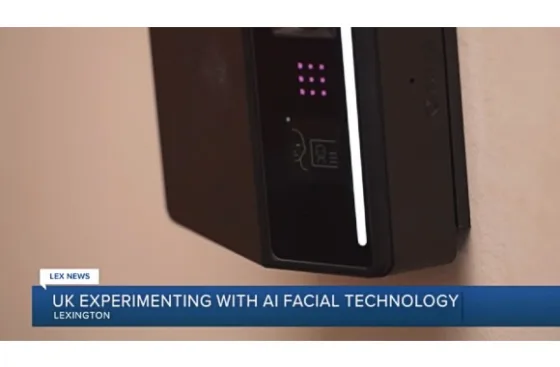
The University of Kentucky is testing a new AI face scanning technology for entry into some of its dorms and research facilities this fall.
The surveillance technology is designed to replace key cards for building access. It’s undergoing a two-week trial at the Lexington university, and participation is optional, local news outlet WKYT reports.
Named the Rock, the technology comes from the company Alcatraz AI. Its CEO Tina D’Agostin told WKYT that the system does not store photos or collect names or other personal data.
The technology works by creating a “facial biometric profile that … is nothing more than a mathematical equation. You’re zeros and ones to us once you’ve been scanned,” D’Agostin said.
University Police Chief Joe Monroe also emphasized to LEX 18 News that it’s facial scanning, not facial recognition, technology.
Regarding the name, Monroe admitted that Alcatraz “may not be the best name for the product, and we’ve pointed that out.”
The trial is part of the public university’s larger efforts to improve campus safety.
D’Agostin with the AI company told WKYT: “Many times when bad actors have entered dorms when there was an active shooter or whether it was to physically assault a female, they actually entered by tailgating, and so many campuses have sought us to provide that intelligence at the door, to empower their security teams to help detect when this incident occurs so they can react to it in real time.”
But Libertarian writer Elizabeth Nolan Brown responded with skepticism at Reason magazine recently.
“This sounds nice—but also makes no sense. An unauthorized person could just as easily follow an unwitting resident into a building after the resident scans their face as they could follow an unwitting resident who just swiped a key card,” she wrote.
Additionally, Brown questioned the security and privacy of its data storage.
“… records of those ones and zeros on their own could still be invasive, creating a permanent faceprint that could, at any point in the future, be attached to your identity and used for surveillance and tracking,” she wrote.
A University of Kentucky law professor also brought up potential risks in an interview with LEX 18:
Still, the use of facial AI raises questions about privacy, data security, and whether the technology could eventually expand beyond voluntary participation.
University of Kentucky law professor Michael Murray said the technology offers advantages but also carries risks.
“AI offers a lot of benefits, but it’s not cost-free, and it’s not risk-free,” Murray said. “That’s the bottom line.”
Murray said he believes the university is taking a cautious approach by limiting participation and keeping the program voluntary.
“It seems like they’re taking it quite seriously … to roll it out with a very low threshold of risk,” Murray said. “They are making most of the access voluntary as a convenience.”
Other surveillance technology, including the growing use of Flock cameras to monitor traffic, also has prompted concerns about privacy on college campuses across the country.
In the spring, for example, the unannounced installation of two dozen security cameras across Penn State University’s campus prompted surveillance state worries, according to the Daily Collegian student newspaper.
MORE: ‘Extraordinary intrusion’: Calif. professors demand halt to cybersecurity surveillance software

