EDITORS' CORNER
Student newspaper identifies 24 cameras on campus, but university ‘never announced’ their installation
The quiet installation of two dozen security cameras across Penn State University at some point since August is prompting surveillance state worries, according to a new investigation by the campus newspaper.
The Daily Collegian reports the public university “never announced when and where these cameras were installed,” and a new surveillance policy governing their use, which was adopted in August, isn’t listed on the University Police & Public Safety website.
Freshman Garin Roelofs is one of the students working to raise awareness about the cameras, according to the report.
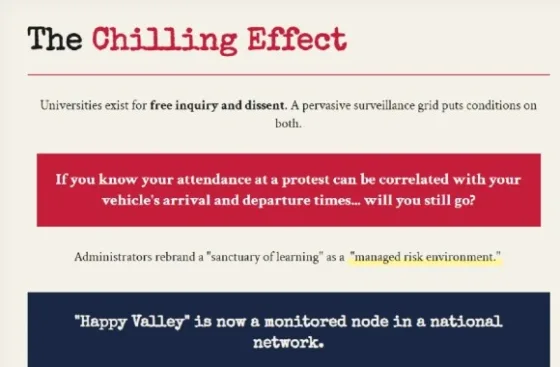
He set up a website, The Panopticon, to share information about the surveillance system and Flock Safety, the company that runs it.
“Every vehicle entering Penn State University is now subject to automated identification, pattern analysis, and indefinite data retention. This investigation details the infrastructure, capabilities, and implications of the Flock Safety deployment,” the website states.
Roelofs told The Collegian that he submitted public records requests to Penn State to find out more, but his requests were denied.
Although it’s a public university, Penn State and a few other higher education institutions received a unique carve-out in the state open records law that exempts them from providing certain records that other public institutions must provide.
The Collegian confirmed the presence of 24 surveillance cameras on campus based on data from DeFlock. The group monitors license plate readers and other surveillance systems that “collect data on millions of vehicles regardless of whether the driver is suspected of a crime.”
One of the concerns that Roelofs and other students have is that any Flock user can access Penn State’s data and vice versa, according to the student newspaper.
“More than 30 localities dropped Flock after asking one question: Who else can see our data?” Roelofs told The Collegian.
“Penn State is harder to move than a city government,” he said. “The state-related exemption blocks Pennsylvania Right-to-Know requests, so you cannot force disclosure. You have to go through the faculty senate, student government, public forums, media and the Board of Trustees.”
Meanwhile, a university official told The Collegian that the cameras are a test project:
Jacqueline Sheader, UPPS’s information officer, said the Flock cameras are part of a “limited, time-bound pilot.” …
“The pilot supports defined law‑enforcement purposes, including stolen‑vehicle recovery, missing‑person cases and investigative leads,” Sheader said. “It is limited in scope and duration, with no contract or cost during the testing period.”
Sheader did not address the Collegian’s questions regarding when the pilot started and how long it will last, as well as specifics about the aforementioned policy and our request to view it. She also didn’t respond to questions about whether the cameras will be removed after the pilot ends or if their usage will be expanded.
She said access to the system is restricted to “trained, authorized UPPS personnel” and system usage also being logged and audited.
Similar concerns have been raised on other campuses, including the University of Illinois Urbana-Champaign and Emory University.
Over the weekend, about 80 students and community members gathered on Emory’s Atlanta, Georgia campus to protest Flock security cameras and license plate readers there, The Emory Wheel reports.
Meanwhile, UI Urbana-Champaign now uses drones, gunshot detection devices, automatic license plate readers, and roughly 3,000 security cameras to watch its public campus, The College Fix reported last year.
The University of Kentucky also faced criticism back in 2013 when it decided to spend $5 million to install 2,000 security cameras across campus, The Fix reported.
One institution, Westfield State University in Massachusetts reported a drop in bias and hate crimes in 2018 after it installed 400 security cameras. However, as The Fix noted at the time, it is “unknown whether all of the allegations were legitimate bias incidents or hate crimes — or if some were hoaxes perpetrated to advance a narrative.”
MORE: University to install 400 cameras to catch campus hate crimes