FEATURED
ANALYSIS: Newspaper ads that appeared to be nonpartisan get-out-the-vote efforts actually funneled students to progressive Political Action Committees
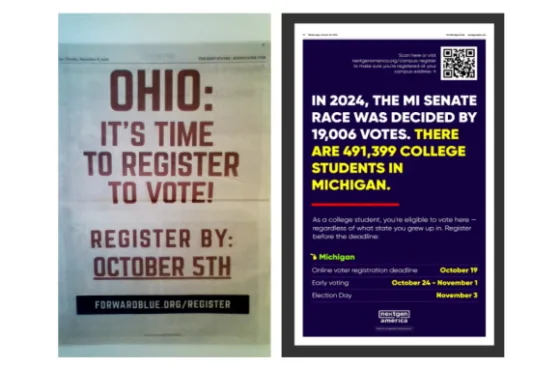
Leftwing super PACs paid for several full-page ads in college students newspapers in swing states of Ohio and Michigan ostensibly to promote get-out-the-vote efforts, but a closer look reveals it was likely a way for them to also harvest college students’ contact information in swing states.
Full-page ads were put out in at least three campus newspapers that The College Fix could identify: University of Michigan’s Michigan Daily, Ohio State University’s The Lantern, and Kent State University’s Kent Stater.
The ads in Michigan and Ohio State’s student newspapers were paid for by NextGen America, a progressive advocacy nonprofit and political action committee. The Kent State ad was purchased by Forward Blue, a leftwing political action committee focused on electing “fearless progressives.”
The NextGen America ads asked students to scan a QR code to register. As part of that process, students automatically “agree to receive occasional election reminder emails from Rock the Vote,” a leftwing political organization dedicated to “building the political power of young people.”
The portal also asks for students’ phone numbers and to agree to receive periodic text messages from Rock the Vote, which is supposed to be nonpartisan but leans left-of-center in its advocacy.
According to a photograph of the ad obtained by The College Fix, the back of The Kent Stater’s Sept. 8 issue featured a full-page advertisement for “Ohio: It’s Time To Register To Vote!” the ad reads. “Register by October 5th.” The bottom of the ad includes a link that redirects to VoteAmerica.org.
The page asks for the student’s first and last name, date of birth, home address, email, and cell phone number. It asks students to agree to accept messages from Forward Blue and election reminders from Vote America.
Forward Blue is a political action committee with a stated objective to elect Democrats and progressive candidates by mobilizing young voters, particularly Gen Z and college students.
Kent State University’s media relations team referred The Fix to the Kent Stater, noting the publication is independent. The Kent Stater’s news director did not return The Fix’s request for comment.
While the tactic is legal, the ads appear to be a sly way to harvest students’ contact information in areas considered swing states with tight elections. For example, the Senate race in Michigan was considered one of the closest and hotly contested in the nation. In that case, the Democrat Abdul El-Sayed won by a 7 percentage point margin.
Even if the students opt-out of the texts, they still must hand over their email addresses to the super PACs.
In the corporate world, a similar tactic is used. When creating accounts on company websites, user information including emails and phone numbers are often sold by companies.
Forward Blue explicitly targets young voters, boasting in their website’s “about” section to have reached over 45 million “young and first time voters” during the 2024 election.
The website also claims to have shifted young voters’ perception of Democrats by 11 points, though Republicans received a 10 point increase in young voters in 2024 compared to the 2020 election. In this most recent election, young voters leaned blue again.
A Kent State employee who asked to remain anonymous said the ad seemed wrong.
“Forward Blue paid for the advertisement, and placing these advertisements in student newspapers seems to be a part of the organization’s modus operandi across the country,” he told The College Fix.
“While most of the message is neutral, the prominent Forward Blue URL in the advertisement abandons the normal pretense of political neutrality; by mentioning Forward Blue, the advertisement shifts from a simple reminder of voter registration to an advertisement for a left-wing political organization in a public campus newspaper.”
MORE: College-aged voters key demographic in Democrats’ midterm victories