EDITORS' CORNER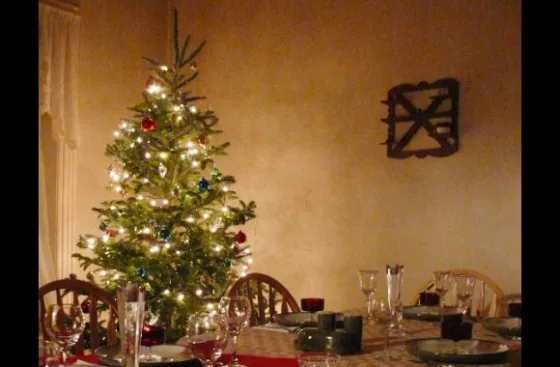
OPINION
A family’s iconic trek through the snowy woods to find the perfect evergreen. The battle at home to make the darned thing stand straight in the tree stand – and then keep it from falling over, angel and all. Untangling the lights. Cleaning up the pine needles and scrubbing the sap off your fingers.
And that magical, warm glow as everyone stands around watching the tiny lights flicker on for the first time.
Our culture has lost something special with the rise of the artificial tree and the fall of so many Christmas tree farms, Cornell University economics Professor Trent Preszler points out in his new book “Evergreen.”

Preszler’s book makes the case that evergreen trees have played a significant role in human history, including as a symbol of life at Christmas.
“I can’t for the life of me find or think of another thing in American culture that occupies that place between a sacred symbol, something that’s part of a Christmas tradition, but also is an industrial product, something that really, the American economy is based on,” he told WBNG 12 News in a recent interview.
His book is an entertaining mix of history, economics, science, and Christmas nostalgia, of course with some politics added in. That’s based on the excerpts, reviews, and author interviews I read online. (I contacted the publisher twice asking for a copy to review. No answer.)
According to Cornell’s online news site:
Preszler’s interest in evergreens started with some oddly colored Christmas trees. A few years ago, he went shopping at a Long Island tree farm and encountered specimens spray-painted outlandish, unnatural colors.
“Being both a botanist and an economist, I was fascinated by the fact that we took the most natural thing in the world – probably our most renewable resource – a tree, and it still wasn’t good enough; we had to spray paint it gold and pink and blue,” he recalls.
“And they were the bestsellers,” he said. “People were driving off with them, and I was in awe at how commercial the whole entire enterprise had become. That sparked curiosity: If I followed this story, where would it go?”
His book traces the history of the evergreen as far back as he can go, writing about the biological evolution of the trees and moving into their economic and cultural significance from ancient Rome to the American Revolution to the World Wars to today.
And, as you’d expect from a professor, he throws in some politics, too. One section focuses on “the role of logging in LGBTQ history of the 19th and early 20th centuries – something that Preszler, himself a gay man, never knew,” according to the Cornell Chronicle.
He mentions “climate change,” too. According to WBNG 12 News:
With the artificial tree industry on the rise and farmers aging out, family-owned farmers are facing several challenges. On average, Christmas tree farms only make around $25,000 a year.
Climate change poses additional challenges for the already struggling farms. Heat domes in Oregon killed millions of Christmas tree seedlings, which are irreplaceable for farmers.
The book, however, ends on an optimistic note as Preszler urges people to plant new trees.
“I close my book on a note of hope. And I really hope that hope rests within the tiny evergreen promise of a seed. And with all the environmental pressures facing evergreens and Christmas trees today, I hope people embrace tree planting,” said Preszler.
He told Scientific American, “I just think the most wholesome and pure thing we can do around Christmas is to get a real tree.”
“They give a local farmer a job. They often occupy sites that are marginal, quite rocky soil that’s not good for growing other crops that may otherwise be turned into strip malls, so they’re protecting America’s landscape. They’re natural, they’re completely biodegradable, and they return to the earth. And Christmas tree farms themselves provide a habitat for all kinds of wildlife, birds, other types of grasses and wildflowers,” he said.
I’ll add something more, an element that Preszler hints at through his family stories in the introduction to his book: The wonder and joy of those imperfect but special moments that a fresh Christmas tree creates.
Arguably, a live evergreen is unnecessary. Practically, it’s a waste of time, energy, and money. There’s the sticky sap, the pine needles, and the ornaments and tangle of lights that need to go up and down every year.
And yet. And yet, it’s somehow a reflection of the best of life.
Beauty, family, tradition, nostalgia, effort, Christ – they’re all things that academia has largely turned away from in recent decades. Yet these things are in essence what makes life worth living. And they’re things that, as I and others have noticed, college students especially are hungering for.
Preszler may not have meant to convey that exact message in his book. But, politics aside, his writings point out something significant that our culture has lost and offer a simple means of starting to get it back again: the Christmas evergreen.
MORE: Gen Z’ers ‘hungry for truth’: Record 52 students join Catholic Church at ASU