FEATURED
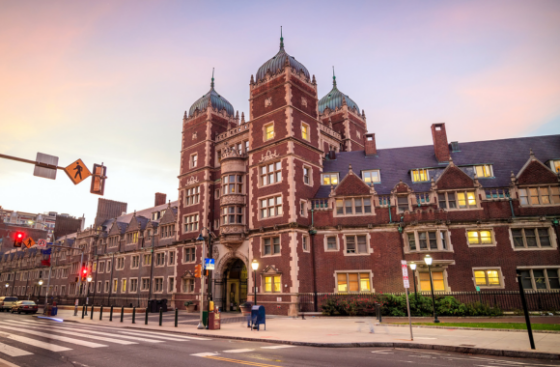
ANALYSIS: Democrat professors outnumber Republican colleagues 28 to 1 in Pennsylvania political science departments
Professors registered as Democrats outnumber colleagues registered as Republicans by a 28 to one ratio in political science departments across six Pennsylvania universities, a College Fix analysis found.
The analysis reviewed the political science departments at the University of Pennsylvania, Temple University, Carnegie Mellon University, University of Pittsburgh, West Chester University, and Penn State University.
At four of the six — University of Pennsylvania, Carnegie Mellon, Temple, and West Chester — zero registered Republican professors could be found. At Penn State, one was identified. At the University of Pittsburgh, two were found.
The Fix identified the affiliation of 101 professors after reviewing 147 professors in political science departments at some of Pennsylvania’s largest universities. The Fix based its analysis on voter registration data from the counties in which the universities are located.
The breakdown was 84 Democrats, three Republicans, and 14 third-party or unaffiliated, including one socialist. The rest, 46, could not be found in the voter rolls.
By percentages, 3 percent of identified professors are registered Republicans, and 83 percent are registered Democrats.
The analysis only includes professors, not adjuncts, lecturers, emeriti, or non-teaching staff.
The Fix cross-referenced* their names against public information, such as curriculum vitae and research papers, to match names with voter registrations. Other information, including estimated birth year, was matched against birthday data included in the election statistics.
When asked about the analysis, the University of Pennsylvania’s department chair pushed back, saying the 46 professors whose registrations weren’t found might also include Republicans or other third-party independents.
“Registered Democrats, assuming your count is accurate, outrank all others 84 to 63, that’s approximately a 4-3 ratio, though, of course, the ‘not found’ may include Democratic voters,” Professor Brendan O’Leary told The Fix via email.
“These numbers may reflect a lower willingness to register as Republicans among regular Republican voters who are political scientists, a subject worth exploring,” he said.
O’Leary also pointed out that voter registration is not always a reliable indicator of how someone votes, and that the “Republican” and “Democrat” labels are not homogenous.
“Some Democrats are socially conservative, e.g., those who are Catholics but vote Democratic. And some Republicans, loosely called MAGA-Republicans, don’t fit anyone’s sensible definition of a conservative,” he said.
When asked about concerns among conservatives about political biases in academia, O’Leary said he has been at the Ivy League school for 25 years and never saw any bias in his department’s hiring practices.
“No one has ever used the claim during hiring that x is a conservative or y is a registered Republican (or some variation thereof) as an argument, and if they had they would have been ruled out of order and would have faced possible citation for professional misconduct,” he said.
Instead, he said candidates are assessed based on their teaching skills, peer-reviewed publications, “historical and empirical knowledge,” and “statistical and modeling skills.”
“You should also consider self-selection into disciplines,” O’Leary said.
He mentioned that Penn’s economics department, which is right next door to his, tends to have more libertarian leaning scholars – although he also emphasized that he doesn’t know “the entirety of the opinions in the economics department.”
“The question might then become: do people with certain political preferences steer toward some disciplines rather than others? You’d have to control for such matters before assuming any intentional bias in hiring,” he said.
However, another former Pennsylvania professor who now serves as campus freedom fellow for the conservative American Council of Trustees and Alumni said the findings did not surprise him at all.
Still, “it is especially troubling to see such political one-sidedness in political science departments,” Steve McGuire told The Fix via email this week. McGuire used to teach at Villanova University, a Catholic institution near Philadelphia.
“One would think that political scientists of all people would be attentive to the pedagogical value of exposing students to a variety of political perspectives,” he said. “How will their students understand and be prepared to operate in the political arena without encountering all the major players and learning what and how they think? And how can they plausibly claim to be offering mere scholarly expertise when they are so obviously in the tank for one party?”
McGuire said the “political lopsidedness” that The Fix’s analysis found suggests that political scientists are part of the “polarization” problem that they so often talk about.
“If they truly cared about the study of politics and the future of the university, they would immediately begin working to broaden the range of views represented in their departments,” he told The Fix.
The Fix also contacted the other departments’ chairs about the analysis. West Chester’s chair, Professor Chris Stangl, replied that he would not have time to comment by the deadline, saying it’s the middle of his advising season. University of Pittsburgh Chair Jae-Jae Spoon declined to comment. None of the others responded.
Past analyses of professors’ party registrations and political donations have found similar results.
For example, a University of Central Florida analysis by The College Fix in 2024 found Democrats outnumber Republican professors by four to one.
Another Fix analysis in 2025 found that Democratic professors outnumber their Republican counterparts by a ratio of about four to one even in math and engineering departments, disciplines that tend to be viewed as more right leaning.
The skew does not appear to be limited to professors either.
An analysis this summer by the Buckley Institute, a conservative academic center, found Ivy League governing boards are overwhelmingly Democratic, with about seven out of ten trustees registered as Democrats and only one in ten as a Republican
Editor’s note: The analysis was aided in part by the Gigasheet analytics program for large data sets.
MORE: Just 19 Republican professors found at ASU compared to 284 Democrats