FEATURED
ANALYSIS
In his 1951 book “God and Man at Yale,” William F. Buckley, Jr. describes the hypocrisy and partisanship he found at Yale University, even as administrators and professors preached a message of political compromise and freedom of thought.
Nearly 75 years after the book’s publication, Yale University continues to display a one-sided ideological preference toward Democrats, as a new Buckley Institute report revealed that a whopping 27 departments at Yale University appear to employ zero Republican professors.
Out of the 1,335 faculty members reviewed, only 30 were identified as Republican, while 1,099 were identified as Democrats, revealing a stark imbalance in political affiliation among the Ivy League institution’s educators.
“Yale remains an ideologically monolithic campus with an intellectual orthodoxy that makes expressing even mainstream alternative viewpoints challenging,” Lauren Noble, Buckley Institute founder and executive director, told The College Fix.
“As a result, four in ten students report self-censoring, with the heaviest burden falling on Republicans (79% report self-censoring),” she said via email.
The research found that across the Yale Law School, school of management, and the 43 undergraduate departments analyzed, only 2.3 percent of all faculty identified as Republican, while 82.3 percent were Democrats, and 15.4 percent Independents.
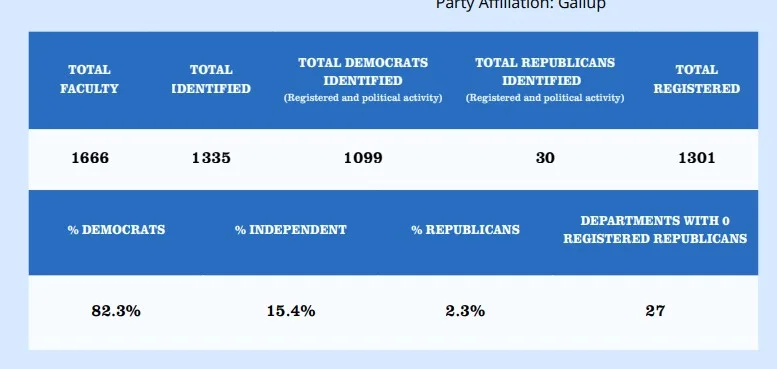
Most surprisingly, out of the 43 departments surveyed, 27 entire departments contained zero Republican professors, according to the survey:
American Studies
Anthropology
Architecture
Astronomy
Black Studies
Chemical Engineering
Chemistry
Classics
Comparative literature
Earth and Planetary Sciences
East Asian Languages and Literature
Ecology and Evolutionary Biology
Electrical and Computer Engineering
English
Environment
French
Germanic Languages and Literature
Global Affairs
History of Art
Italian Studies
Molecular Biophysics and Biochemistry
Music
Near Eastern Languages and Civilizations
Neuroscience
Psychology
Slavic Languages and Literature
Sociology
The College Fix sent multiple emails to representatives of the 27 departments as well as to the offices of their respective deans, and only received a single response from a professor who admitted he hasn’t “discussed these matters with colleagues.”
The greatest disparity was found in Yale’s humanities, where ideological leanings arguably have the greatest impact on a student’s perception of the world, according to an institute news release.
Across the 18 humanities departments, Democrats outnumber Republicans at a ratio of 72 to 1, it stated. “In total, across 409 faculty identified in the humanities, Democrats made up 88.0% of the faculty versus only 10.8% for independents and 1.2% for Republicans,” it added.
Noble told The Fix that “when students feel they can’t speak up to challenge ideas, the pursuit of truth suffers and with it the university’s fundamental purpose.”
For this reason, the Buckley Institute initiated a student survey section of the report that expanded on its findings by asking Yale students how they themselves have experienced the campus-wide political censorship.
Of the 517 undergraduates that participated in the survey, “about one third of students agree that faculty sometimes try to indoctrinate students with their personal political beliefs.”
“Republican students (79%) are more likely to say they often self-censor during classroom discussions than Democrat students (29%),” according to the results.
Noble said she believes that “Yale has taken positive steps to mitigate campus censoriousness, like adopting institutional neutrality and making civil dialogue training a part of new student orientation.”
“However,” she added, “the university has a long way to go to build a campus where civil debate is encouraged.”
Launched in 2011, the institute’s mission is to promote intellectual diversity, freedom of speech, and expose students to often-unvoiced views at Yale University through robust, open debate. It organizes various activities, including fellowships, debates, and internships.
The survey results were determined using voter party affiliation registration data and political campaign contributions, both of which are public record.
“In certain instances, social media profiles and other public information were used to identify faculty on the voter rolls in cases where multiple entries under a given name existed,” the institute stated.
MORE: Zero Republican professors found across 33 departments at seven universities: College Fix analysis