FEATURED
Individuals more likely to believe words can harm rated themselves as higher in intellectual humility, while also expressing greater support for censorship
A new psychology study suggests that Americans who believe words can cause “lasting” psychological harm are also more likely to support censorship, safe spaces, and silencing controversial viewpoints.
These individuals are also more likely to struggle with depression and believe themselves to be intellectually humble, according to the research, published in the journal Personality and Individual Differences.
The study introduces what scholars call the “Words Can Harm Scale,” a measurement tool designed to quantify how strongly individuals believe speech can cause lasting emotional damage.
The researchers surveyed nearly 1,000 U.S. adults and found that individuals who scored higher on the scale were more likely to endorse trigger warnings, support safe spaces, and believe controversial viewpoints should be suppressed. They also reported higher levels of anxiety and depression and lower resilience.
Lead researchers created the 10-item scale to better understand the role of perceived harm in ongoing debates about speech and censorship.
“A lot of societal disagreements seem to hinge on the belief that words can cause lasting harm,” co-author Sam Pratt, a psychology PhD student at UCLA, told The College Fix in an exclusive interview. “We wondered whether people’s attitudes on these issues could be predicted by a general belief that words can cause harm, so we created a scale to measure it.”
The researchers define “harm” not simply as offense or discomfort but as lasting psychological damage.
“We’re interested in the perception that words can cause lasting psychological damage — leaving people emotionally scarred, traumatized, or permanently harmed,” Pratt said.
Importantly, the study does not attempt to determine whether speech always causes such damage. Instead, it focuses on how belief in harm shapes social and political attitudes.
“America is deeply politically polarized, and a growing part of the problem is intolerance for opposing viewpoints on both sides,” he said. “To help bridge our growing divide, a first step is to understand which speech each side views as harmful, and why.”
The scale asks participants to indicate their level of agreement with various statements and record their response on a sliding scale. These include, “I could be traumatized without ever being touched, just through someone’s hurtful words,” and “A person might develop posttraumatic stress disorder or at least some of its symptoms from something they read,” or “Even a simple phrase can be emotionally traumatizing for someone vulnerable.”
Referencing the answers they received, Pratt said, “The more strongly people believed that words can harm, the more they supported efforts to censor or silence opposing viewpoints.”
The study also identified demographic patterns among participants. Researchers found that individuals who scored higher on the scale were somewhat more likely to be younger, female, non-white, and politically liberal.
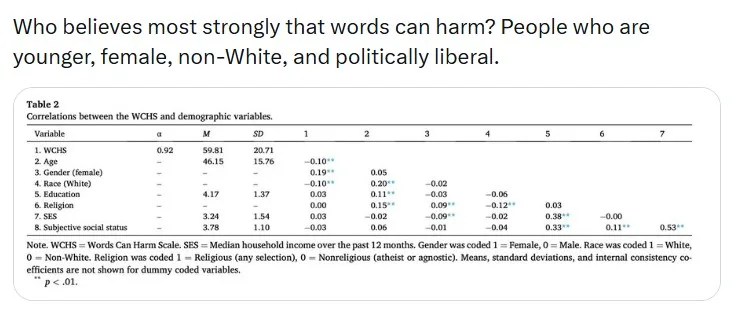
Pratt emphasized the differences were modest.
“The first thing to note is that these correlations were small,” he said. “The groups overlap considerably.”
He suggested several possible explanations, including personal experience. “It could be that groups more frequently targeted by hostile or derogatory speech — like women and racial minorities — develop this belief from firsthand experience,” he said.
One of the study’s more striking findings involves mental health.
Participants who strongly believed words can cause harm were more likely to report anxiety and depression symptoms, difficulty regulating emotions, and lower resilience.
However, researchers caution that the direction of causation remains unclear. Do people become more emotionally vulnerable after adopting beliefs that speech is harmful, or do already vulnerable individuals gravitate toward those beliefs?
Jesse Merriam, a senior research fellow at the Claremont Institute and a constitutional law professor at Patrick Henry College, told The Fix that broader cultural forces may help explain why some groups are more likely to view speech as harmful.
He pointed to structural incentives that emerged following the Civil Rights era.
“The Civil Rights Revolution produced a legal and cultural framework in which the claim of harm is itself a source of power,” Merriam said. “Groups trained by that framework to understand their identity in terms of protected status have an institutional incentive to treat speech as harmful.”
He cautioned against assuming the findings reflect purely psychological differences between individuals.
“The most compelling explanation, in my view, is structural,” Merriam said.
Another finding from the study is that individuals who scored higher on the Words Can Harm Scale also rated themselves as higher in intellectual humility, even while expressing greater support for silencing opposing viewpoints. Intellectual humility is “the degree to which people recognize that their beliefs might be wrong,” according to the “Leary Intellectual Humility Scale.”
Merriam said this tension may reveal something deeper about contemporary academic culture. “Rating oneself highly in intellectual humility [or intellectual uncertainty] is not itself a sign of intellectual humility,” he said. “That paradox may be the most revealing feature of the study.”
The findings also raise questions about how colleges handle controversial ideas and free speech. Merriam said that while private colleges have the legal authority to impose speech policies, doing so may undermine education.
“A central purpose of education is to engage ideas one has not yet considered, and arguments one cannot yet answer,” Merriam said. “A campus that insulates students from discomfort is failing in a very basic way.”
Merriam warned that shielding students from difficult ideas could carry long-term consequences.
“The long-term cost [of free speech restrictions] is serious: the formation of an intellectual class that has never had its convictions seriously challenged,” he told The Fix.
MORE: Gonzaga U. professor upset 12K run billboard uses phrase ‘our race’