
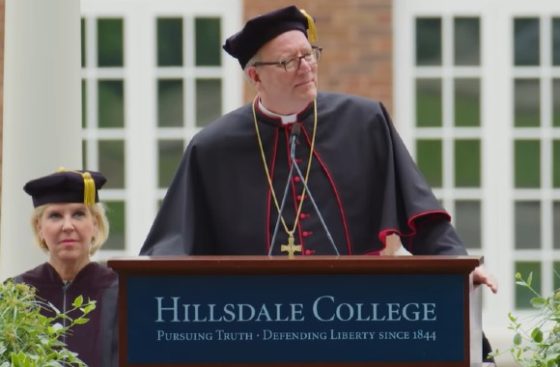
Universities are in “crisis” because they focus on the wrong goals, according to Bishop Robert Barron.
“More and more, the university treats education not as an intrinsic good but as a mere instrument—a means to economic security, social prestige, and self-invention,” the scholar and Catholic Minnesota bishop wrote in the latest issue of First Things. “The university is reimagined as a service provider, the student as a consumer.”
Ideally, a university should be ordered to truth, the bishop writes:
When education is subordinated to self-invention rather than ordered to the pursuit of truth, the notion that students ought to submit their minds to an inherited body of knowledge and pedagogical tradition becomes untenable. Traditional curricula, disciplinary standards, and intellectual authorities are increasingly viewed with suspicion as remnants of a repressive past or impediments to personal freedom. In many institutions, this suspicion is not merely tolerated but fostered.
Early universities were more tightly focused than today, Barron says.
“Universitas was not meant to represent a loose aggregation of specialized disciplines, mutually suspicious but unified by a shared campus and administrative bureaucracy,” he wrote. “It first stood for a community of research ordered to the whole of reality—not merely the practical arts and sciences but also the liberal ones, those free from utilitarian constraint.”
The root of the modern university’s crisis goes back to four main thinkers, according to Barron.
The “architects” of the “pessimistic anthropology” undergirding today’s university are Karl Marx, Friedrich Nietzsche, Jean-Paul Sartre, and Michel Foucault.
“Each articulates a distinctive form of suspicion or nihilism that continues to shape the academy today,” Barron says. He then goes through the ideology of each thinker and how it affects how colleges approach education.
There is a better way, though.
Here Barron draws on the work of German philosopher Josef Pieper, who had a much more pleasant view of human nature — “one capable of wonder, receptive to meaning, and open to the whole of reality.”
It is this “contemplation” that can save universities.
Barron writes:
Curricula must invite students into sustained engagement with the fundamental questions of truth, goodness, beauty, and the meaning of human life. Spaces of true leisure must be protected from the tyranny of utility. Pedagogy must reward attentiveness as much as achievement, listening as much as assertion. Theology and metaphysics must be restored to their rightful place within the whole of learning, for without them the university loses confidence in the intelligibility of its own vocation.
“Humane education,” the bishop says, “assures students that their desire to understand is both real and just, and that to take this desire seriously is not naivete but the beginning of wisdom.”

