
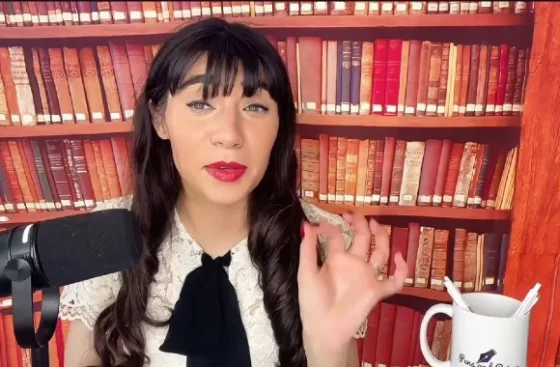
Liza Libes began her studies at Columbia University as a liberal. She supported Hillary Clinton in 2016 as a first-time voter and debated her grandmother, a former professor, about Donald Trump.
In a piece Monday on her “Pens and Poison” substack, Libes described how her views began to change in the wake of that election. A social media influencer, writer and creator, Libes’ work focuses primarily on the politicization of classic literature and calls for the restoration of valuing literature as an art.
Eventually, when she graduated from the Ivy League school, Libes said she realized that she “was left not with the open-minded experience” that the university had promised her.
“If Columbia taught me one thing, it’s that the intellectual (anti-intellectual?) left does not stand for freedom of expression but is concerned solely with shutting down dissenting viewpoints,” she wrote:
At 19, in fact, I’d often get into arguments with my grandmother, a retired Soviet chemistry professor, who insisted that a vote for Donald Trump would lead our country in the right direction.
I remember feeling bewildered that my biggest role model, a woman who had lived through and escaped the oppressive regime of the Soviet Union—where neighbors snitched on one another to the KGB and the press kowtowed to the whims of Joseph Stalin—would support a candidate whom John Oliver and Trevor Noah told me would erect an American Third Reich.
We were Jewish, after all.
… on Wednesday, November 9th, 2016, walking into an exam for my Abnormal Psychology lecture at Barnard, Columbia’s all-girls sister school, I was surprised to find that the morning’s most abnormal behavior patterns were not nestled in the exam questions but plastered on the faces of my classmates, many of whom burst into the classroom bawling, insisting that they were unable to sit for the exam because of the election results.
The professor acquiesced and moved the exam to the following week.
I was rightfully taken aback. What were these girls even crying over? No one had died. Barack Obama would still be president for the next several months. We would have a dullard for a president for the next four years, sure, but did these girls really think that they—members of the privileged elite whose parents were paying $80,000 per year for them to attend one of the best universities in the world—would be personally affected by the reign of Donald Trump?
What was more astonishing was that my classmates—girls who supposedly represented the apex of female empowerment—did not at all embody the feminist strength that my grandmother once taught me. Incapable of sitting through a 45-minute exam because they had read on their phones that the world was ending, my classmates weren’t strong or independent—they were weak.
That was just the first of several experiences that led her to began questioning her progressive views.
Read her full column at “Pens and Poison.”

