OPINION/ANALYSIS
Jared Gould | Minding the Campus
‘Sport is unusually good at bringing together students who otherwise would never even meet’
I’m not one to track college sports, but pickleball’s rally across campuses has caught my attention.
Pickleball is now the fastest-growing sport in America, and young people are driving it. The Sports & Fitness Industry Association reports that more than a million players under 18 joined between 2022 and 2023, while the largest age group—about 2.3 million players—is 25 to 34. And the trend is really taking over college and university campuses. “Just two years ago,” a communications firm told me, “fewer than 20 colleges had organized teams—today, more than 300 schools have pickleball clubs nationwide, including Harvard, where students launched the Ivy League’s first sanctioned club in 2023.” A quick Google search also showed that Drury University became the first to make pickleball an official varsity program—though the sport still isn’t NCAA-sanctioned and remains largely club- and intramural-based.
One reason pickleball is taking off is that it is remarkably easy to pick up, roughly on par with getting an A at Harvard.
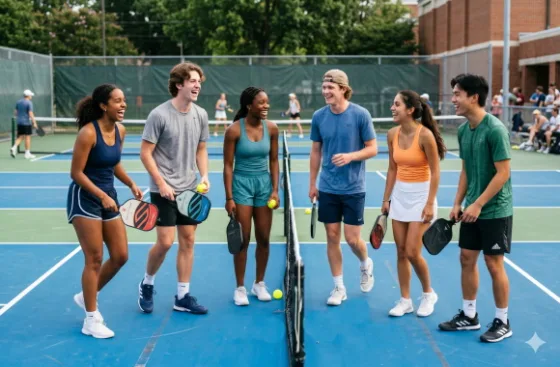
But in a campus environment saturated with technology, driving a loneliness crisis and the dystopian phenomenon of students treating AI chatbots as romantic partners, the rise of pickleball is something to be moderately happy about. It pushes back against the screen-dominated college experience by forcing students to interact with other students. As one professor from SUNY Brockport put it, these kids are “moving their asses.” High praise, and entirely warranted.
Elle Freedman, one of the founders of the Harvard Pickleball Club and now Brand Partnerships Coordinator at CityPickle, told me the sport is unusually good at bringing together students who otherwise would never even meet. In her case, she formed friendships with a pre-med student from across campus, a varsity football linebacker, and a 28-year-old Navy veteran—people she is still friends with today. The appeal, she alludes, is not so much in the game itself as in what forms around it: durable, unlikely friendships. Robert Putnam might even approve.
That is good news against the steady stream of bad news in higher education. Any development that pulls students away from their phones is welcome. But let’s not get carried away.
The professor at SUNY Brockport, for instance, estimates that only about 20 percent of students at any given campus participate in organized athletics at all. That estimate is broadly in line with the available data, with some variation. At smaller liberal arts colleges—and at many mid-sized schools—participation can land somewhere in that 20 percent range, though it drops off at larger universities. So, pickleball may be growing quickly, but it is likely drawing from students already inclined to be active—which is to say, most students are probably not “moving their asses.”
Universities, meanwhile, are pouring lots of money into new facilities—a single court can run anywhere from $20,000 to $50,000. Texas A&M has built 10. The University of Alabama is investing roughly $1.6 million in new courts. In fact, schools from Maryland to California are converting existing spaces and/or building new courts to meet demands.
It would take a deeper investigation to untangle how these courts are being paid for—whether from taxpayer subsidies or student fees—but however you slice it, colleges and universities are dumping hundreds of thousands to millions of dollars into pickleball facilities. If these investments help foster the kind of social formation Freedman describes, there is a case for them. Colleges are not, after all, just about lectures. But the SUNY professor warned that trends move quickly. A multimillion-dollar pickleball complex may look great today. But Gen Z could wake up tomorrow, think of the game as “mid,” and suddenly, campuses are left with a bunch of empty courts. So, taxpayers should be mindful.
It is also worth noting that pickleball’s rise has coincided with more demanding sports struggling to maintain participation. American college tennis players, for instance, are all but disappearing. In 2005, roughly seven in 10 incoming Division I tennis freshmen were American-born; today that number sits below four in 10. What this says about students’ appetite for difficulty, I will leave to others to sort out, but this is hard to ignore.
Still, on balance, this is a positive development. Pickleball is getting students outside, moving, and interacting with people they would not otherwise have met. It does not solve the isolation crisis, of course, and the students playing it were likely already inclined toward physical activity. But it’s not nothing, and there’s probably some outliers. And if students are choosing the game because it is easy, so be it. Outside of certain grading curves, this may be the last low-barrier entry point they encounter for a while. The rest of life will not be so forgiving.
This column was originally published on April 23, 2026 at Minding the Campus and is reprinted with permission.