FEATURED
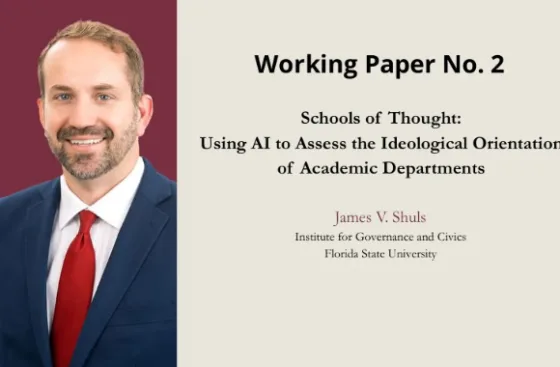
Civics expert uses artificial intelligence to analyze liberal tilt based on academic research
Florida college students have a better chance of being exposed to conservative viewpoints through classes at civics centers rather than longstanding academic departments, according to an innovate study of the Sunshine State’s professors.
The study, conducted by Florida State University’s Institute for Governance and Civics, used artificial intelligence to “assess the ideological orientation of academic departments.”
The working paper from Professor James Shuls, a scholar at the center, analyzes the published research of 823 tenure-track faculty in 50 academic departments at Florida’s five largest public universities. Shuls compared them with 92 faculty at five civic centers: the University of Florida’s Hamilton School and centers at the University of Texas at Austin, Ohio State University, Arizona State University, and the University of North Carolina at Chapel Hill.
Instead of surveys or political donations, Shuls focused on each scholar’s academic record. He found that the research in traditional departments leaned left and the research at civic centers leaned right, at similar rates.
He also used AI programs and asked them how, based on the research by the professors, they would advise potential graduate students, one liberal and one conservative, about applying.
When AI programs advised hypothetical students, 62 percent of the advice to conservative students considering the traditional departments was negative, as was 60 percent of the advice to liberal students considering the civic centers.
The study used three human coders to review the advice output and categorize the advice through four standard classifications: Do Not Apply, Discouragement, Advice, Encouragement.
Shuls explained to The Fix why his paper looked at research and not political donations.
“Most analyses of faculty political orientation rely [on] assessing observed political behaviors, such as party registration or giving to political campaigns,” he wrote. “The key limitation to this approach is that most people do not give to political campaigns and many are not registered as a party voter.”
Shuls’ method broadens who can be studied, since not everyone donates but “every scholar has an academic record.”
Shuls told The College Fix the results need some nuance. The AI programs discouraged students on both sides based on what the faculty had published.
“If you are conservative, you are not likely to be at home in a department where the core focus of faculty scholarship is equity, decoloniality, and progressive power structures,” he said.
Shuls continued:
<BLOCK>On the other hand, if you are a democratic socialist and believe we need to tear down the patriarchal structures embedded in the American founding, you may not feel welcome in a civic center where faculty scholarship is focused on engagement with western and classical traditions and the work favors traditional moral virtues.” <BLOCK>
In one case, Grok told conservative students to apply to a department only if they were “prepared to keep your political and philosophical views private for several years.” For liberal students, Grok called the same department “one of the most ideologically welcoming and reinforcing environments in the country for progressive, social-justice oriented students.”
Still, the paper cannot prove that faculty discriminate against students, Shuls noted. Instead, a department’s scholarship alone may discourage some students from applying.
“Faculty scholarship gives a sense of what is prioritized in an academic unit,” the scholar told The Fix. “By digging into and understanding the scholarship, you can better understand the ethos of a department or, as I say in the paper, the department’s core dogma.”
He also noted that students would be able to run that kind of analysis themselves: “As AI systems grow more ubiquitous, it will be incredibly easy for prospective students to simply ask, ‘Based on their research, does this department align with my values?’”
Civics centers have grown in the past several years as a counterweight to what conservatives see as an ideological echo chamber at many universities. At the same time, groups like the AAUP have pushed back against the centers, arguing they themselves favor conservative views.
One essay, “Proselytizing Speech: Florida’s Publicly Funded Conservative Centers,” published in the AAUP’s Journal of Academic Freedom, says Florida centers are part of a broader effort on the political right to remake public higher education. Public records obtained by John Sailer also discovered an AAUP leader discussing his plan to try to “knock those f****rs out,” with reference to the centers.
Shuls cites the essay in his paper.
The College Fix emailed five AAUP leaders, including Secretary-Treasurer Danielle Aubert, twice in the past month and also called the organization’s main line. The Fix asked for their assessment of the paper’s findings and its comparison of traditional departments with civic centers, but none responded.
MORE: Conservative professor leaves UC Berkeley, knocks lack of political ‘diversity’