
 FEATURED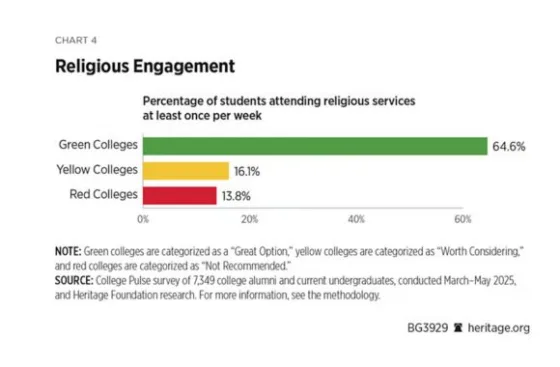
Key Takeaways
- A Heritage Foundation survey reveals that U.S. colleges promoting virtue, tolerance, and religious freedom yield graduates with better personal well-being than those from lesser-rated institutions.
- The survey evaluated 987 colleges, rating them green, yellow, or red based on their commitment to virtues that contribute to a healthy society.
- Colleges like Liberty University and the U.S. Naval Academy, which received a green rating, prioritize academic excellence and free expression, while red-rated schools like Harvard tend to suppress diverse viewpoints and are influenced by ideological theories.
- The report advocates that college ratings should focus on character-building outcomes rather than solely academic metrics.
U.S. colleges that excel in promoting virtue, tolerance, and religious freedom produce graduates with greater personal well-being than their peers, a new Heritage Foundation survey found.
“The Heritage Foundation education-policy team wanted to know if graduates of the schools they rated in Heritage’s ‘Choosing College with Confidence’ guide are prepared to demonstrate the virtues on which a healthy society depends,” a summary of the report states.
The conservative think tank found that “Current and former students of the guide’s best-rated colleges had the best outcomes for family, faith, community, morals, political tolerance, and well-being.”
This survey was conducted in conjunction with criteria provided and supervised by College Pulse, an organization focused on methodical surveys and data-driven research.
The group administered the survey to 7,000 current and former students at 987 institutions. Each school recieved a green, yellow, or red rating, according to the report.
“The results, collected independently from the process of rating the colleges, confirm that colleges rated green (‘great option’) have significantly better outcomes than those rated yellow (‘worth considering’) or red (‘not recommended’),” the report states.
The Heritage report argues that college rating systems should measure outcomes consistent with education’s broader mission of shaping character, rather than just inputs like test scores or economic measures such as earnings.
Heritage Senior Research Fellow Jay Greene, who co-authored the survey, told The Fix that the group defined virtue as “a set of traditional American values that have long been advocated by Heritage.”
These values include marriage, family life, religious involvement, and support for free expression.
Greene said that most survey participants were “looking for schools that align with their values,” help them find “positive environments,” and support them in pursuing “their vision of a good adult life.”
When asked about any surprising findings, Greene told The Fix that he was surprised by how much the green-rated schools were outperforming those with a red or yellow rating. He said that he hopes this encourages schools to “promote virtue as part of the education they offer.”
Addressing lower-rated universities, Greene told The Fix, “they should facilitate a culture of free speech and mutual tolerance” instead of trying to “systematically disparage religion or traditional paths in life, like marriage and children.”
Schools that were given a green rating, such as Liberty University, Ave Maria University, and the United States Naval Academy, were found to prioritize “academic excellence, free expression, and ideological balance.”
Red schools, such as the University of Central Florida, Vanderbilt, and Harvard, were found to suppress diverse views and beliefs. They are also very heavily influenced by ideological theories, such as “diversity, equity, and inclusion.”
Yellow schools, such as Notre Dame, UCLA, and Duke, were found to be “distinguished by their robust programs and centers,” but they may have had an imbalance of liberal-conservative clubs, a minimal presence of DEI, or simply had a bad return on investment based on the cost of attendance.
Emily Davis, associate vice president of media and public relations at Hillsdale College, told The Fix the college’s green marker reflects “the students, the education we offer, and the independence that makes it possible.”
Davis also told The Fix that Hillsdale strives to create students “who can think seriously and debate fairly.” She said that the school also seeks an environment of students who are “respectful of the rights of others.”
Recent surveys show that Hillsdale ranks first in the nation in promoting diversity of thought and student comfort when interacting with differing viewpoints. Davis told The Fix that this is “evidence that our approach is working.”
The College Fix reached out to various schools with a red marker, but did not receive a response. College Pulse declined to comment and referred The Fix back to The Heritage Foundation.
MORE: More college students favor socialism than capitalism, new poll finds

