BUZZ
Good to know: One panelist says U.S. currently ‘not as extreme as [Nazi-] occupied France’
Earlier this month, the Columbia University School of International and Public Affairs hosted the conference “Backlash: The Institute for Propaganda Analysis and the Attacks on Disinformation Researchers.”
According to the Columbia Spectator, the event featured a discussion on the Institute for Propaganda Analysis, a Columbia “research group” founded in 1937 “which aimed to educate the general public on propaganda.”
The institute closed just five years later.
Rutgers University’s David Greenberg noted that as the institute tried to remain “apolitical,” it received “scrutiny from both the right and left.” Its founder, Clyde Miller, was “dismissed” as the U.S. was on the cusp of entering World War II.
Greenberg added the institute “struggled to reconcile its claim to political neutrality with its focus on combating fascist and right-wing propaganda,” ultimately becoming a “victim” of its “own internal contradictions.”
(In 2017, Greenberg claimed Republicans’ turn to “right-wing populism on cultural issues” is what has made the country so politically polarized.)
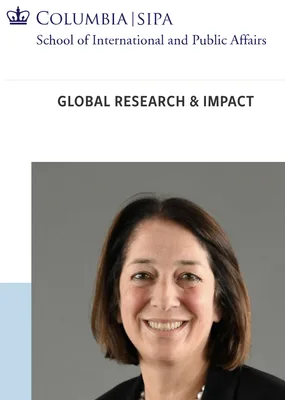
The SIPA’s Anya Schiffrin (pictured), who in 2023 regarding a Florida shooting pointed the finger at an “increase in polarization, the availability of guns and the virality of white supremacy” as a “hallmark of [U.S.] political culture, “tied the institute’s mission “to today’s landscape.”
“I think it’s a sad story about Columbia University that will really resonate profoundly with those of us who worry about academic freedom and the silencing of dissent,” Schiffrin said, echoing her remarks from last year regarding Columbia’s antisemitism-related settlement with the Trump administration.
“I’ve been here for more than 20 years, and there’s an atmosphere of censorship, self-censorship, and a chilling, which has to be taken seriously […] It’s very important to actually listen to the faculty and not dismiss their concerns. If somebody speaks up, it means that they’re really worried. People don’t like to speak up, so somebody that’s speaking up should be listened to.”
After a brief review of the Trump’s threatened funding and budget cuts to Columbia and the National Science Foundation, the Spectator quotes University of Cambridge doctoral candidate Mutale Nkonde as saying “When we get attacked, we are not scared. We are activated.”
In 2021, Nkonde and her co-authors had a paper retracted by the Harvard Kennedy School’s Misinformation Review for “flaws in the methodology” and “discrepancies between the data and the findings” which resulted “in unsubstantiated conclusions drawn from their analyses.”
Nkonde claimed the retraction wasn’t “valid” and was due to a “harassment campaign.”
While discussing WWII Vichy “French intellectuals” who deluded themselves by believing “they were protecting their institutions,” former Associate Director of the Institute of War and Peace Studies Jean-Marie Guéhenno said that while the U.S. today “is not as extreme as [Nazi-] occupied France […] the one capital sin for a university is to abandon the pursuit of truth.”
Ironically, France doesn’t have the same freedom of speech protections as the U.S., guaranteed by our First Amendment. “Hate speech” is criminalized in the former, as is the “glorification” of terrorism, and even Holocaust denial.
French President Emmanuel Macron has ripped the First Amendment on several occasions this year.
In February he said “Free speech is pure bullshit if nobody knows how you are guided through this so-called free speech—especially when it guides you from one hateful speech to another […] I want public order. I want to avoid racist speech, hateful speech.”
In September, he declared “The so-called American ‘free speech’ today, which some people have promoted, is the opposite of free speech.”
MORE: Columbia’s satire student paper apologizes for land acknowledgment joke