FEATURED
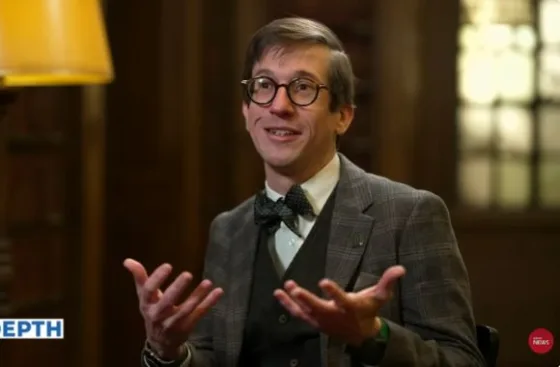
‘Who can hang a man in the wild, wild west, which is an accurate description of AI in higher ed right now?’ scholar says
Santiago Schnell recently resigned from his position as Dartmouth College provost after an independent, faculty-led committee found that he failed to disclose his use of artificial intelligence to alter his writing in a national newspaper and academic journals, allegedly violating school policy.
However, a University of Chicago professor is raising serious concerns about the investigation.
“This Advisory Committee finds that the Provost used AI to meaningfully alter his writing in violation of at least one publication’s AI use and/or disclosure requirement, failed to disclose his use of AI in clear violation of a national newspaper’s stated policy, was not forthcoming about his AI use, and fell short of the standards set forth by Dartmouth’s Code of Ethical Conduct,” the faculty advisory committee report stated in part.
The committee reviewed multiple papers he wrote, including publications in the ChemSystemsChem journal, Washington Post and the Journal of Catholic Higher Education.
In all three, Schnell was found to have violated their AI use policies in some capacity, according to The Dartmouth.
The committee further found that Schnell’s actions were inconsistent with the College’s Academic Honor Principle.
“As Dartmouth’s chief academic officer, the provost should not only uphold this principle but model its application in his own academic and professional work,” the report stated.
However, University of Chicago Professor Dorian Abbot told The College Fix that Dartmouth didn’t already have an AI policy in place, raising suspicions about the report.
“If a University is going to punish someone for using AI, it should only be based on an already in-place policy that clearly states exactly what is allowed, what isn’t, and what procedures will be followed if someone is accused of a violation,” he said.
Abbot also told The College Fix that Schnell is not the only faculty member to use the new technology in his work.
“Almost all science faculty and their research groups use AI. The rules about exactly what is allowed are confusing, rapidly evolving, and differ widely across journals,” he said.
“The result is that many faculty trying to do everything right will mess something up slightly,” Abbot told The Fix.
Asked what standards universities should adopt moving forward, Abbot said all authors should take full responsibility for their work, know what it contains, and be able to defend it.
“It may make sense to require disclosure of AI assistance, but that has to be balanced against all the other tools we use and do not typically acknowledge in scientific journal articles, such as operating systems, software packages, search engines, spell-check, autocorrect, etc.,” he said.
Abbot raised several other concerns about Dartmouth’s investigation in a Nov. 15 Substack post for Heterodox STEM, including the fact that there is no standard for how such a case should be handled at the college.
He also noted the report says that the committee did not use AI while conducting their investigation. This cannot be true because the investigation started with running Schnell’s work through Pangram, which is an artificial intelligence tool, Abbot wrote.
Further, he wrote believes that Schnell may have had a target on his back because he was a proponent of university reform.
Finally, he wrote the violations outlined in the report could be easily corrected by adding an AI acknowledgement to the article.
Abbot also wrote that moving forward, he has adjusted the way he interacts with AI policies. He makes sure to read policies and include acknowledgement statements where necessary, encouraging his students to do the same.
“They shouldn’t be embarrassed about using AI to do better science, but we need to say clearly how we used it,” Abbot wrote.
Other scholars have expressed initial support for Schnell, who has pushed for a more classical education style at American universities, although they may disapprove of his AI usage, according to the National Catholic Register.
Like Abbot, some have questioned if Schnell has been treated fairly in the process. They have raised concerns about the sudden demand for proper AI use, when the wider landscape of higher education leaves the issue ambiguous.
“Obviously, I am against AI writing. And yet I feel whiplash here,” Jennifer Frey, a Catholic philosopher at the University of Virginia, wrote in a post on X.
“Who can hang a man in the wild, wild west, which is an accurate description of AI in higher ed right now? Especially at Dartmouth, which has so strongly encouraged [AI] use in the name of ‘not being left behind’!”
Reached for comment, Professor Schnell referred The College Fix to his lawyers, who did not respond to emails.
However, Schnell previously told The Dartmouth that he uses AI for “language refinement, copyediting, improving clarity and organization and making writing processes more efficient,” but “review[s] the final text and take[s] responsibility for its content.”
“I develop ideas and arguments, conduct the research, evaluate the evidence and sources, determine the structure, prepare drafts and decide what appears in the final text,” Schnell wrote.
Dartmouth did not respond to multiple requests for comment on how the investigation was conducted.
Schnell is a mathematical biologist whose work intertwines the study of multiple sciences. He is best known for developing the Schnell-Mendoza equation, a method for estimating enzyme kinetic parameters.
Additionally, Schnell, a Venezuelan native, is recognized for creating more advanced mathematical models of the polymerase chain reaction, which is a fundamental of molecular biology.
Before assuming the role of provost at Dartmouth, Schnell was the William K. Warren Foundation Dean of the College of Science at the University of Notre Dame and held faculty positions at the University of Michigan and Indiana University.
In addition to being provost, Schnell was a professor of mathematics, with adjunct appointments in biochemistry and cell biology and biomedical data science at the Geisel School of Medicine.
MORE: Dartmouth provost under fire for ‘using AI for everything’