EDITORS' CORNER
OPINION: The terminology of critical theory and oppression studies is forever malleable depending on how convenient it is for the Left
I never liked fraternities. I never much liked the guys who joined fraternities. And I never thought much of girls who frequented the parties thrown by fraternities.
Instances back in the day, like the current situation involving a Cornell fraternity, helped shape this view, because I saw and heard about stuff I thought were only in films like “Animal House.”
Thankfully my daughter, who graduated from my alma mater, felt the same way. She had the common sense to know who and which parties to avoid on the weekend. Drinking lots of alcohol doesn’t excuse rape, but it clouds judgement and makes it harder to avoid situations that can go south quickly. But of course, we’re not supposed to bring up on-campus drinking culture.
I’m speaking anecdotally, of course. This was at a school where most of the frats (which weren’t all that big a thing on campus as a whole) had notorious reputations for one reason or another. But certainly then, as now, there are fraternities that do good things and have decent men who join their brotherhoods.
Nevertheless, as usual the Cornell case has the Left falling all over itself again with arrogant self-righteousness, and in the process it can’t stop blatantly contradicting itself when it comes to mores, standards, and most importantly the law.
Regarding that last item (and add in the media), as my colleague Matt Lamb opined earlier this week, those in the vast progressive campus network never seem concerned about American jurisprudence, specifically the presumption of innocence, until it is used against them.
The problem is that the solution the left is moving towards is simply a two-tiered system of sexual liberation for women and responsibility only for men.
— Inez Stepman ⚪️🔴⚪️ (@InezFeltscher) October 7, 2026
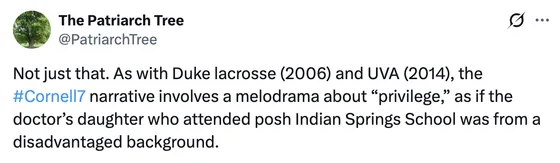
How quickly this network and the media have forgotten the Duke lacrosse case, the ersatz-but-made-famous-by-Rolling Stone University of Virginia rape case, and former Columbia University student Emma Sulkowicz‘s antics.
The more I read of the Cornell 7 case documents the angrier I get. While even the expectation of “consent check-ins” is insane in the context of a drug-fueled orgy, this woman is accusing of rape: – guys who themselves passed out and were more intoxicated than she was by her own admission (where’s their rape case?) – guys who every time she expressed any kind of even mild wish to the contrary, stopped sexual activity and even sat her down to recover from voluntary drug-induced dizziness to make sure she was ok – guys she explicitly and in writing told a day or two later that the sexual contact was “legal” – three guys who had NO SEXUAL CONTACT with her whatsoever, who only walked in briefly, backed out, and went for a Big Mac – another guy whose only sexual contact with her was a kiss This is bonkers.
— Inez Stepman ⚪️🔴⚪️ (@InezFeltscher) October 6, 2026
Our American college student newspapers did not disappoint us in this regard either this past week. Here’s a small sampling:
Texas A&M student Sidney Uy claims in her student paper that Cornell’s investigation into “Jane Doe’s” accusations “was hardly a real one at all,” and that the university “likely knew exactly what they had on their hands and how this would look: horrifying.”
The University of Cincinnati’s Ronna Erenstoft in The News Record says the case “highlights the prevalence of rape in college settings and how perpetrators can shirk the consequences of their heinous crimes when administrators do not respond appropriately.”
Oddly enough, the headline of Erenstoft’s op-ed reads “The Cornell defendants need to be held accountable,” yet the closing paragraph begins with “If found liable, the Cornell defendants should be held accountable for their actions” (emphasis added).
MORE: Cornell activists trash admin. building in solidarity with alleged rape victim
Olivia Declercq of U. Alabama’s student paper The Crimson White says the Cornell case is “emblematic of a country that always protects men”:
From the Epstein files to UA’s most recently reported sexual assault case just last month, the narrative in the United States is clear: women will continue to be targets of abuse from men.
The Yale Daily News’ Maddy Corson uses the cliché title “We are all Jane Doe” for her op-ed in which she writes “I keep hearing the now-cliche phrase, ‘not all men.’ It’s a rhetorical crutch that shields the complicit from accountability.”
We’re supposed to believe her because she claims she once had reported an “assault,” and then allegedly was treated poorly by a Yale administrator.
Columbia College Student Council President Arvin Kim says the Cornell case “speaks to a broader culture and policy failure to prevent sexual violence and hold offenders accountable, and that touches college campuses everywhere, including ours.”
Council VP Lindsay Lee adds it is “a societal, cultural issue.”
A University of Pennsylvania student paper editorial titled “Penn has a Cornell problem, too” hilariously (unintentionally, I’m sure) complains that “alternative resolution methods” such as restorative justice — hugely pushed by progressives, mind you — do not allow for “justice” and “accountability.”
Those last two in particular demonstrate the wonderful contradictions of the Left. These originate from critical theory (which literally can be manipulated into meaning whatever wants) and what I deem “oppression studies.”
Restorative justice? Perfectly fine for public school discipline where the hallways and classrooms are chaos, but not punitive enough for a frat bro who had a drunken hookup and may have touched where he shouldn’t.
It’s “hate” speech when someone speaks out against men playing in women’s sports (creating an “unsafe” environment for “marginalized” individuals), but when pro-Hamas activists rampage through campus breaking into offices and buildings and harassing Jewish students, such is “exercising First Amendment rights.”
If campus rape bureaucrats really believe that the sordid campus bacchanal is a rape epidemic, why don’t they share with females the simple steps for 100% avoiding being “victimized?” Either because those bureaucrats know that drunken hook-up sex is not rape or because they are more interested in maintaining the ideology of female victimhood than in protecting what they claim are actual victims. I called out the campus rape hoax in @CityJournal years ago: https://t.co/AJNchaoOMr Full interview on @realDailyWire’s Wired In Live is here: https://t.co/aE6ubkKwe1
— Heather Mac Donald (@HMDatMI) October 8, 2026
And there’s the conundrum of leftists telling us there’s no difference between trans-females (men) and biological females (they can’t even define “woman,” for Heaven’s sake), so much so that not only is competing against each other in sports perfectly fine, so too is using the same locker rooms and bathrooms. Yet a legally adult biological female is an completely inept bungler at frat party.
Which is sort of addressed by this:

Ultimately, by all accounts the seven Cornell defendants, some of whom were only barely involved, all received some form of punishment. The entire fraternity has been banned from campus. Two students were expelled and two were suspended for two years, according to records obtained by the NY Times.
Another, a student who had graduated, got a three-year ban from Cornell for the “crime” of kissing “Jane Doe” without her consent.
But as feminist scholar Camille Paglia once noted, if “a goal of feminism is to have the same freedoms as men,” then with that freedom “comes consequences, and owning those consequences if one makes bad choices […] college women should not be surprised that if they go out and get drunk that bad things can happen.”
MORE: ‘Deeply disturbing’: Cornell president breaks silence on frat assault allegations