
 EDITORS' CORNER
OPINION: Latest ‘Battle of the Sexes’ tennis match allegedly not worth it as both players recognize male athlete superiority
It seems there was a new “Battle of the Sexes” tennis match a few days ago in which Nick Kyrgios, the 673rd-ranked player on the men’s circuit, defeated Aryna Sabalenka, the #1 women’s player in the world.
Two professors and two PhD students from Penn State were worried how the outcome — and the match in general — would affect “gender equity” even before it took place.
The original tennis “Battle of the Sexes,” which I sort of remember as a kid as my all-female elementary school teachers were happy at the result, took place in 1973 when the #2 women’s player at the time, 29-year-old Billy Jean King, defeated 55-year-old loudmouth Bobby Riggs.
Riggs had previously “trounced” the #1 women’s player, the appropriately named Margaret Court, according to the authors.
The PSU quartet of “critical scholars of sport” (lead author Jaime Schultz “is dedicated to the critical and historical study of sport and physical activity” and specializes in “sex, gender, and sexuality in women’s sport” and “racial politics and cultural memory”) note that while King’s victory was considered a “feminist triumph over entrenched sexism,” they don’t know what the point is of the Kyrgios-Sabalenka match.
(Feminism was a big, er, thing in the early 70s; among other things, the “women’s” cigarette Virginia Slims even sponsored the Women’s Tennis Association tour during that decade, and Marvel Comics had a team dubbed the “Lady Liberators” defeat the Avengers in 1970’s issue #83 — complete with Valkyrie/Enchantress exclaiming on its cover “All right girls — let’s finish off these male chauvinist pigs!”)
Well, the point is (was) to show that male athletes are superior — period. (Critical scholars have a knack for missing the obvious, not to mention obfuscating the point with a lot of flowery language and ad hominems.)

The authors detest that Sabalenka and Kyrgios don’t play (pun intended) to the politically correct set by expressing their belief that men are better athletes. For instance, they claim Sabalenka “thr[e]w sand into the gears of the ongoing struggle for gender equity” for saying she prefers to watch the “more interesting” men’s tennis.
In Kyrgios’ case, he has a bad-boy reputation on the court, once pushed his girlfriend during an argument, and is tangentially linked to the sketchy Andrew and Tristan Tate.
Not to mention, the Sabalenka/Kyrgios match was played in the United Arab Emirates, home of “egregious” human rights violations such as “gender discrimination [and] the criminalization of same-sex relations.”
Since apparently it needs to be said again, men are superior athletes because of inherent biological differences (in this case, advantages). And these edges are why male athletes make more money overall — the product they put out is in (much) higher demand than what women offer.
A big L for the “men and women are the same” crowd.
— John LeFevre (@JohnLeFevre) December 28, 2025
The Battle of the Sexes 2025
World No. 1 Aryna Sabalenka
VS.
World No. 671 Nick Kyrgios (injured)
They even gave her a smaller court.
Kyrgios wins in straight sets.pic.twitter.com/Ef32gBinjY
As noted by the authors, even Billy Jean King recognized this fact, but she argued women “put on as good a performance” (emphasis added) as men in her sport, and “sometimes better.” And that’s fine — if you can make such a case to sponsors, venues, tours, and leagues, more power to you.
But if you can’t (the tennis Italian and Canadian Opens aren’t yet convinced), all you have left is the complaint of women’s tennis player Ons Jabeur: “respect.”
Academia and media will run with that contention, of course. For example, they’re the ones who make a big deal out of alleged “landmark” moments like the female athletes who made ridiculously pathetic kickoffs in college football games, all in the name of some “We’ve Come So Far!” exasperation.
Unfortunately, women athletes, such as players in the WNBA, could “respect” themselves out of their jobs if they fail to recognize reality.
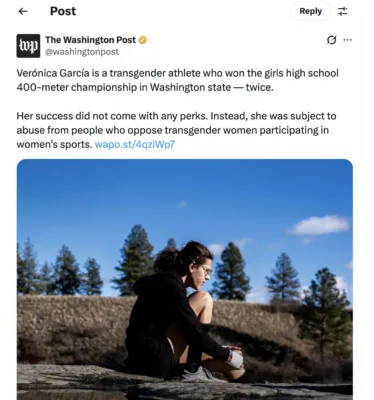
The “respect” narrative also could be applied to another current issue not mentioned by the Penn State academics: that of of transgender women — aka biological men — playing in women’s sports. A recent Washington Post story is an example: It ignores the real issue, but “respects” Mr. García by using his preferred pronouns and lamenting how he didn’t receive “perks” from his victories.
MORE: ‘Historic’ college baseball-playing female has had total of 2 at-bats in 2 years
MORE: Professors: Biases, not biology, responsible for gender ‘inequity’ in sports

