
 FEATURED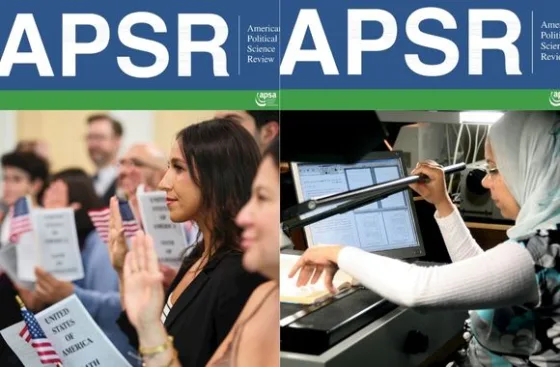
Academic papers by women and racial minorities were prioritized for publication by the American Political Science Review, according to a new report from the Goldwater Institute.
The policy is just one of the results of a takeover by the self-described “Feminist Collective” at the publication, run by the American Political Science Association and published by Cambridge University Press.
The all-female editorial group also shifted the journal’s focus to identity politics and away from topics such as the U.S. Constitution, the study from the Goldwater Institute concluded. The group lost power in 2024, however it may have approved some articles that were published into 2025, which covers the most recent set of issues. Goldwater’s report covered articles published between 2020 and 2025.
The policy change followed a 2020 statement by the editors that called on political journals “to actively dismantle the institutionalized racism, sexism, heterosexism, ableism, and settler colonialism that continue to characterize and structure it.”
The organization fulfilled this mission over the next five years, as the Goldwater Institute found that 132 of the publication’s 549 articles focused on “race, gender, oppression, and related topics,” while only three articles used the words “constitution” or “constitutional” in their abstracts.
The author of the report called the actions “a legal, bloodless takeover” during a phone interview with The College Fix.
Timothy Minella said the editors “instituted a very radical agenda,” that “points to a larger issue” of “overall left bias in academia … not limited to political science and not limited to this particular journal.”
“This clearly is not cutting-edge, deep analysis of politics,” Minella said, “this is stuff that you would expect to come out of a left-wing think tank, but it’s coming out of an organization [calling] itself, political sciences’ premier, scholarly, research journal.”
The Goldwater Institute pointed out many of the editors come from public universities, which means taxpayers were subsidizing this research.
The articles show the need for “guardrails” that determine “what we’re paying public university faculty members to do when it comes to research,” and “hold [faculty members] accountable for having some sort of legitimate research.”
Faculty research “is a big part of [professor’s] job descriptions, especially at public universities at big flagship universities like Ohio State, Arizona State. University of Minnesota,” Minella said.
“In fact, in the social sciences and the humanities, it’s not unusual for these faculty members to only teach three courses in the entire year,” he said. “That means two courses in one semester, one course in the other semester. What are they doing in the time that they’re not teaching?”
According to Minella, it’s often radical research.
Articles that the American Political Science Review published under the directives of the “Feminist Collective” include “Universal Suffrage as Decolonization,” “From Thin to Thick Representation: How a Female President Shapes Female Parliamentary Behavior,” and “Overcoming the Political Exclusion of Migrants: Theory and Experimental Evidence from India.”
The report also said some of the research is “indistinguishable from left-wing activism,” stating:
The APSR’s obsession with race- and gender-based political advocacy has led to a flurry of other “scholarship” indistinguishable from left-wing activism, including published “research” articles like “Violence in the American Imaginary: Gender, Race, and the Politics of Superheroes”— in which the author finds that the Marvel character “Punisher’s unrestricted violence valorizes white male grievance.”
The American Political Science Review’s media team did not respond to two emails and a phone call in the past several weeks. The Fix asked for comment on the Goldwater Institute report and any intentions to change policies.
The Fix reached out to four female editors listed on APSR’s Editorial and Advisory Board via their university emails.
None of those contacted, Sarah Anzia, Lisa Blaydes, Katharine Baldwin, and Sarah Bush, provided comments on the Goldwater report.
Anzia said she was not on the board during the time covered in the report. Professor Bush’s email sent back an automated response about being on leave.

