FEATURED
Key Takeaways
- Detransitioners say it's time for higher education recognize transgenderism as a harmful 'fad.'
- One student says his California college would have paid for him to have 'facial feminization surgery.'
- Others say state laws like 'conversion therapy' bans make it difficult for universities to offer anything other than 'gender affirming care.'
Colleges across the U.S. have long championed support for students who claim to be the opposite gender, offering everything from scholarships and hormone therapy referrals to insurance that covers transition surgeries.
But for detransitioners – students who believed they were another gender and then realized they were not — what does that landscape look like?
The College Fix had the opportunity to interview several detransitioners about their college experiences last week. All ambassadors with the Independent Women’s Forum, their advice for colleges and universities was varied, but their message was clear: Higher education needs to stop promoting transgender ideology as official school policy.
A recent report suggests the number of young adults who identify as transgender or non-binary is on the decline. Transgender identification is down from 6.8 percent of college students in 2022-2023 to 3.6 percent in 2025, according to data from Eric Kaufmann, professor of politics at the University of Buckingham.
“‘Queer’ and ‘nonbinary,’ at minimum, were fads—just like goth and punk once were. ‘Transgender’ will prove to be a fad, too,” detransitioners Prisha Mosley and Luke Healy wrote in a recent analysis of the data. Both are ambassadors with the Independent Women’s Forum.
Speaking with The Fix, Healy said he is demanding more from colleges that have embraced the transgender ideation.
When he thought he was a transgender woman, Healy was told to enroll at a California state school so that the insurance would pay for his facial feminization surgery. In California, he said, “Parents are paying the tuition for me to get parts of my facial bones shaved off.”

Now a detransitioner, he believes colleges should apologize and actively reverse course on the issue.
“Colleges need to do reconciliation on how much they have promoted this and how many lives that they have unmistakably ruined…” Healy told The Fix. “How many people have been robbed of being mothers? How many people have been robbed of being fathers? And how many people have been robbed of ever being normal again?”
Healy connects these tragedies to a broader societal sickness. “Colleges, just like the rest of society, need to realign around common morals that we should all hold as, well, common. I don’t know how that is going to happen without some sort of Christian revival.”
“In the same way that medical schools no longer teach lobotomies or trepanning anymore … this needs to see the same level of refutation,” he told The Fix.
“Colleges wouldn’t teach classes on the earth being flat, you know? They would say that’s crazy,” Healy said.
Simon Amaya Price, who socially transitioned but never underwent any medical transitions, also spoke with The Fix about his experiences attending both Bard College at Simon’s Rock and Berklee College of Music in Boston.
He described a campus culture where detransitioning voices were silenced by policy and peer pressure. Amaya Price said he experienced cancel culture firsthand for speaking out against affirmative action policies.
He gave several tangible steps that colleges can take to better support students who are confused about their gender: “Get rid of the DEI department … get rid of the pronoun policy … I am not a fan of telling people what they can and cannot say. Say explicitly in your policy that using sex-based pronouns do not constitute any violation of the code of conduct whatsoever.”
In some states, conversion therapy bans that prohibit “non-affirming” mental health care make it legally difficult for colleges to offer therapy to detransitioners.
For Claire Abernathy and Violet Turner, who attended Allegany College of Maryland, the state’s ban compounded the isolation that they felt on campus.
“In Maryland, it is illegal to support a person with cross-sex ideation in any way other than to recommend transition,” Abernathy told The Fix. “It’s considered conversion therapy. If either of us wanted help in overcoming the feelings that led us to want to transition, it would actually be illegal.”
When asked how a college could navigate support for detransitioners in a state with conversion therapy laws, Abernathy said, “I’m not sure that they could, frankly … I’m not sure how to work around that, within the law.”
On campus, Turner told The Fix that she and Abernathy encountered an environment steeped in what felt like mandatory affirmation of transgenderism.
In every extracurricular activity or group, “you were expected to introduce yourself and say your pronouns,” Abernathy said.
The ideology permeated into academics as well. Abernathy, who studied early childhood education, said DEI and transgender ideology was discussed extensively in training future teachers. “It was basically explicitly said that ‘transition is the only way.’ You [the teacher] have to affirm the student’s identity and you can’t tell the parents.”
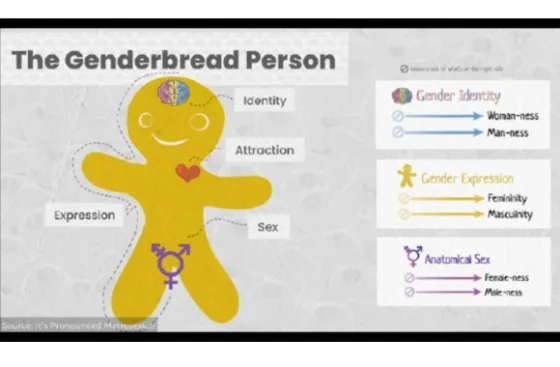
Abernathy said she herself was shown the “genderbread man” in sex ed in her Texas middle school.
Accessing mental health services was another problem. According to Abernathy, the college’s appointment form “had pronouns as a mandatory question.”
Turner said the college’s therapist “worked with the hospital” and wrote letters recommending hormone treatment for students as part of her “gender affirming” care.
Abernathy said, “I did not feel supported or comfortable accessing the mental health resources on campus because of that.”
Other detransitioners called for campuses to make drastic changes, too.
Amaya Price said he believes colleges should take a hands-off approach regarding student mental health. “I do not think it is a college’s or a university’s job to take care of the mental health of their students. I think it is great to have a page on the website to say, ‘Here are some local therapists … we can help you get scheduled.’”
His message to higher education is this: Get administrations out of the transgender issue. Leave it to the student body to facilitate support groups, rallies, and therapy.
Meanwhile, Mosley believes colleges should have a clearer protocol for transgender students who want to get off hormones.
She also said colleges need to do a better job supporting people who do not want to lie about who they are anymore – namely, detransitioners.
“Give them a platform,” Mosley told The Fix.
More practically speaking, Healy believes that solutions begin prior to any student setting foot on a campus. “I think that the internet needs to be completely removed from [children’s] lives before they go to college.”
Trans and nonbinary identification is plummeting among 18 to 24-year-olds, as Amaya Price, Mosley, Abernathy, Turner, and Healy all attest to. And they believe America should expect colleges to adapt their approaches to transgender ideation. For these young adults, this begins with prioritizing free speech and truth telling.
“There needs to be a ferocious assertion of the truth,” Healy said.
Editor’s note: This article was updated to clarify that while Simon Amaya Price socially transitioned, he did not undergo any medical transition while identifying as transgender.
MORE: ISU student paper calls detransitioner ‘anti-trans activist’