FEATURED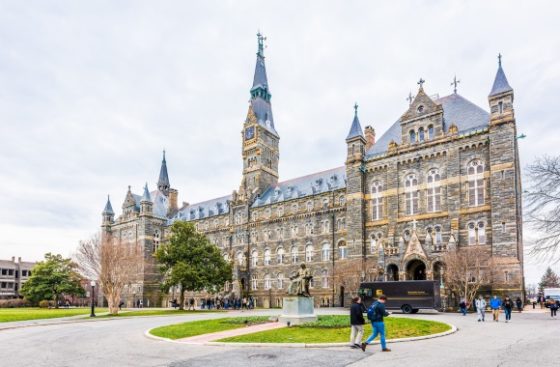
Center’s director said organization works to combat anti-Islam sentiment
Georgetown University’s Prince Alwaleed Bin Talal Center for Muslim-Christian Understanding favors Islamist causes with a “long history of terror-supporting leaders” and scholars, a recent Washington Free Beacon report found.
A Middle Eastern affairs expert told The College Fix that the center’s work promotes a one-sided narrative that shields Islam from criticism while attacking Western and Israeli interests.
Meanwhile, the center’s founding director, John Esposito, told The College Fix the center intends to combat anti-Islam sentiment.
The center was established in 1993 by Irish Jesuit, Arab Christians, and Muslims who were “top businessmen in the Middle East,” Esposito told The Fix.
He said they’d originally considered Harvard University, but ultimately chose Georgetown because it was “closer to the sphere of influence” in Washington D.C., and was a recognizable name in the Arab world.
“They were concerned that Islam would be seen, and Muslims would not be seen for what it was, but for what some Muslims were doing,” he said. The center aims to dispel negative sentiments toward Muslims, he said.
In addition, “Their concern was that with the end of the first Gulf War and now the driving out of the Soviets, that Islam might be seen as the next global threat,” Esposito told The Fix.
The founding director himself has a history of supporting and defending radical Islamist figures and ideologies, the Free Beacon reported.
For example, he defended his friend Sami-Al Arian, a professor at the University of South Florida, when he was charged with conspiracy to assist the Palestinian Islamic Jihad, a terrorist organization, in the early 2000s.
Esposito wrote a letter to the presiding judge, Leonie Brinkema, asking for the release of Sami-Al Arian in the “interest of justice,” and describing him as a “proud, dedicated, and committed American” and “a man of conscience with a strong commitment to social justice.”
Al-Arian ultimately pled guilty and was deported. Though he’s not welcome in the U.S., Al-Arian appears to be welcome on the GU-Qatar campus. In 2017, he was invited to give a lecture there on the challenges of youth in the Middle East.
Further, when asked in an interview with the Middle East Affairs Journal in 2000 whether Hamas was a terrorist organization, Esposito responded ambiguously.
“One can’t make a clear statement about Hamas,” he said. “One has to distinguish between Hamas in general and the action of its military wing, and then one has also to talk about specific actions. Some actions by the military wing of Hamas can be seen as acts of resistance, but other actions are acts of retaliation, particularly when they target civilians.”
Andrew Harrod, a Middle East Forum Campus Watch Fellow, told The College Fix that influences from agenda-driven faculty and funding sources have corrupted the ACMCU’s work.
“Despite whatever established credentials such institutions might have, their scholarly endeavors concerning Islam have degenerated into one-sided diatribes against the West and Israel,” he said.
He pointed out that “Islam never receives the slightest criticism,” and highlighted figures such as Professor Jonathan AC Brown, who was removed from his position as department chair for what was perceived as a pro-Iran, anti-America post earlier this year.
He also told The Fix that the whitewashing of Islam is a problem within American higher education at large.
“Such nefarious funding influence is of a piece with organizations like the Council on American-Islamic Relations (CAIR) trying to control narratives on Islam in academia and beyond,” he said.
“CAIR, for example, launched a lawsuit against Arizona community college professor Nicholas Damask in 2021 when his course material raised too many troubling questions about Islamic doctrine and violence,” Harrod told The Fix.
“The pattern is clear: command all societal cultural controlling heights in order to stigmatize all critical inquiry into Islam as bigoted ‘Islamophobia,’” Harrod said.
The Georgetown center has also consistently accepted donations from other foreign sources.
A 2025 Institute for the Study of Global Antisemitism and Policy report found that the center had received over a billion dollars from the government of Qatar since 2005, in part to build an international satellite campus there. Qatar holds Islam as the state religion and bases much of its legislation on Sharia law.
Charles Asher Small, founding director and president of the institute, told the Jewish News Syndicate that this is an exercise of “soft power.”
“The big takeaway is that we found $1 billion of soft power from the Qatari regime that goes into one of the most important universities in the United States, and if not the world,” he said.
In 2005, the center accepted a $20 million gift from Saudi prince and investor Alwaleed Bin Talal. Bin Talal is considered a prominent progressive voice in Saudi Arabia, especially concerning women’s rights.
“Bridging understanding between East and West is important for peace and tolerance,” Bin Talal said in a statement provided by Harvard at the time, to which he donated another $20 million.
Further, the center accepted $1 million from the International Institute for Islamic Thought in 2017. This funding has supported one of the center’s largest projects, the Bridge Initiative, which claims to “disseminate original and accessible research to inform the general public about Islamophobia.”
In July, the Center for Muslim-Christian Understanding was the focus of testimony before the House Committee on Education and Workforce as part of an investigation into antisemitism at prominent American universities.
“A global orientation is in the DNA of Georgetown’s Jesuit mission,” GU president Robert Groves said at the time.
“We respect the cultures in which we work and follow their laws, but the mission of faith-based dialogue addressing the important questions facing each human and building people for others remains constant,” he said.
MORE: U.S. professors’ work with Hamas-linked think tank prompts security concerns