FEATURED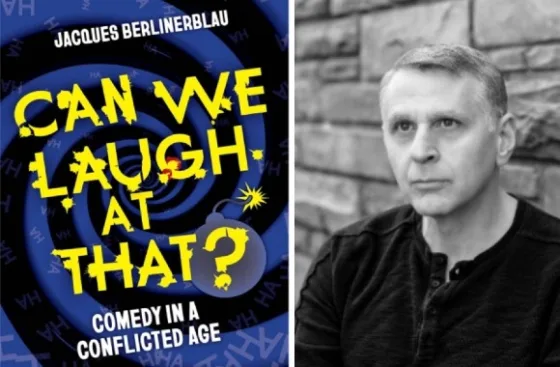
Professor talks about tenure’s effects on free speech, Gen Z humor, and more
Georgetown University Professor Jacques Berlinerblau is back with another book, “Can We Laugh at That?: Comedy in a Conflicted Age,” which tackles issues of comedy and free speech.
A professor at Georgetown’s Center for Jewish Civilization, he is a prolific author and commentator on higher education.
In his new book, Berlinerblau, who describes himself as “neither right nor left” politically, explores the genre of modern comedy and the recent cultural hostility toward jokes perceived by some as “crossing the line.”
“Humorists the world over are no longer simply denounced in grouchy op-eds. Now comedians are being hounded by criminal investigations and civil suits, or forced off the airwaves. They are menaced by vigilantes and religious fundamentalists. Some have been forced into exile, imprisoned, or even murdered,” the book description states.
Published March 24 and available on Amazon, the book is not Berlinerblau’s first. His previous work includes guidance to students about how to pick a college, the value of tenure, administrative bloat, the de-emphasis on teaching, and more, The Fix previously reported.
The College Fix recently interviewed Berlinerblau about his new book, free speech, comedy, and Gen Z in academia.
The College Fix: What prompted you to write the book?
Berlinerblau: Well, this is kind of sad. I’m a scholar of literature and fiction and I was just noticing that undergraduates were not vibing with fiction as much as they previously did, that professors were nervously discussing in the faculty lounge, which doesn’t even exist anymore, about how ill prepared students were for serious literature and how few students they were getting.
So I became interested in a sister art form: comedy. I’d always been interested in comedic fiction. So I asked myself, why don’t you just make this sort of lateral move and look into stand-up comedy, sketch comedy?
Now, I’m also an expert in secularism. And all secular states claim (they don’t always back up the claim) to be very concerned with freedom of speech. And what I find interesting about comedy is the way it foregrounds freedom of speech issues in a way that literature doesn’t because it’s immediate, a performing art.
TCF: What was the writing process like?
Berlinerblau: I write in a kind of rage and panic. I tend to do a lot of research, a lot of research, a lot of research, and then I just start writing. And I work with research assistants, most of whom are undergraduates, and I have them do research for me, but most importantly, I have them criticize everything I’m writing.
I think my new book is a younger read in a strange way because a lot of 20 year olds were writing and telling me, “This doesn’t make any sense” or “You have to explain this to people in my generation.”
The writing process was in this very intense dialogue with Gen Z. And I’d have to explain things about comedians like Dave Chappelle or Eddie Murphy or older comedians. And they’d have it to explain to me how unfunny they found some of that stuff. Or how they find this to be very, very funny, and I didn’t.
TCF: What do you think about comedians who say they won’t do shows on college campuses anymore?
Berlinerblau: It’s complicated. I would not teach the course I presently teach [Comedic Fiction and Comedy, Blaspheme, International Relations] if I didn’t have the full protection of my university.
In other words, because of my expertise, I’m allowed to say anything I want as long as it pertains to my subject matter. I understand comedians who don’t have that protection and are coming to college campuses and are feeling that the audiences are not giving them a fair shake.
But on the downside there’s a whole history of comedians getting their technical chops into shape by working on college campuses. I think this is a lose-lose, right? I respect the decision of a comedian to say, “I just can’t perform in front of these kids. They’re too close-minded.” I think kids are actually more open-minded on college campuses, but that’s a different question. I think comedians lose valuable training because it’s really important for stand-ups to work with audiences that are not well inclined towards you and that don’t get the joke.
TCF: How do free speech and censorship influence comedy? How have concerns about free speech in academia influenced that?
Berlinerblau: It depends on the country. In the United States, when a comedian says something that really drives people to utter distraction, the worst thing that generally happens is cancellation.
Cancellation, it’s kind of a boogeyman. Most of the comedians I studied who were allegedly canceled were not obliterated. Their careers just took on different shapes.
Some do indeed have less market share, less visibility, but they continue to succeed. An example of that is Louis C.K. He was canceled for that incident, which we needn’t rehearse here. Is he less profitable? Yes. Is he profitable? Yes, absolutely. So it’s not a happy story for anybody. But he continued his career in ways that people who are always complaining about cancellation, I don’t think, can account for.
TCF: Do you think that comedians are aware that it’s not going to kill them if they get canceled or do you think that they’re hearing about it in the news and are very intimidated, perhaps more than they should be?
Berlinerblau: If you go to any stand-up set in any city in the United States, I’ve noticed the comedians are always talking about cancellation. They’re always like, “I hope I don’t get canceled for this,” right? They’ve been talking about this for years.
Some comedians get canceled and they come back bigger. An example of that from my book is Shane Gillis. Just as he was about to join the cast of SNL, some podcasts from his past surfaced, in which he was making anti-Asian, homophobic, anti-Semitic, and racist jokes. He got canceled. And now Shane Gillis is almost atop the comedic food chain in the United States.
So I do think we really, really exaggerate the degree to which cancellation is an actual thing. I use the phrase too big to fail. A lot of these comedians just, you can’t really cancel them. And if you do cancel them, people get curious and they start googling and they start following the comedian and oftentimes their audiences get larger.
My view on cancellation is it’s a lot more complicated than the left and the right make it out to be when it comes to comedy.
TCF: I’ll ask again. How do free speech and censorship influence comedy and how have concerns about free speech in academia influenced that?
Berlinerblau: In the United States, comedians are sometimes canceled. Up until the second Trump administration, that was basically the extent of it. We had what I would call a comedic controversy, a comedian would get canceled. They’d lose their agent, they’d sign with a new agent, they’d lose their Netflix gig. And then they’d sign with somebody else and life would go on.
What was interesting about the Jimmy Kimmel and Stephen Colbert episodes is the apparent involvement of the federal government. We seem to perhaps be lightly wading into a new era of comedic censorship, and free speech flags are being raised.
Back in the 60s, there was a comedian Lenny Bruce. A Jewish comedian, really quite brilliant, a little bit tortured. He was a heroin addict, and he used to do these very, very risque bits at small comedy clubs, and he used to use a lot of bad words and make fun of Christianity and the mainstream and whatnot.
And eventually local attorney generals would attend his shows, waiting for him to say things that contravened local laws, be they blasphemy laws or laws about what can and cannot be said in public.
In some instances, he was arrested on stage. That’s municipal or state involvement in comedy, and that’s as close as we’ve come to having stand-up comedy being regulated by some form of government.
All right, so let’s go to the Kimmel and Colbert episodes. What we have there is something which concerns me because, the denials aside from the Trump administration, it seems pretty clear to me that the government is getting involved in the dissemination of comedy by threatening local licenses, by demanding that certain comedians be taken off the air. And this is unusual. I didn’t find any examples of this up until the recent Trump administration.
And this is something that I think all people on the left and the right have to think very, very carefully about. Comedic free speech is being challenged for the first time in the recent history of the United States by the federal government.
TCF: Do you want to talk at all about other countries and how free speech and censorship influence comedy abroad?
Berlinerblau: I really came to appreciate how unusual American free speech laws are. When you look at France or India, they’re very, very different.
In the liberal democracies, we’re noticing the same disturbing trend that comedians excite some type of unrest through their jokes, and governments are showing a willingness to intervene and shut those comedians down. But this is where it gets so complicated.
In France, the comedian I studied in the book is named Juduni Mabala Mabala and he’s an anti-Semitic insult comedian who engages in Holocaust denial. There are laws in France against Holocaust denial.
I’m all about free speech, right? But this is a French comedian in France who makes jokes and engages in commentary in which he denies, in some way, shape, or form, the existence of the Holocaust. So he’s often fined. He’s never been in prison, but he has been arrested for these types of comments.
Now, I’m wondering if we were to bring that back to the United States, how Americans would think about that. Should we have laws about certain things that can never be said? Ten years ago, I would have said 95% of Americans would say absolutely not.
But look what happened after the murder of Charlie Kirk. People were making dumb, gratuitous jokes and issuing statements which really were not particularly empathetic or compassionate. One would assume under traditional American free speech law it was their right to do it, but instead, a lot of folks lost their jobs.
And that is indicative of this shift that I’m seeing, but other countries are ahead of the curve on this. They have much more rigorous standards for what can and cannot be said.
TCF: Do you think more restrictions are a good thing?
Berlinerblau: That’s really complicated. This is the comment I want to make: This is the most important discussion we need to have about free speech in the internet age because it’s not like free speech in Thomas Jefferson’s time. It’s not like free speech in James Madison’s time. James Madison didn’t have TikTok. He didn’t have Instagram.
So what speech can do in 2026 is very different from what speech could do in 1791 when the Bill of Rights was ratified.
I’m begging people on the left and on the right to come together and I’m begging experts in particular — people who understand free speech law, to reflect together on how speech has changed and only then make their conclusions as to what we need to do.
TCF: Are things changing for the better on college campuses regarding comedy and free speech since the issue has gained more attention in recent years?
Berlinerblau: No, they’re not, and the key independent variable is tenure. The fewer scholars who have tenure, which means full academic freedom protections, the worse it is for the serious study of comedy. I can show my students images of the Shelly Abdul cartoons (images of the prophet Muhammad that led to a massacre in Paris in 2015). But the only way I can show those is in the sanctity of a classroom, and what protects me is tenure.
I’m very, very concerned that the way we even talk about comedy on college campuses is being threatened by this professional collapse of the tenure system.
The second issue is more nuanced. Gen Z has a very different understanding of what is acceptable free speech. All the survey data that we have indicates that Gen Z is an outlier and much less tolerant of hate speech.
This is radically changing the landscape of American free speech because [Gen Z is] the future and understands expressive liberty very differently from my generation. I’m Gen X.
TCF: Do you think that Gen Z’s comparative lack of tolerance has to do with our proximity to the internet?
Berlinerblau: It could be, but I’m noticing two types of students. I’m noticing what people might call the snowflakes. The kids that just don’t want to hear any negative term in a work of fiction or in a comedic bit that we’re studying and it makes them very, very nervous.
And then I notice kids who are more on the right who are like, “Bring it! We’re adults who are Americans — we value free speech. This is a patriotic virtue.”
But I’m also noticing something else. And I want to be very, very clear about this. I think with Gen Z, if they trust you’re not making them consume fiction or comedy to humiliate them or to really injure one group or because you find it really funny that jokes are being made about LGBTQ people or conservative white women, if you establish that trust as a professor, Gen Z is totally cool.
Those two things together, trust and tenure, make for some really interesting classes, in which I feel my students can be comfortable dealing with racial slurs, dealing with ethnic slurs, religious slurs because we’re trying to understand what the artist is trying to do and what the impact of these words might be.
TCF: One last real question. What is it like teaching material like this in the “woke” university?
Berlinerblau: I mean, where does woke come from, right? It’s a term from African-American culture that is hijacked by a lot of millennial and Gen X politicians who are seeking a lot of advantage.
I think Gen Z internally, whether right wing or left wing, all grew up in a very unusual moment in history, where you were all on the internet from age 3 and are much savvier about woke and non-woke. You understand the internet is like an ocean. It’s this vast and complicated place and you never know where things are coming from or if the person saying what they’re saying actually believes it.
So back to your question. The woke university to me is a kind of fable, and skilled professors that are experienced in the classroom and committed to really generating dialogue know how to obliterate woke as a hovering concept.
You never want your student pointing at you and saying, “You’re a woke professor.” And if you’re an even moderately skilled professor you’re not going to lead Gen Z to ever do that.
I rather like teaching [Gen Z]. I like the fact that you guys hunt information the way you do and are so satisfied when you find it because you go online. Your eagerness and the aggression by which you want information, I really, really like, and that’s positive in the classroom. Now we just have to make sure the information is correct.
TCF: Is there anything else you want readers to know?
Berlinerblau: The whole purpose of higher education and college is to have these experts that introduce you to the complexity of an issue. We’re not politicians. We’re not activists, or at least we shouldn’t be activists.
And it’s our job, not so much to tell you what to think. I don’t want to say it’s how to think. It’s like how to approach a question and understand the intricacies of the question.
That’s what good professors do, right? They don’t lead you to a conclusion. They help you figure out how to get to your own conclusions. Emile Durkheim, the French sociologist, once said that in a democracy, the job of a professor is to help citizens clarify their thoughts for themselves.
We want them to be clear in their thinking, and that’s the job of a professor.
Editor’s note: The interview has been edited for length and clarity.
MORE: New book tells students how to pick ‘a college amidst an educational crisis’